


























Key Takeaways
- Collaborative robots reduce worker injury rates by 50-70% by handling dangerous, repetitive, or physically demanding tasks
- Cobots enhance rather than replace skilled workers, augmenting craft expertise and enabling higher-value work
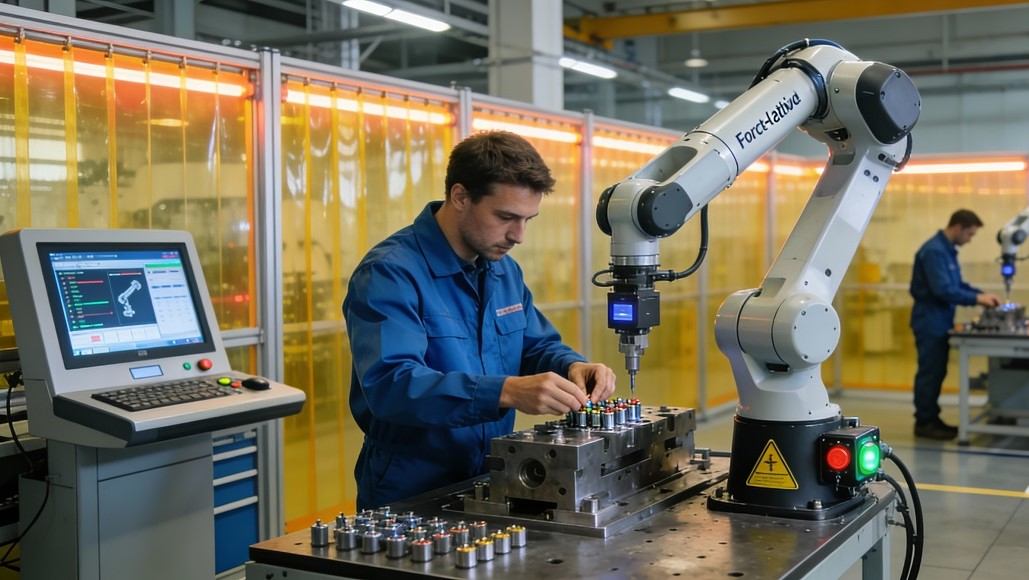
- Force-limited design and safety sensors enable safe operation beside human workers without protective cages
- Easy reprogramming allows rapid task switching, enabling efficient production of varied component designs
- Worker satisfaction and retention improve substantially when cobots eliminate dangerous and fatiguing tasks
- Hybrid human-robot teams achieve productivity improvements of 30-50% compared to either manual or fully automated approaches
Manufacturing has traditionally forced uncomfortable choices between automation and human expertise. Fully automated systems achieved high productivity but required expensive infrastructure and struggled with design variation. Manual operations provided flexibility and leverage human expertise but suffered productivity limitations and safety challenges. Organizations selected approaches based on specific circumstances, rarely finding solutions perfectly balancing both dimensions.
Collaborative robots (cobots) introduce a fundamentally different paradigm. Rather than replacing workers with machines, cobots augment worker capability, enabling skilled technicians to achieve productivity approaching fully automated systems while maintaining flexibility and leveraging human expertise. Cobots handle dangerous, repetitive, and physically demanding tasks while humans perform judgment-based, complex, and adaptable tasks. This human-robot collaboration proves remarkably powerful, often exceeding productivity of either approach independently.
The adoption of cobots in prefab plants is accelerating as manufacturers recognize that augmentation strategies prove superior to replacement strategies. Rather than workforce displacement challenges accompanying full automation, cobot implementation creates engagement opportunities as workers focus on higher-value contributions. The result combines improved safety, enhanced productivity, and improved worker satisfaction—rare combinations where all stakeholders benefit.
Understanding Collaborative Robot Capabilities
Collaborative robots differ fundamentally from traditional industrial robots through design enabling safe human interaction. Traditional robots operate in caged environments where human interaction is impossible during operation. Collaborative robots incorporate force-limiting technology, real-time safety monitoring, and collision detection enabling safe operation adjacent to human workers.
Force limitation represents the fundamental safety mechanism. Rather than rigidly following programmed paths, cobots monitor forces during motion. If an obstruction impedes motion, force-sensing detects the obstruction and immediately stops motion, preventing injury. Force limits ensure that even if collisions occur, forces remain below thresholds causing injury. A human hand contacting a stopped cobot experiences no harmful force.
Safety sensors including proximity sensors, pressure sensors, and vision systems monitor the workspace. If humans enter the workspace, sensors detect presence and robots reduce speed or stop entirely. Rather than requiring explicit safety barriers separating humans and robots, sensor networks enable dynamic safety adjusting to worker presence.
Handling Dangerous and Repetitive Tasks
Cobots excel at performing dangerous tasks that humans prefer to avoid or that create occupational hazards. Material handling involving heavy components becomes safer when cobots assist. Rather than humans manually lifting heavy items, cobots support weight while humans position components. Over extended work periods, this assistance reduces physical strain substantially.
Chemical applications represent another hazardous area where cobots prove valuable. Applying toxic chemicals, working in fume-producing environments, or handling materials hazardous to human health becomes safer when cobots perform operations while humans monitor. Humans maintain overall process control while machines execute dangerous detailed operations.
Repetitive tasks that create occupational strain receive particular benefit from cobot assistance. Tedious assembly operations where repeated small motions accumulate repetitive strain injury risk become more tolerable when cobots handle the most repetitive portions. Humans perform remaining operations while cobots automate the most problematic repetitive elements.
Precision tasks where human fatigue affects accuracy improve when cobots provide assistance. After eight-hour work shifts, human precision inevitably degrades due to fatigue. Cobots maintaining constant precision throughout shifts deliver consistent quality despite human fatigue. Human workers remain engaged in process oversight and problem-solving while cobots provide precision repetitively.
Enhancing Skilled Worker Productivity
Rather than cobots replacing skilled workers, effective implementation augments worker productivity. A skilled welder might manually weld some joints while cobots weld other joints. The combination enables production rates exceeding either working independently. Manual welding allows skilled judgment on critical welds while cobots handle routine welds. The result leverages human expertise where valuable while achieving productivity through automation.
Skilled technicians increasingly find themselves bottlenecks in complex operations. A single expert worker cannot simultaneously handle multiple complex tasks. Cobots enable parallelization—while human experts oversee critical operations, cobots handle supporting operations independently. The multiplication effect achieves remarkable productivity without losing expert knowledge.
Programming and reconfiguring cobots requires expertise but provides opportunity for continuous improvement. Rather than cobots being “set and forget” systems operated by relatively unskilled personnel, cobot systems benefit from involvement by skilled workers who understand manufacturing deeply. Skilled workers program cobots optimally, troubleshoot problems, and continuously improve operations. This engagement maintains worker interest and utilizes expertise effectively.
Workforce Development and Training Implications
Cobot implementation requires workforce development different from full automation or traditional operations. Rather than training workers to operate cobots passively, organizations develop cobot programming competencies. Rather than craftspeople executing operations with machines providing support, hybrid approaches require new skill combinations.
Training programs increasingly emphasize collaboration approaches. Rather than training workers as equipment operators or craftspeople exclusively, training develops both manual craft skills and basic cobot programming/maintenance competencies. Workers becoming proficient with both dimensions become more valuable than specialists in either dimension alone.
Safety training proves critical. While cobots are designed to be safe, incorrect programming or operation could create hazards. Comprehensive training regarding force limitations, safety sensor operation, and proper workflow practices ensures safe operation. Organizations implementing cobots report that safety-focused training dramatically improves actual safety outcomes.
Change management challenges emerge as workers transition from traditional approaches to hybrid human-robot collaboration. Some workers enthusiastically embrace cobots as making their jobs safer and more interesting. Others resist change, preferring familiar traditional approaches. Successful implementations invest in change management, building worker confidence in new approaches and providing clear communication regarding benefits and job security implications.
Economic Analysis and Productivity Gains
Cobots represent lower capital investment than fully automated systems. While robotic assembly lines costing millions enable only specific operations, cobots can be redeployed to varied tasks relatively inexpensively. This flexibility enables organizations to justify cobot investments through multiple applications rather than single-purpose justifications.
Productivity improvements prove substantial. Organizations implementing cobots in assembly operations report 30-50% productivity improvements. Hybrid human-cobot teams achieve high throughput approaching full automation while maintaining flexibility and leveraging human expertise. Time-to-market improvements from rapid reconfiguration often prove as valuable as throughput improvements.
Safety improvements deliver financial benefits beyond humanitarian value. Workplace injury reductions decrease medical costs, workers compensation insurance expenses, replacement worker costs, and productivity losses from worker absence. Organizations report that safety benefits alone often justify cobot investments within reasonable payback periods.
Quality improvements emerge as cobots provide precision consistency. While skilled workers provide quality judgment, cobots provide precision consistency humans cannot maintain across full work shifts. The combination achieves high quality reliably.
Case Studies and Real-World Examples
Successful cobot implementations span diverse operations. A midsize fabrication company integrated cobots assisting welders on difficult-to-access joints. Rather than replacing welders, cobots positioned themselves near joints enabling welders to work more comfortably and precisely. Output increased 35% while worker strain decreased substantially.
A prefab facility implemented cobots assisting assembly line workers lifting heavy panels. Rather than workers experiencing physical strain, cobots supported panel weight during positioning. Workers focused on alignment and fastening while cobots handled weight support. Worker satisfaction improved dramatically as physical strain disappeared.
A complex assembly operation employed cobots for material handling between work stations. Rather than workers spending 30% of time transporting materials, cobots handled transportation autonomously. Workers focused on value-added assembly tasks. Output increased 25% while worker satisfaction improved as manual material handling disappeared.
Integration with Smart Manufacturing Systems
Modern cobot implementations integrate into Manufacturing Execution Systems (MES) and broader Industry 4.0 ecosystems. Cobots provide data regarding cycle times, production counts, and performance metrics. Integration enables continuous optimization as manufacturing systems adjust operations based on actual performance data.
Predictive maintenance systems monitor cobot health, alerting operators when service requirements emerge. Rather than unexpected cobot failures disrupting production, predictive systems schedule maintenance during planned downtime.
Implementation Challenges and Success Factors
Successful cobot implementation requires careful planning and change management. Organizations cannot simply install cobots and expect immediate productivity improvements.
Effective implementation requires:
- Thorough analysis of tasks where cobot assistance provides value. Not all operations benefit equally from collaboration.
- Worker involvement in implementation planning, building support and identifying practical challenges.
- Comprehensive training developing both cobot operation competencies and safety discipline.
- Realistic timeline expectations allowing worker familiarity development before expecting full productivity gains.
- Clear communication regarding job security, career opportunities, and benefits of new approaches.
- Continuous improvement focus, regularly evaluating effectiveness and optimizing operations based on experience.
Future Evolution and Broader Implications
Cobot capabilities continue advancing. Improved sensors enable more sophisticated safety. Artificial intelligence enables increasingly intelligent task handling. Integration capabilities deepen enabling seamless collaboration with broader manufacturing systems.
The fundamental paradigm—humans and robots collaborating rather than competing—increasingly characterizes manufacturing evolution. Rather than humans being entirely replaced by machines, future manufacturing will feature deeply integrated human-robot teams where each contributes unique capabilities. Humans contribute judgment, creativity, and adaptability. Robots contribute consistency, strength, and precision.
Organizations successfully implementing collaborative approaches position themselves optimally for evolving manufacturing. Rather than managing workforce displacement as automation advances, organizations develop engaged workforces whose jobs become more interesting, safer, and higher-value as automation supplements human effort. The result improves competitiveness while creating better work experiences for people.
