
























Ventilation used to be a compliance calculation: bring in the outdoor air the code table requires, condition it, and move on. The pandemic raised the stakes on both sides of that equation at once. Occupants and public health guidance pushed outdoor air rates and filtration upward, while energy codes, decarbonization targets and utility costs pushed consumption downward. Ventilation engineers now sit at the exact point where those pressures meet, and the buildings that resolve the conflict successfully treat airflow, energy and measurement as one design problem rather than two opposing ones.
Why Ventilation Energy Use Grew After the Pandemic
The energy penalty of elevated ventilation is structural. Every cubic foot per minute of outdoor air must be heated, cooled, humidified or dehumidified to indoor conditions, and in most climates that conditioning load rivals the entire envelope load of a well-insulated building. When operators increased outdoor air fractions in 2020 and 2021, often to 100 percent on systems never designed for it, energy consumption rose in ways that facility budgets noticed immediately. Fan energy added its own cost, since pushing more air through fixed ductwork raises fan power by the cube of the airflow increase.
Some of that elevated operation has quietly become permanent. Tenants ask about air change rates in lease negotiations, insurers and institutional owners reference airborne risk in facility standards, and facility managers who throttled ventilation back to pre-2020 levels in some cases chose not to. The consequence is a permanent need for strategies that deliver clean air without proportional energy growth, and that need is reshaping ventilation design across office, education, healthcare-adjacent and hospitality segments.
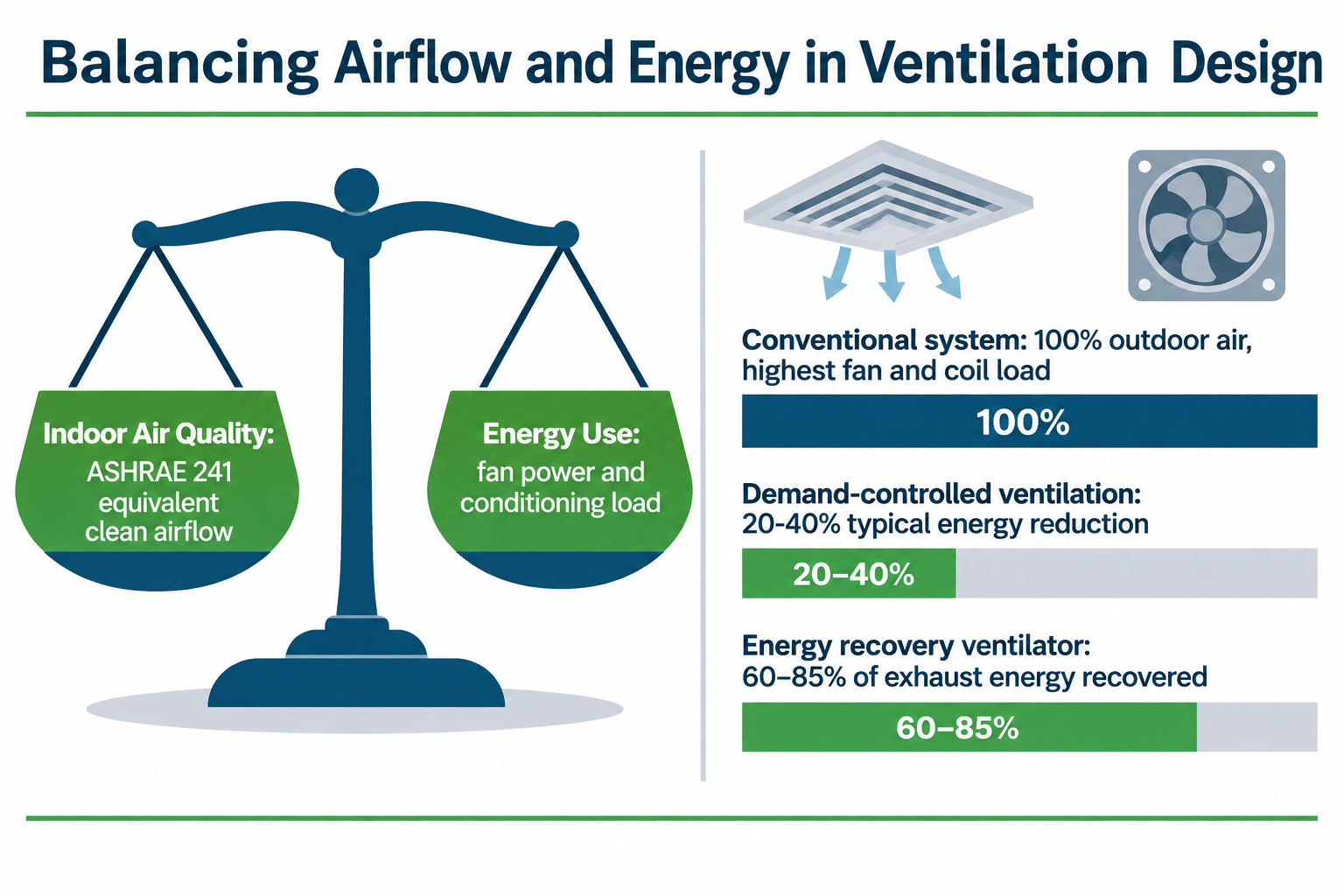
The cost asymmetry drives the redesign logic. Outdoor air conditioning energy scales with volume and climate severity, while filtration and air cleaning energy scales mainly with fan pressure, which is nearly always the cheaper lever. That asymmetry explains the direction modern standards have taken: rather than mandating ever more outdoor air, they specify equivalent clean airflow outcomes and leave the mix of outdoor air, filtration and air cleaning to engineering judgment. Buildings that exploit that flexibility can hold or improve measured air cleanliness while cutting the conditioning energy that a pure outdoor-air strategy would spend.
Codes and Standards Reshaping Airflow Targets
The regulatory framework has responded with a two-track structure that designers should understand precisely. On one track, ASHRAE Standard 62.1 continues to define minimum outdoor air ventilation rates for acceptable indoor air quality under normal conditions. On the other track, ASHRAE Standard 241, released in 2023, defines equivalent clean airflow rates for periods of elevated infection risk, expressed as equivalent clean airflow requirements per person and per area rather than as raw outdoor air volumes. The distinction matters because Standard 241 accepts any combination of outdoor air, filtration and air cleaning that delivers the required equivalent clean airflow, which opens an efficiency pathway that a pure outdoor-air approach forecloses. Key elements of the current framework include:
- Ventilation rate procedure under 62.1: outdoor air calculated from occupant density and floor area, with an indoor air quality procedure as an alternative compliance path.
- Infection-risk mode under Standard 241: pre-defined equivalent clean airflow rates that buildings activate during elevated risk periods, with rates that can be met through outdoor air, filtration, or air cleaning in combination.
- Filtration requirements: higher minimum efficiency filtration values, which improve clean air delivery but raise static pressure and fan energy unless filters and fans are selected for it.
- Monitoring expectations: growing code and certification pressure for direct measurement of indoor conditions rather than open-loop assumptions.
The design implication is that modern systems should be built to operate efficiently in normal mode and to step up cleanly in infection-risk mode, a dual-state requirement that earlier standards never asked of ventilation systems.
Technologies That Close the Gap
Three technology families now carry most of the load in reconciling clean air with energy discipline. Demand-controlled ventilation uses carbon dioxide sensing, occupancy counting and increasingly networked sensor grids to modulate outdoor air to actual occupancy instead of design assumptions, and in buildings with variable occupancy it routinely delivers energy reductions in the 20 to 40 percent range against fixed-rate operation. Energy recovery ventilators transfer heat and moisture between exhaust and incoming outdoor air, recovering a large share of the conditioning energy; sensible recovery effectiveness commonly runs between 60 and 80 percent, and enthalpy wheels add latent recovery in humid climates.
Filtration and air cleaning complete the toolkit. Upgrading filtration improves clean air delivery without any outdoor air increase, though the fan energy cost of higher pressure drop must be engineered rather than assumed, and air cleaning technologies from ultraviolet germicidal irradiation to electronic filtration can add equivalent clean airflow where outdoor air is constrained. The design discipline is to compare options on delivered clean air per unit of energy, a calculation that Standard 241’s framework makes explicit. When designers run that comparison honestly, the results often invert conventional assumptions: in cold climates, filtered recirculated air plus heat recovery frequently beats brute-force outdoor air on every metric except familiarity.
Sensor strategy deserves equal attention to equipment strategy. Carbon dioxide sensors in return ducts or high-density zones give demand-controlled ventilation its occupancy signal, and their accuracy and placement determine whether the system saves energy by modulating correctly or loses both energy and air quality by modulating on bad data. Sensor technologies have improved and fallen in cost, but automatic baseline correction, regular calibration and sensible zone selection still separate reliable installations from unreliable ones. In spaces with intermittent dense occupancy, such as conference rooms, classrooms and assembly areas, sensor-driven flushing cycles recover air quality between uses at a fraction of the energy cost of continuous maximum ventilation.
Measurement and Continuous Verification
The final piece is verification, because a ventilation strategy that nobody measures is a strategy that quietly degrades. Continuous monitoring of carbon dioxide, particulate matter and airflow, tied to building automation with alerting rather than just logging, turns ventilation performance into an operational metric that facility teams actually manage. Sensor calibration and placement discipline matter more than sensor brand, and buildings that treat airflow stations and CO2 sensors as maintainable instruments keep their demand-controlled ventilation savings for years, while buildings that install and forget watch the savings evaporate within two seasons.
Verification is also where digital tools earn their place in ventilation engineering. Buildings that pair sensor networks with HVAC digital twins gain a calibrated model of how airflow and energy actually behave across zones, which exposes stuck dampers, drifted sensors and misguided schedules that monthly utility bills only hint at. That capability turns ventilation design from a one-time construction deliverable into a maintained performance system.
Verification also disciplines the procurement of air cleaning equipment, a market where performance claims often outstrip field evidence. Technologies that deliver measurable equivalent clean airflow in standardized testing can still underperform in buildings when installed without regard to airflow patterns, duct velocities or maintenance access. Measured clean air delivery, tracked over time against baseline conditions, is the only basis on which owners should accept or retain such equipment, and the monitoring infrastructure that supports ventilation verification supports this assessment at marginal additional cost.
Design Implications for New Builds and Retrofits
For new construction, the practical recipe is now well established: design outdoor air systems for the 62.1 baseline with demand control, specify energy recovery wherever exhaust and supply are within reasonable proximity, select filtration for clean air delivery per unit of fan energy, and provision the sensor network from day one. For retrofits, the sequence matters more: energy recovery and demand control typically pay for themselves fastest, filtration upgrades deliver immediate equivalent clean airflow gains at modest capital cost, and ventilation improvements should be coordinated with heating load reduction so that the conditioning energy saved on mild outdoor air is not lost to an oversized heating plant.
Cost expectations have become realistic as deployments mature. Demand control retrofits typically pay back through fan and conditioning savings within a few years in buildings with variable occupancy, energy recovery installations carry longer paybacks that improve sharply in extreme climates, and filtration upgrades are capital-light but operating-heavy through filter replacement and fan energy. Combining measures changes the arithmetic: heat recovery lowers the energy cost of every additional outdoor air increment, which makes ambitious targets affordable in climates where they would otherwise be prohibitive.
Indoor air quality and energy efficiency are frequently framed as a trade-off, and that framing survives only in buildings whose ventilation systems lack modulation, recovery and measurement. Modern designs demonstrate that the trade-off is largely an engineering artifact: with demand control matching airflow to real occupancy, energy recovery recycling conditioning energy and monitoring keeping both honest, buildings can deliver cleaner air than code minimums require at energy consumption their owners can defend. The tools are mature, the standards support them, and the remaining variable is whether design teams apply them as a system.