
























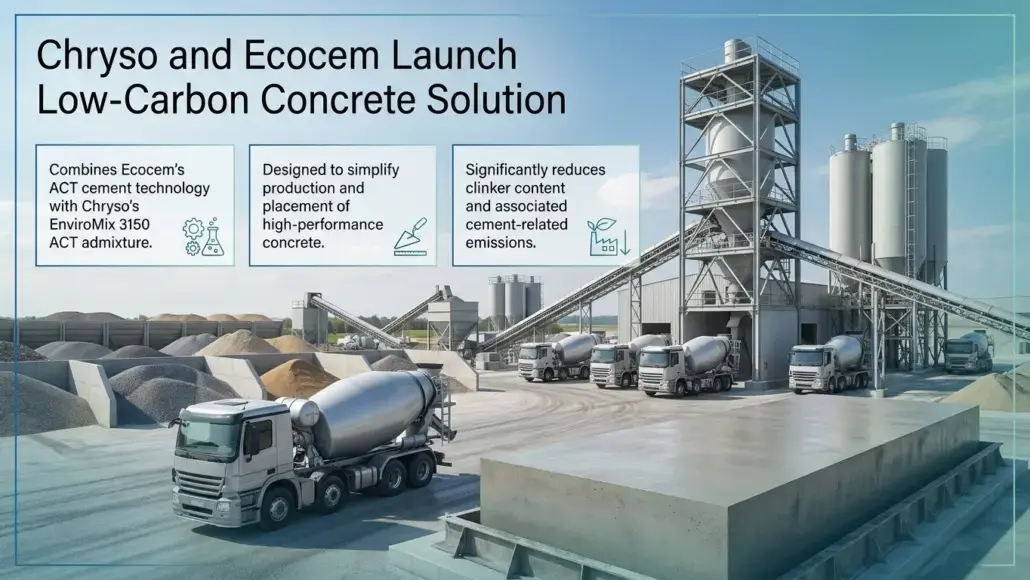


Chryso and Ecocem have launched a low-carbon concrete solution combining Ecocem’s ACT cement technology with Chryso’s new EnviroMix 3150 ACT admixture.
The system was unveiled at BATIMAT 2026 and is designed to simplify the production and placement of high-performance concrete while reducing clinker content and associated emissions.
Ecocem says its ACT technology can reduce cement-related carbon emissions by up to 70%. Chryso developed the EnviroMix 3150 ACT superplasticizer specifically to work with the chemistry of the ACT binder.
According to the companies, combining the two technologies can reduce the carbon footprint of concrete by more than 50%, corresponding to GWR5 classification and beyond.
The low-carbon concrete solution is also designed to maintain technical performance. The companies report high flowability, low viscosity at low water-to-cement ratios and more than 90 minutes of workability retention.
The workability period can potentially be extended further without causing segregation, supporting the use of the technology in demanding construction applications. The low-carbon concrete solution is already being used in the UK during the refurbishment of the former John Lewis headquarters in London.
Almost 1,300m³ of low-carbon concrete is expected to have been placed on the project by the end of 2026. C20/25 and C30/37 concrete mixes incorporating Ecocem ACT have been developed for the project. EnviroMix 3150 ACT provides 90-minute workability retention and what the companies describe as excellent pumpability.
Frédéric Guimbal, vice-president of the construction chemicals performance segment at Saint-Gobain, said ‘‘Decarbonizing concrete is not just about developing new cements. It also requires admixture technologies that can unlock their full potential.’’
Chryso aims to develop products that can be integrated into existing industrial production processes, potentially allowing concrete producers to adopt lower-carbon formulations without major changes to their operations.
Olivier Guise, executive director at Ecocem, said the collaboration demonstrates how cement technology and concrete chemistry can be developed together to combine lower emissions with technical performance and ease of use.
The collaboration between Chryso and Ecocem has already resulted in two patent applications, with the companies considering additional areas of cooperation.
The low-carbon concrete solution represents their latest effort to combine reduced cement emissions with practical requirements such as workability, pumpability and high-performance concrete production.