
























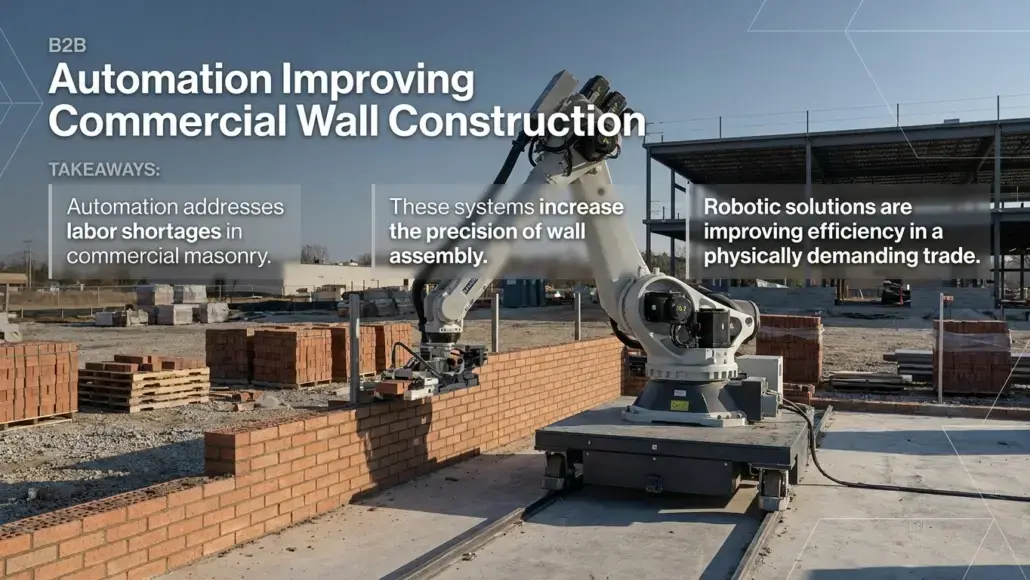


The commercial construction sector is currently undergoing a significant technological shift as it addresses the dual challenges of labor shortages and the demand for increased building precision. Among the various innovations entering the field, these systems stand out as critical drivers for improving the efficiency and quality of wall assembly. Traditional masonry is one of the most physically demanding and time-consuming trades, requiring skilled artisans to manually place thousands of units with consistent accuracy. By introducing automated systems into this workflow, contractors can significantly accelerate project timelines while ensuring that the finished product meets higher structural and aesthetic standards. These systems range from semi-automated bricklaying robots to sophisticated mortar management tools, all designed to work alongside human masons rather than replacing them entirely.
Integrating automated machinery into commercial projects requires a strategic rethink of site logistics and material handling. Unlike manual bricklaying, where small quantities of materials are staged locally, automated systems often benefit from centralized material distribution and optimized delivery paths. The shift toward automation also necessitates a more rigorous approach to quality control, as the machines depend on consistent material dimensions and mortar properties to function at peak performance. As the technology matures, it is becoming increasingly clear that the future of masonry lies in the successful collaboration between advanced mechanical systems and the expert oversight of experienced tradespeople.
Robotics and the Acceleration of Bricklaying Operations
The most visible manifestation of automation in masonry is the emergence of robotic bricklaying systems. These machines are capable of placing bricks and blocks at speeds that far exceed human capacity, often maintaining a consistent pace throughout the work shift. Robotic systems utilize advanced sensors and computer vision to identify the correct placement for each unit, adjusting for slight variations in the substrate or the material itself. This precision is particularly valuable in commercial wall construction, where long stretches of repetitive masonry can lead to physical fatigue and a subsequent drop in accuracy for manual workers. By delegating the heavy lifting and repetitive placement to a robot, masons can focus on the more complex aspects of the trade, such as corners, openings, and intricate detailing.
Furthermore, these robotic systems contribute to a safer work environment. The physical toll of masonry often leads to long-term musculoskeletal injuries among workers. By reducing the need for repetitive bending, lifting, and reaching, advanced robotics help to extend the careers of skilled professionals while attracting a new generation of workers who are comfortable with technology-driven environments. The data generated by these machines also provides valuable insights into project progress, allowing project managers to track productivity in real-time and make informed adjustments to the schedule. This level of predictability is a major advantage for commercial contractors who operate under strict deadlines and tight profit margins.
Mortar Management and Consistency in Structural Bonds
Beyond the placement of the units themselves, automation is transforming the way mortar is mixed and applied. The strength of a masonry wall depends heavily on the consistency and quality of the mortar joints. Traditional hand-mixing can lead to variations in the water-to-cement ratio, which in turn affects the bond strength and durability of the wall. Modern automated mortar systems use precision dosing and continuous mixing technology to ensure that every batch of mortar is identical. This not only improves the structural integrity of the building but also reduces material waste by providing exactly the amount of mortar needed for the current placement cycle.
The precision afforded by masonry equipment automation complements the use of automated concrete finishing techniques to create a unified structural envelope. When these technologies are used in tandem, the transition between different building systems becomes smoother, reducing the likelihood of errors at the interface of masonry and concrete elements. Automated mortar applicators also allow for more uniform joint thicknesses, which is essential for both structural performance and the visual appeal of exposed masonry walls. By minimizing the human factor in the mixing and application process, contractors can achieve a level of quality that was previously difficult to sustain over large-scale commercial projects.
Digital Integration and Building Information Modeling
The success of masonry equipment automation is deeply tied to the rise of building information modeling (BIM). Automated systems rely on digital data to guide their operations, requiring detailed 3D models that specify the location of every brick, joint, and reinforcement element. This digital-first approach encourages better coordination during the design phase, as potential conflicts can be identified and resolved before construction begins. For example, the placement of electrical conduits and plumbing within a masonry wall can be pre-planned and integrated into the robotic placement sequence, eliminating the need for costly field modifications or “chasing” of the walls after they are built.
In addition to improving coordination, the integration of automation and BIM provides a comprehensive digital record of the construction process. Every unit placed by an automated system can be logged, creating a “as-built” model that is incredibly accurate. This data is invaluable for future maintenance and renovation work, as facility managers will know exactly what is behind the finished surfaces. The shift toward a digital workflow also facilitates the use of modular and prefabricated masonry components. In some cases, automated systems are used to build entire wall sections in a controlled factory environment, which are then transported to the site for rapid assembly. This off-site approach further enhances productivity and quality control by removing the variables of weather and site conditions.
Optimization of Site Logistics for Automated Workflows
Transitioning to automated masonry requires a careful analysis of site logistics. Robotic systems and automated mixers have specific footprint and power requirements that must be accounted for during site setup. The movement of materials also becomes a critical factor; for a robot to work at full speed, it must have a continuous supply of bricks and mortar. This often involves the use of specialized pallet handling equipment and automated guided vehicles to transport materials from the staging area to the work face. Project managers must balance the increased productivity of the automated systems with the logistical effort required to support them.
Training and workforce development are also essential components of a successful automation strategy. While the machines perform the repetitive tasks, human operators are needed to set up, monitor, and maintain the equipment. These roles require a new set of skills, blending traditional masonry knowledge with technical proficiency in robotics and digital interfaces. Contractors who invest in training their teams to work with modern tools are better positioned to leverage the technology for a competitive advantage. The goal is to create a hybrid workforce where technology enhances human skill, leading to a more efficient, safer, and higher-quality construction process. As the industry continues to evolve, those who embrace these advancements will be the ones to define the next generation of commercial wall construction.
Sustainability and Material Efficiency in Modern Masonry
The environmental impact of construction is an increasing concern for developers and regulatory bodies. Masonry equipment automation contributes to sustainability goals by significantly reducing material waste. Precision application of mortar and the accurate placement of units mean that fewer materials are discarded during the construction process. Furthermore, the increased speed and efficiency of automated systems can lead to shorter project durations, reducing the energy consumption and carbon emissions associated with site operations. By optimizing the use of resources, automation helps to make masonry a more sustainable choice for large-scale commercial projects.
In the long term, the durability and longevity of automated masonry walls also contribute to environmental goals. The superior bond strength and uniform quality achieved through automated systems result in buildings that require less maintenance and have a longer service life. As the construction industry moves toward a circular economy, the ability to track and manage materials through digital models will become even more important. Masonry equipment automation is not just a tool for productivity; it is a foundational technology for a more efficient and sustainable built environment. The ongoing development of this sector promises to deliver even greater benefits as new materials and smarter machines enter the marketplace, ensuring that masonry remains a vital and innovative trade for years to come. Contractors must also recognize that these systems facilitate the use of lower-carbon materials, such as recycled aggregates and alternative cementitious binders, which might otherwise be difficult to handle manually. By providing a stable and controlled placement environment, automation ensures that these sustainable materials perform to their full potential without compromising structural integrity. This holistic approach to efficiency and environmental stewardship marks a new era for the masonry industry.