


























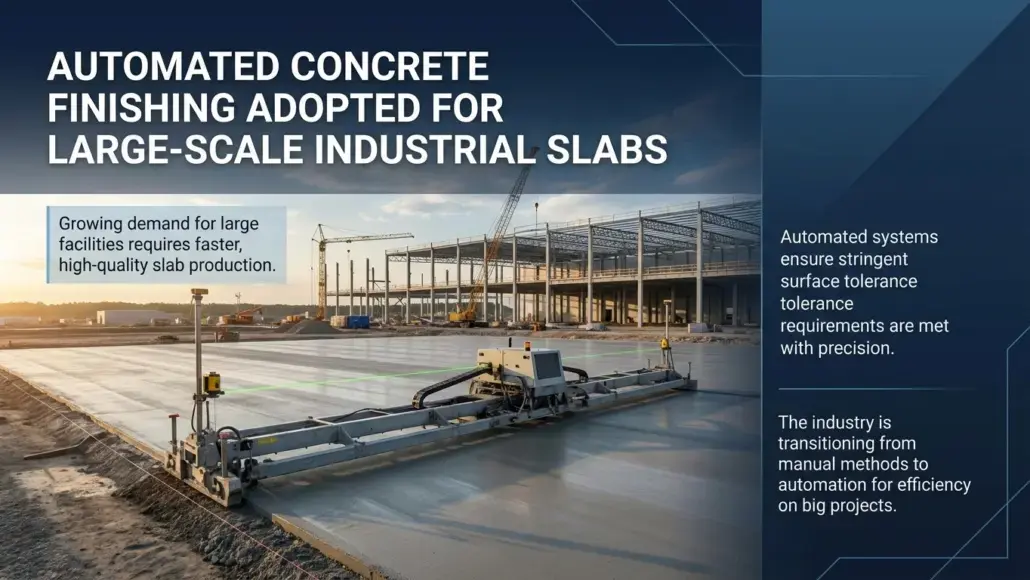


The production of high-quality concrete slabs is a cornerstone of modern industrial and commercial construction, requiring a delicate balance between speed, precision, and labor management. As the demand for larger warehouses, distribution centers, and high-tech manufacturing facilities grows, the industry is increasingly turning toward automated concrete finishing systems to meet stringent surface tolerance requirements. Traditional manual finishing methods, while effective for smaller projects, often struggle to maintain consistency over vast areas, leading to variations in floor flatness and levelness. By automating the screeding and troweling processes, contractors can achieve superior results in a fraction of the time, significantly enhancing the overall efficiency of the slab construction workflow.
Automated systems leverage advanced technologies such as laser guidance and robotic controls to ensure that the concrete is leveled and finished to exact specifications. These machines can operate continuously, even in challenging environmental conditions, reducing the physical strain on workers and minimizing the risk of human error. The shift toward automation is not just about productivity; it is also about meeting the evolving needs of end-users who require exceptionally flat floors for the operation of automated guided vehicles and high-reach forklifts. As the technology continues to evolve, the integration of automated concrete finishing into standard construction practices is becoming a key differentiator for competitive contractors.
Laser Guided Screeding and Precision Leveling
One of the most significant advancements in slab construction is the widespread adoption of laser-guided screeds. These machines use a rotating laser transmitter to establish a precise grade reference across the entire pour area. The screed’s head, which is equipped with receivers, automatically adjusts its height hundreds of times per second to ensure that the concrete is placed at the correct elevation. This level of precision is impossible to achieve through manual methods, particularly on large-scale pours where traditional forms may not be available. By maintaining a constant grade, laser screeds eliminate high and low spots, resulting in a significantly flatter and more level floor.
The speed of laser screeding is another major advantage for slab construction efficiency. A single machine can level thousands of square feet of concrete in a single day, allowing contractors to complete large pours that would otherwise require multiple days and a much larger crew. This increased throughput helps to keep projects on schedule and reduces the window of vulnerability to weather-related disruptions. Furthermore, the uniform compaction provided by the vibratory screed head improves the overall density and strength of the slab, reducing the likelihood of future surface defects. The transition to laser-guided technology has effectively set a new standard for performance in the industrial flooring sector.
High Capacity Power Trowels and Surface Quality
Once the concrete has been leveled, the next phase of the process involves the use of power trowels to achieve the desired surface finish. While walk-behind trowels are still common for smaller areas, high-capacity ride-on trowels have become the tool of choice for large commercial and industrial slabs. Modern power equipment includes sophisticated ride-on trowels that feature high-torque engines and precision pitch controls. These machines allow operators to apply the perfect amount of pressure and friction to the surface, closing the pores of the concrete and creating a dense, durable, and highly polished finish.
The integration of automated concrete finishing techniques provides a stable surface for the subsequent use of concrete testing equipment to verify the structural integrity of the slab. When the surface is consistently finished, the data collected by testing tools becomes more reliable, allowing for a more accurate assessment of the concrete’s performance. Many modern power trowels also incorporate electronic control systems that monitor engine load and rotor speed, automatically adjusting to the changing condition of the concrete as it sets. This level of automation ensures that the finish is uniform across the entire slab, regardless of slight variations in the mix or environmental factors like wind and temperature.
Labor Optimization and Workforce Safety
The physical demands of traditional concrete finishing are well-documented, with workers often spending hours on their hands and knees or operating heavy equipment in strenuous positions. Automation significantly reduces these physical requirements, allowing a smaller team to manage much larger areas with less fatigue. By delegating the most repetitive and taxing tasks to machines, contractors can better utilize their skilled labor for oversight, quality control, and the management of complex details such as joints and penetrations. This optimization not only improves productivity but also helps to address the ongoing labor shortage in the construction industry.
Safety is also a primary benefit of adopting automated systems. Manual finishing involves significant risks, including repetitive strain injuries, exposure to wet concrete, and the hazards associated with working in proximity to heavy machinery. Automated screeds and ride-on trowels provide a safer working environment by keeping operators in more ergonomic positions and reducing the number of people needed on the wet concrete surface. Many modern machines are also equipped with advanced safety features, such as automatic shut-off switches and improved visibility for the operator. By fostering a safer and more efficient workplace, these mechanical solutions help to attract and retain talented professionals who are looking for careers in a modern, technology-driven industry.
Data Driven Quality Control and Surface Tolerance
Achieving high F-numbers (floor flatness and levelness) is a critical requirement for many modern industrial projects. Automated finishing systems are uniquely suited to meeting these specifications because they provide a high degree of repeatability and precision. Many contractors now use digital floor profilers to measure the flatness of the slab immediately after finishing, providing real-time feedback that can be used to adjust the operation of the machines for the next section of the pour. This data-driven approach to quality control ensures that the final product meets or exceeds the client’s expectations, reducing the need for costly grinding or remediation work.
The use of automated concrete finishing also facilitates a more consistent application of surface treatments, such as liquid hardeners and densifiers. Because the mechanical finishing process creates a uniform pore structure, these treatments can penetrate more deeply and evenly, leading to a more durable and wear-resistant floor. The combination of precision leveling, high-capacity troweling, and data-driven verification results in a high-performance slab that can withstand the rigors of heavy industrial use. As building owners become more sophisticated in their requirements, the ability to deliver verified surface tolerances through automation will remain a vital competitive advantage. Furthermore, the detailed reports generated by digital profiling tools serve as a permanent record of the slab’s quality, providing peace of mind for both the contractor and the facility manager. This transparency is increasingly important in modern project delivery models where performance-based outcomes are tied to contractual payments. By documenting every square foot of the floor’s flatness, contractors can proactively address any concerns before they impact the client’s operations. This focus on verifiable results is transforming the relationship between contractors and building owners, fostering a culture of accountability and excellence in industrial floor construction. Additionally, the ability to quickly analyze this data allows for immediate adjustments in the finishing technique, ensuring that the entire pour maintains a consistent standard of excellence from beginning to end.
Future Innovations in Autonomous Finishing Robotics
The next frontier for automated concrete finishing is the development of fully autonomous robotic systems. Researchers and manufacturers are currently testing robots that can navigate a pour area without human intervention, using advanced sensors and artificial intelligence to determine the optimal path and finishing technique. These autonomous units would be capable of working around the clock, further increasing efficiency and allowing for even larger and more complex pours. The integration of these robots with building information modeling (BIM) will allow for a seamless transition from design to execution, with the robot following a digital plan with millimeter precision.
As these autonomous systems become more common, they will also become more integrated with other site technologies, such as drone-based surveying and real-time material tracking. The result will be a highly coordinated and efficient construction ecosystem where every phase of the slab construction process is optimized for performance. The ongoing evolution of automated concrete finishing technology reflects the broader trend toward digitalization and automation in the construction sector. By embracing these advancements, contractors can improve their productivity, enhance the quality of their work, and deliver projects that meet the highest standards of the modern built environment. The focus on efficiency and precision is driving a new era of innovation in concrete construction, ensuring that the industry remains capable of meeting the challenges of the future.