

























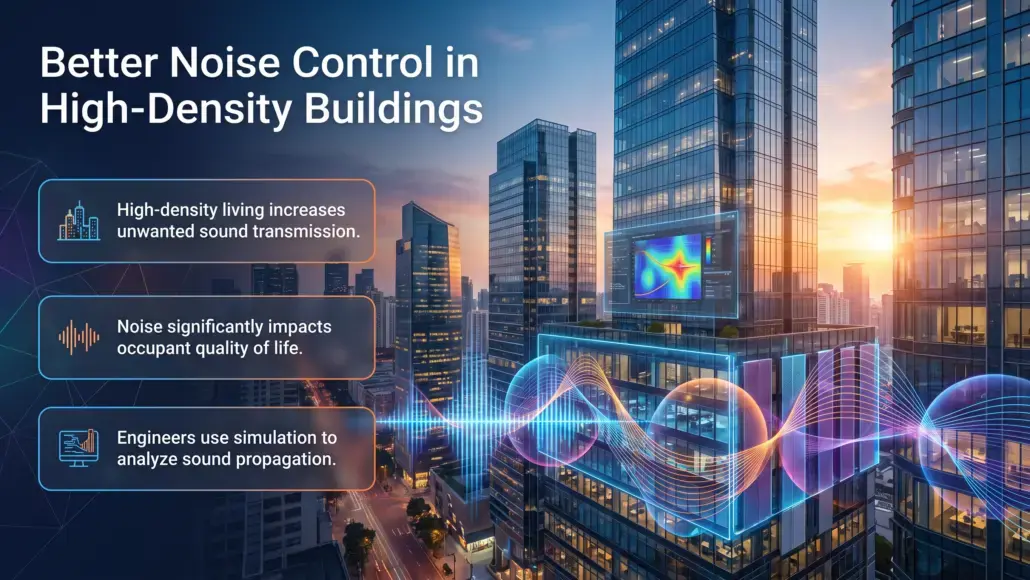


The rise of high-density living in global urban centers has brought the challenge of noise control to the forefront of the construction industry. As residential and commercial spaces become more integrated and compact, the potential for unwanted sound transmission increases, significantly impacting the quality of life for occupants. To address this, engineers are increasingly relying on sound propagation simulation to simulate and analyze sound propagation within and around complex building structures. These advanced models allow designers to visualize how sound waves interact with various building surfaces, helping to identify potential problem areas long before the first brick is laid. By accounting for the unique acoustic characteristics of urban environments, such as traffic noise and industrial activity, firms can develop more effective mitigation strategies that are tailored to the specific site conditions.
The process of sound propagation simulation involves the use of sophisticated algorithms that calculate sound pressure levels across a wide range of frequencies. This data-driven approach allows for a granular understanding of how different architectural forms and material choices will influence the internal acoustic environment. For example, a model might reveal that a particular facade design reflects too much street noise into the upper floors, prompting a change in geometry or the selection of more absorbent materials. This level of precision is essential for meeting the stringent acoustic standards that are now required in many jurisdictions. In addition, by integrating these models into the early stages of design, architects and engineers can collaborate more effectively to create spaces that are both visually stunning and acoustically serene, demonstrating that density does not have to come at the expense of quiet.
Engineering Solutions for Airborne and Impact Sound Insulation
One of the primary goals of noise control in high-density buildings is to provide effective insulation against both airborne and impact sound. Airborne sound includes voices, music, and television, which travel through the air and can penetrate walls and floors if they are not properly sealed. Impact sound, on the other hand, is caused by physical contact with a surface, such as footsteps or falling objects, and can be transmitted through the structural frame of the building. sound propagation simulation plays a critical role in designing the multi-layered assemblies required to block these diverse sound sources. By simulating the transmission loss of different wall and floor configurations, engineers can select the most efficient combination of mass, decoupling, and absorption to achieve the desired level of sound insulation.
The complexity of these assemblies requires a deep understanding of material science and structural engineering. For example, the use of resilient channels or sound-rated insulation can significantly improve the acoustic performance of a standard partition wall. acoustic modeling allows designers to test these components in a virtual environment, ensuring that the final assembly meets the project’s performance goals while remaining within budget and space constraints. This focus on engineering precision is particularly important in luxury residential developments, where high levels of acoustic privacy are a major selling point. By providing a scientifically verified level of sound insulation, developers can offer a premium experience that sets their project apart in a crowded market. The ongoing development of new acoustic materials, such as high-density membranes and porous composites, will continue to expand the range of solutions available for effective sound control. These innovations allow for more efficient use of space, as high performance can be achieved with thinner and lighter assemblies. This is a significant advantage in high density developments where every square centimeter of floor space carries a high premium. By staying at the forefront of material science, construction firms can deliver superior value to their clients while simultaneously addressing the complex technical challenges of modern noise control. The integration of these advanced materials with precise sound propagation simulation represents the future of structural sound management, enabling the creation of quieter and more sustainable buildings for a growing urban population.
Mitigating Flanking Paths in Multi Unit Residential Structures
Even the most resilient wall and floor assemblies can be undermined by flanking paths, which are secondary routes that sound travels through to bypass a primary acoustic barrier. Common flanking paths include shared utility ducts, electrical outlets, and the structural connections between walls and floors. Identifying and mitigating these paths is one of the most challenging aspects of noise control in multi-unit buildings. acoustic modeling provides a powerful tool for visualizing these complex sound transmission routes., allowing engineers to design targeted interventions that block sound at its source. This might involve the use of acoustic sealants, specialized gaskets, or the strategic layout of utility runs to minimize their impact on acoustic privacy.
The mitigation of flanking paths requires a holistic approach to building design that considers the interaction of all building systems. For instance, the placement of a bathroom next to a bedroom in an adjacent unit can create significant acoustic challenges if the plumbing is not properly isolated. Through the use of sound propagation simulation, these risks can be identified during the space planning phase, allowing for a more efficient layout that naturally minimizes sound transmission. This proactive integration of acoustic logic into the design process is essential for creating high-performance buildings that meet the expectations of modern urban dwellers. The focus on detail ensures that the building functions as a cohesive system, providing a high level of comfort and privacy for every occupant regardless of their location within the structure.
Integrating Vibration Isolation for Mechanical and Utility Systems
In high-density buildings, the noise and vibration generated by mechanical systems, such as HVAC units, elevators, and pumps, can be a major source of occupant dissatisfaction. If not properly managed, these vibrations can travel through the building’s structural frame and manifest as audible noise in residential units. To prevent this, engineers use sound propagation simulation to design and implement comprehensive vibration isolation systems. These systems typically involve the use of resilient mounts, inertia bases, and flexible connectors that decouple the mechanical equipment from the building structure. By simulating the dynamic response of the building to these equipment loads, engineers can ensure that the isolation measures are appropriately sized and placed for maximum effectiveness.
The integration of vibration isolation is not just about reducing noise; it is also about protecting the building’s infrastructure. Continuous exposure to high levels of vibration can lead to mechanical failure and structural fatigue over time. Acoustic modeling helps to identify the resonant frequencies of the building and the equipment, allowing designers to avoid configurations that could lead to amplified vibrations. This focus on long-term performance is essential for the operational efficiency of the building and the satisfaction of its tenants. As mechanical systems become more complex and powerful, the role of sound propagation simulation in managing their impact on the built environment will only become more important. The move toward more intelligent and responsive building systems will also provide new opportunities for active vibration control, further enhancing the acoustic quality of modern urban living.
Advancing Acoustic Comfort through Data Driven Design Optimization
The ultimate objective of noise control in the construction sector is to enhance the acoustic comfort of the building’s occupants. Acoustic comfort is more than just the absence of noise; it is the creation of an environment where sound is balanced and pleasing to the ear. Through the use of data-driven design optimization, engineers can now fine-tune the acoustic properties of a space to suit its specific function. For example, the acoustic requirements of a high-end office are very different from those of a residential unit or a public lobby. Acoustic modeling allows for the customization of absorption and reflection patterns to ensure that every space provides the optimal acoustic experience for its users.
This focus on the user experience represents a shift in how the industry approaches acoustics, moving from a purely compliance-based model to one that prioritizes performance and well-being. By leveraging the insights gained from advanced simulations, developers can create spaces that are not only quieter but also more productive and relaxing. This added value is increasingly recognized by the market, with acoustic quality becoming a key metric for high-performance buildings. The continuous refinement of sound propagation simulation techniques, combined with the availability of more accurate performance data, will ensure that the next generation of high-density buildings provides a superior level of comfort for all. The commitment to acoustic excellence is a testament to the industry’s dedication to creating better, more livable cities for a growing global population. By prioritizing the invisible but essential element of sound, the construction sector is raising the bar for what it means to build a high quality home or workplace. This dedication to performance and occupant satisfaction is what will define the leading firms of the future, as the market increasingly values the quiet and comfort that only a scientifically designed space can provide. The move toward more sophisticated and data driven noise control is a logical and necessary response to the challenges of modern urban life, ensuring that our cities remain places of growth, innovation, and tranquility for all who inhabit them. Through these efforts, we are not just building structures; we are crafting the foundations of a better quality of life. As urban density increases, the importance of this work will only continue to grow, shaping the way we design and experience the built environment for years to come.