
























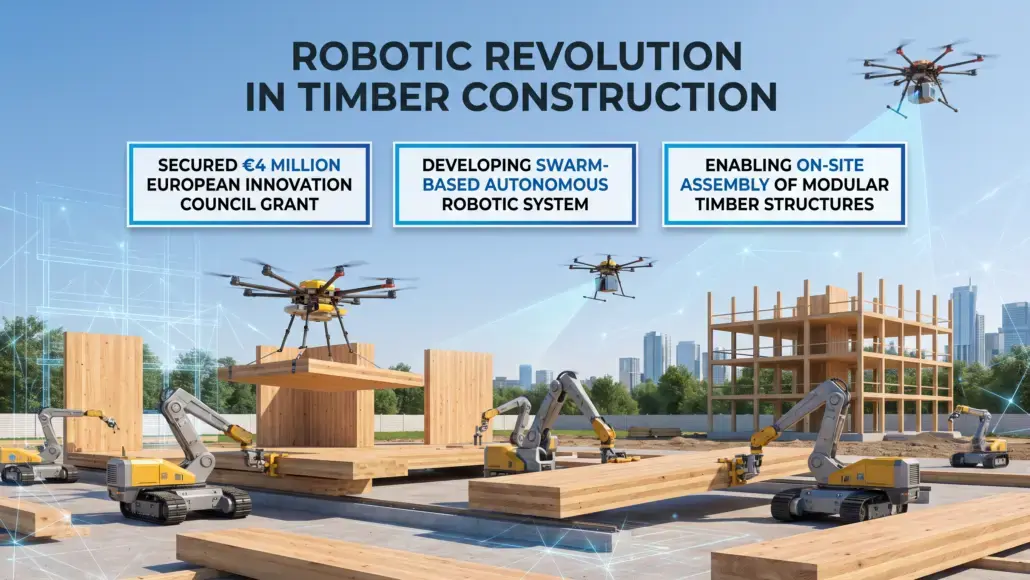

British studio Foster + Partners has joined an academic consortium that has secured a €4 million, three-year research grant from the European Innovation Council’s Pathfinder funding programme to develop an autonomous system for timber construction. Named SWIFT-Build, short for Swarm-based Inverted Fabrication for Timber Buildings, the project will develop a fleet of robotic assemblers, lifting units and drones designed to construct modular timber structures on site. The project is intended to improve the sustainability and efficiency of automated construction, with timber, circularity and flexibility forming key elements of its approach.
Foster + Partners is the industry partner in the consortium, alongside the University of Bristol, the University of Southern Denmark, the Technical University of Munich, the University of Pisa, the Delft University of Technology, the University of Birmingham, and the Ludwig Maximilian University of Munich. Foster + Partners senior partner Irene Gallou said: “Combining state-of-the-art robotics and integrated AI tools, SWIFT-Build’s inverted construction method can adapt to various scales and uses, with the potential for wide-reaching applications,” and added: “The focus on timber modular construction highlights the project’s sustainable agenda, with circularity and flexibility at its core.” The robot construction system is designed around an inverted method that builds structures “from the top down”.
Under the proposed process, ground-based robots will first assemble the uppermost level of a structure at ground level before lifting it to create space for the level below. The process will continue layer by layer, with robots and lifting machines assembling the structure while drones operate overhead to monitor progress and identify potential issues. Foster + Partners said: “The robots share information continuously, allowing them to adapt and operate safely without constant human intervention,”. The robot construction research will culminate in a full-scale demonstration in which autonomous robots construct a timber pavilion designed for disassembly.