






















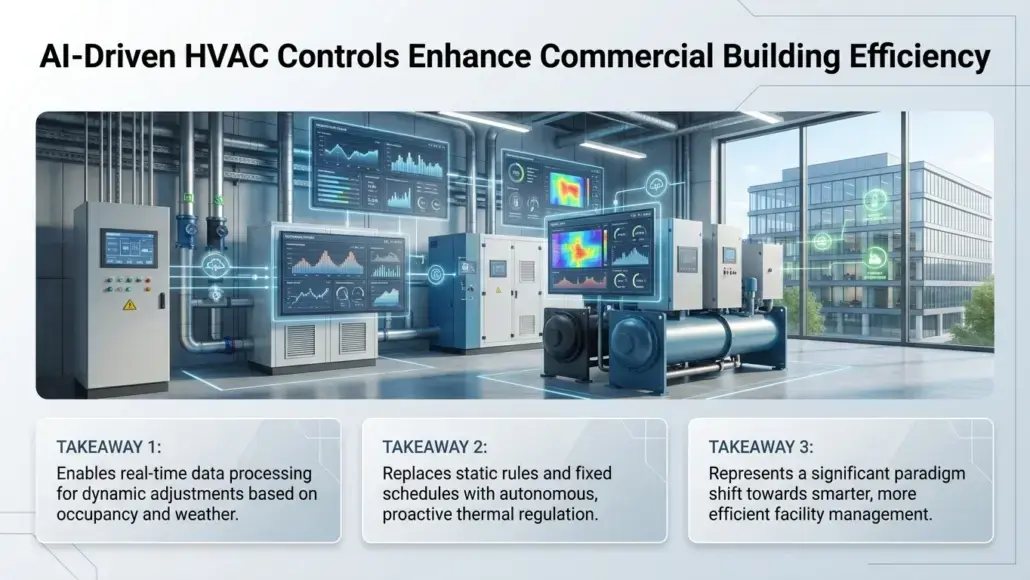


The operational efficiency of modern commercial facilities is increasingly dependent on the ability to process vast amounts of data in real time. Traditional building management systems often rely on fixed schedules and static rules, which cannot account for the dynamic nature of building occupancy, weather patterns, and fluctuating energy prices. The introduction of AI HVAC controls represents a paradigm shift in facility management, providing an autonomous and proactive approach to thermal regulation. By leveraging advanced algorithms and deep learning, these systems can identify patterns and optimize equipment performance in ways that were previously impossible for human operators. This transition is essential for building owners who seek to achieve net-zero targets while maintaining the highest levels of occupant comfort.
Predictive Modeling and Machine Learning Algorithms
At the core of these intelligent systems is the ability to create highly accurate predictive models of building behavior. Machine learning algorithms are trained on historical data, including indoor temperatures, outdoor weather conditions, and occupancy levels, to understand how the building responds to different thermal inputs. Over time, the system learns the specific thermal mass characteristics of the structure, allowing it to predict exactly how long it will take to heat or cool a space. This predictive capability is a fundamental advantage of AI HVAC controls, as it enables the system to initiate changes before the building deviates from its setpoints.
These algorithms do not just react to current conditions; they anticipate future needs. For example, if the weather forecast predicts a sudden rise in temperature, the system can begin pre-cooling the building during the early morning hours when energy prices are lower and the outdoor air is cooler. This thermal precooling reduces the peak cooling demand during the hottest part of the day, lowering utility costs and reducing the strain on the mechanical equipment. The continuous learning aspect of the algorithms ensures that the models are constantly refined, adapting to changes in building usage or the aging of HVAC components. This adaptability is critical for maintaining long-term efficiency and avoiding the performance degradation that often plagues traditional systems.
Beyond this, the application of reinforcement learning allows the system to discover new optimization strategies through a process of trial and error within a safe operational boundary. The AI can test slight variations in setpoints or fan speeds and measure the impact on energy consumption and comfort. By identifying the most effective combinations, the system can autonomously implement control strategies that are tailored to the unique requirements of the facility. This level of granular optimization is far beyond the capabilities of standard building automation logic, providing a significant competitive advantage for facility managers.
Data Aggregation and IoT Sensor Network Integration
The effectiveness of any artificial intelligence platform is directly tied to the quality and volume of the data it receives. The deployment of AI HVAC controls necessitates a resilient network of Internet of Things sensors that provide real-time updates on a wide variety of environmental and mechanical parameters. These sensors track not only temperature and humidity but also indoor air quality, occupancy, and even the power consumption of individual components. The aggregation of this data into a centralized data lake provides the raw material for the machine learning models, enabling a holistic view of building operations.
Integration with existing building systems is often achieved through open communication protocols, allowing the AI to interact with thermostats, actuators, and variable frequency drives. This connectivity ensures that the insights generated by the AI are translated into immediate physical actions. In many cases, the AI resides in the cloud, where it can access superior computing power and external data sources such as local utility prices and real-time weather feeds. The low-latency communication between the local building controllers and the cloud-based AI is essential for maintaining the responsiveness of the system.
Beyond this, the integration of automated air balancing improving multi-zone HVAC performance can further enhance the granular control provided by the AI. By ensuring that the correct volume of air is delivered to each zone based on real-time needs, the system can eliminate the inefficiencies associated with over-conditioning or under-conditioning specific spaces. This synergy between physical air management and intelligent control logic is a hallmark of the most advanced smart building installations, providing a level of comfort and efficiency that is unmatched by traditional methods. The ability to coordinate these complex systems requires a unified data strategy that breaks down the silos between different mechanical and electronic components.
Autonomous Setpoint Optimization and Load Shedding
One of the most immediate benefits of implementing AI is the ability to autonomously optimize setpoints across the entire facility. Traditional systems often have fixed setpoints that are rarely adjusted, leading to situations where the building is cooled or heated more than necessary. The AI can dynamically adjust these setpoints based on the actual number of occupants and the specific activities occurring in each zone. By allowing for a slightly wider deadband during periods of low occupancy or in less critical areas, the system can significantly reduce energy consumption without impacting the overall comfort of the building.
Load shedding is another critical function performed by intelligent controls. During periods of peak grid demand, utility companies often offer financial incentives for buildings that can reduce their electrical consumption. The AI can automatically initiate load-shedding protocols, such as slightly increasing the cooling setpoints or slowing down non-essential fans, to meet the grid’s requirements. The system’s predictive models ensure that these adjustments are made in a way that minimizes the impact on occupant comfort. By participating in demand response programs, building owners can generate a new revenue stream while contributing to the stability of the local electrical grid.
The autonomy of these systems also reduces the workload for facility management staff. Instead of manually responding to comfort complaints or adjusting schedules, operators can focus on higher-level strategic tasks and long-term maintenance planning. The AI provides a constant, vigilant presence, monitoring the building twenty-four hours a day and making thousands of small adjustments that would be impossible for a human to manage. This constant optimization ensures that the building is always operating at its peak potential, maximizing the return on investment for the HVACR infrastructure.
Human-in-the-Loop Supervisory Systems and Dashboards
While the AI operates with a high degree of autonomy, it is essential to maintain a human-in-the-loop for supervisory purposes. Facility managers need a clear and intuitive way to monitor the actions of the AI and intervene if necessary. Modern AI HVAC controls feature sophisticated dashboards that provide a real-time visualization of building performance, energy savings, and comfort metrics. These interfaces translate complex data into actionable insights, allowing operators to understand exactly how the AI is making decisions and what the resulting benefits are.
These dashboards also provide a platform for setting high-level operational goals and constraints. For example, a facility manager can prioritize energy savings over absolute comfort during specific times of the year, or set a maximum carbon footprint for the building. The AI then works within these parameters to find the most efficient solution. The transparency of the system is vital for building trust between the technology and the operators. By providing clear explanations for why a specific action was taken, the AI helps facility managers learn more about their building’s behavior and identify opportunities for further improvement.
The use of natural language processing and voice interfaces is also beginning to emerge in the sector. Facility managers can ask the system questions like, “Why is the energy consumption higher today than yesterday?” or “Which zone has the most comfort complaints?” The AI can then analyze the relevant data and provide a concise, understandable response. This simplified interaction lowers the barrier to entry for advanced building technology, allowing even non-technical staff to benefit from the insights provided by the artificial intelligence.
Cybersecurity and Data Privacy in Smart Building Nets
As buildings become more connected and reliant on cloud-based AI, the importance of cybersecurity cannot be overstated. The HVACR network is a potential entry point for cyber threats that could compromise not only the building’s operations but also the data privacy of its occupants. Implementing AI HVAC controls requires a comprehensive security strategy that includes encrypted communication, multi-factor authentication, and regular vulnerability assessments. Building owners must ensure that their technology partners follow the highest industry standards for data protection and system resilience.
The collection of occupancy data and other personal information also raises important privacy concerns. Facility managers must be transparent about what data is being collected and how it is being used to improve building operations. Anonymization techniques should be employed to ensure that individual occupants cannot be identified from the sensor data. By prioritizing privacy and security from the outset, building owners can build confidence in their smart building initiatives and protect their assets from emerging digital threats.
The resilience of the system in the event of a connectivity loss is another critical consideration. The local building controllers must have enough intelligence to maintain safe and comfortable operations if the connection to the cloud-based AI is interrupted. A fallback to local, rule-based logic ensures that the building remains habitable even during network outages. This layered approach to control logic, combining the superior intelligence of the cloud with the reliability of local hardware, represents a strong architecture for modern commercial building operations. As the technology continues to mature, the integration of edge computing will further enhance the responsiveness and security of these intelligent systems.