





























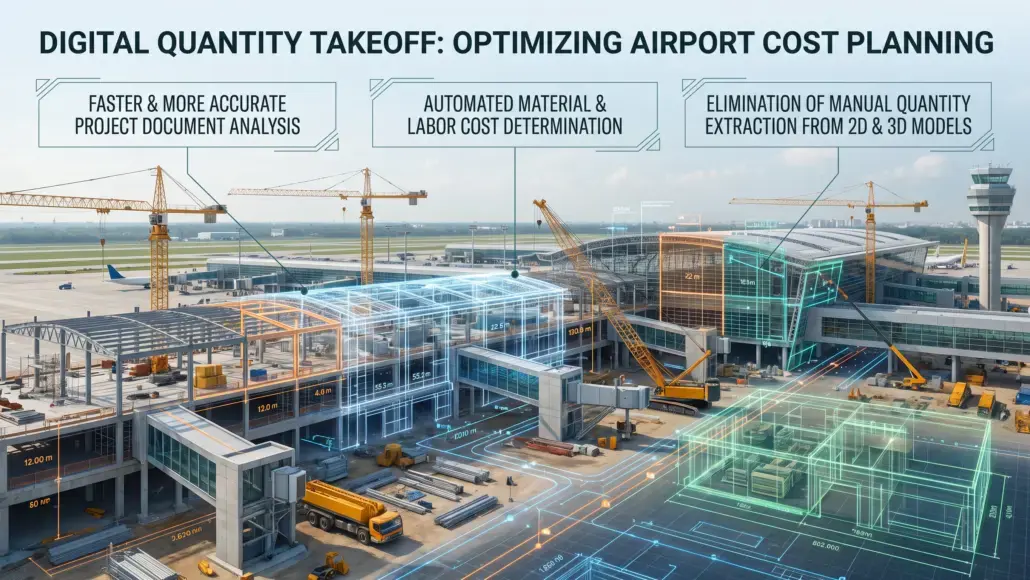


The scale and complexity of modern airport projects necessitate a highly precise approach to cost estimation and financial management. The transition to digital quantity takeoff has revolutionized the way quantity surveyors and estimators analyze project documents, providing a faster and more accurate method for determining material requirements and labor costs. By utilizing specialized software to extract quantities directly from 2D drawings and 3D models, project teams can eliminate the manual errors and inconsistencies that often plague traditional paper based processes. This technological advancement is particularly critical in the aviation sector, where tight budgets and strict accountability are the norm. The ability to generate detailed and reliable cost estimates at every stage of the project lifecycle ensures that airport authorities can manage their resources effectively and avoid the financial surprises that can derail large scale infrastructure developments.
Airport construction involves a vast array of materials, from the high strength concrete required for runways to the specialized interior finishes of a passenger terminal. Traditional quantity takeoff methods, which involve manual measurements and calculations, are not only time consuming but also susceptible to omissions and misinterpretations. Digital quantity takeoff addresses these challenges by providing a centralized and automated platform for measuring lengths, areas, and volumes. The software can be calibrated to the specific requirements of the airport project, ensuring that every element is accounted for with mathematical precision. The resulting data provides a solid foundation for cost planning, allowing for more accurate bidding, better procurement management, and more transparent financial reporting.
Precision Estimating for Large Scale Aviation Procurement
The primary advantage of digital quantity takeoff is the significant improvement in the accuracy of material estimations. For airport projects where quantities of earthwork, steel, and concrete can be enormous, even small percentage errors in estimation can lead to massive cost overruns. Digital tools allow estimators to capture the precise geometry of every component, ensuring that the quantities reflected in the bid documents are as accurate as possible. This level of precision is essential for securing competitive pricing from subcontractors and suppliers, as it reduces the uncertainty and risk associated with the project. The ability to quickly update quantities as the design evolves also ensures that the budget remains aligned with the project scope, providing a more reliable financial roadmap for the airport authority.
In addition to improving accuracy, digital quantity takeoff significantly increases the speed of the estimating process. What used to take days or weeks can now be completed in a fraction of the time, allowing project teams to respond more quickly to changes and requests for information. This agility is vital in the fast paced world of airport development, where decisions often need to be made under tight time constraints. The automated nature of the takeoff process also frees up quantity surveyors to focus on more strategic tasks, such as value engineering and risk analysis. By spending less time on manual calculations and more time on high level financial management, the project team can deliver better value for the airport authority and its stakeholders.
Automated Measurement and Error Reduction in Cost Planning
The elimination of manual data entry is a key factor in reducing errors in airport cost planning. the technology software integrates directly with project management and accounting systems, ensuring that the quantities captured during the takeoff process flow directly into the cost estimate and budget. This integration eliminates the risk of transcription errors and ensures that all stakeholders are working from the same set of data. The software also provides a clear audit trail, allowing for easy verification of every measurement and calculation. This transparency is essential for maintaining accountability and for resolving any disputes that might arise during the construction process. The ability to demonstrate the technical basis for the cost estimate builds trust with airport authorities and provides a solid foundation for financial control.
Additionally, the technology tools facilitate the identification of discrepancies and omissions in the design documents. When measuring quantities in the digital environment, estimators can often spot areas where the drawings are incomplete or where there are conflicts between different disciplines. Identifying these issues early in the project lifecycle allows them to be addressed before they lead to costly changes and delays on the site. The digital takeoff process thus acts as a form of quality control for the design documents, contributing to a more coordinated and constructible project. The focus on precision and detail in the cost planning phase is a hallmark of successful airport development, ensuring that the project is built to the highest standards within the available budget.
Dynamic Budgeting and Phased Development Management
Airport projects are often executed in multiple phases over many years, and the technology provides the flexibility needed to manage these complex financial structures. The software allows for the creation of separate estimates for different project components and phases, providing a detailed view of the financial requirements over time. This dynamic approach to budgeting is essential for managing the cash flow and financing of a major airport expansion. As the project progresses and more detailed information becomes available, the digital models can be updated to reflect the current state of the design and construction. This ensures that the budget remains a living document that accurately reflects the financial reality of the project at all times.
The use of the technology also supports the growing trend toward target value design and collaborative procurement in the aviation sector. By providing a clear and accurate understanding of the project costs early in the design phase, the project team can work together to find the most cost effective solutions without compromising quality or performance. The digital tools allow for the rapid evaluation of different design options and material choices, providing the data needed to make informed decisions that align with the budget goals. This collaborative approach to cost management fosters innovation and leads to better outcomes for the airport authority. The focus on value and efficiency in the financial planning process is a key driver for the success of modern airport projects.
Supply Chain Optimization and Integrated Cost Control
Effective procurement management is essential for controlling costs on a major airport project, and the technology provides the data needed to optimize the supply chain. By having a precise understanding of the material requirements, project managers can negotiate better terms with suppliers and plan for the timely delivery of items to the site. This reduces the risk of material shortages and minimizes the costs associated with excessive storage or expedited shipping. The integration of takeoff data with procurement software also allows for the automated generation of purchase orders and the tracking of material usage against the budget. This level of control is essential for managing the large and complex supply chains associated with aviation infrastructure.
Beyond procurement, the technology also plays a vital role in integrated cost control during the construction phase. By comparing the actual quantities installed against the original estimate, the project team can identify any variances and take corrective action if needed. This real time monitoring of costs ensures that the project remains on track financially and provides early warning of potential issues. The digital record of the project costs also provides a wealth of data that can be used for benchmarking and for developing more accurate estimates for future airport projects. The long term value of the data generated by the technology tools is a significant asset for any firm looking to lead in the airport construction sector.
Strategic Financial Planning and Long Term Asset Value
The ultimate goal of the technology in the airport sector is the realization of long term asset value through effective financial management. By providing the data needed to plan and control costs with precision, these tools ensure that the airport infrastructure is built to the highest standards within the available resources. The ability to demonstrate a track record of data driven financial success is also a powerful tool for securing funding and for maintaining the trust of airport stakeholders. The digital records created during the cost planning and construction phases are a permanent asset that can be used to support future facility management and renovation projects. The transition to a fully digital workflow for airport finance is a key component of the broader transformation of the construction industry.
As the aviation industry continues to evolve and face new financial challenges, the demand for precise and efficient cost planning will only increase. the technology is a key technology that will help the construction sector meet these challenges, providing the tools needed to manage complexity and deliver value. The ongoing development of even more sophisticated estimating and financial management software will further enhance the capabilities of the project team, providing even greater levels of control and insight. The future of airport construction is one where every dollar is tracked and managed with digital precision, ensuring the highest standards of financial accountability and performance. The commitment to using the best available technology is what will define the leading firms in the airport construction sector, and the technology is at the forefront of this technological revolution.