
























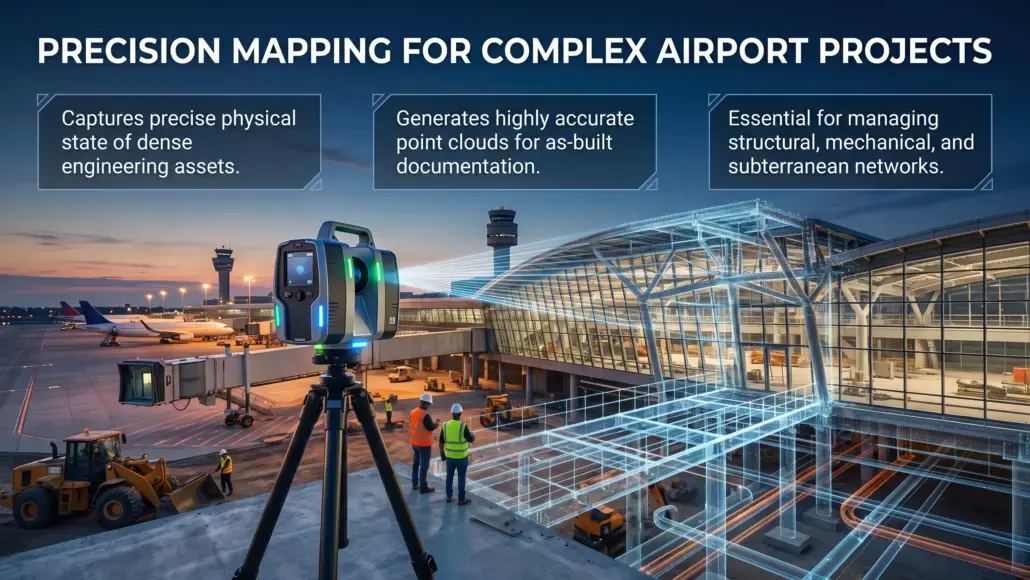


Modern airport facilities represent some of the most complex engineering environments in the world, characterized by a dense network of structural elements, mechanical systems, and subterranean utilities. The implementation of 3D laser scanning has become a standard requirement for capturing the precise physical state of these assets during and after the construction process. By utilizing light detection and ranging technology, surveying teams can generate highly accurate point clouds that reflect the exact positioning of every component within a terminal or across a runway expansion. This level of detail is critical for creating reliable as-built documentation, which serves as the definitive record for project closeout and future facility management. The transition from traditional manual measurements to digital reality capture ensures that the discrepancies between design intent and physical execution are identified and documented with mathematical certainty.
The challenge of documenting large scale airport projects lies in the sheer volume of data and the accessibility of restricted areas. Traditional surveying methods often fall short in capturing the intricate details of overhead MEP systems or the subtle variations in runway topography. However, 3D laser scanning enables the rapid acquisition of millions of data points without the need for physical contact with the structures being measured. This non-invasive approach is particularly advantageous in active airport environments where minimizing disruption to flight operations is a primary concern. The resulting digital models provide a comprehensive view of the infrastructure, allowing engineers to verify that the construction adheres to the strict tolerances required for aviation safety. This process not only improves the quality of the final documentation but also streamlines the communication between contractors, architects, and airport authorities.
Point Cloud Accuracy in Complex Airport Environments
The primary advantage of 3D laser scanning is the ability to produce a high density point cloud that serves as a three dimensional replica of the construction site. In an airport setting, where structural steel, baggage handling systems, and HVAC ductwork often occupy the same tight spaces, the precision of this data is indispensable. The point cloud allows for the detection of clashes and deviations that might be invisible to the naked eye. For instance, if a structural beam is slightly misaligned, the 3D laser scanning data will highlight this discrepancy against the original BIM model. This immediate feedback enables the construction team to make necessary adjustments before the project progresses to a stage where remediation would be prohibitively expensive. The accuracy of the as-built documentation is thus elevated from a general approximation to a precise digital record.
Managing the vast amount of data generated by the technology requires specialized software and hardware, but the investment is justified by the reduction in risk. By having a complete and accurate digital record of the as-built condition, airport operators can manage their facilities with greater confidence. When maintenance is required or when a new tenant needs to modify a terminal space, the existing documentation provides a reliable starting point. This reduces the need for costly and time consuming field investigations, as the necessary information is already available in the digital twin. The integration of the technology into the documentation workflow represents a commitment to technical excellence and long term asset sustainability in the aviation sector.
Verification of Structural Integrity and Compliance
Ensuring the structural integrity of airport infrastructure is a matter of public safety, and the technology provides a reliable method for verifying that all components meet the required specifications. The technology can be used to monitor the deformation of structures over time or to check the flatness and levelness of large concrete slabs, such as those found in hangar floors or terminal halls. By comparing sequential scans, engineers can identify any movement or settling that might indicate a structural issue. This proactive approach to monitoring is essential for maintaining the long term health of the airport assets. The as-built documentation created through this process serves as a baseline for future inspections, providing a clear history of the structural performance of the facility.
Compliance with aviation regulations also necessitates detailed documentation of all airside improvements. the technology is used to verify the clearance heights of overhead structures and the precise locations of navigational aids and lighting systems. The ability to demonstrate that every element of the project meets the rigorous standards set by aviation authorities is a major benefit of digital reality capture. The comprehensive nature of the scans ensures that no detail is overlooked, providing a level of assurance that is difficult to achieve with traditional methods. As airport projects become increasingly complex and subject to stricter oversight, the role of the technology in ensuring compliance and safety will continue to expand.
Reducing Rework through Digital Reality Capture
One of the most significant costs in airport construction is the need for rework caused by inaccurate or incomplete information. the technology mitigates this risk by providing a clear and unambiguous record of the site conditions at every stage of the project. When subcontractors are brought in to install specialized systems, they can rely on the point cloud data to plan their work with precision. This reduces the likelihood of onsite conflicts and ensures that installations fit correctly the first time. The digital documentation acts as a single source of truth for all parties involved, fostering better collaboration and reducing the potential for disputes over site conditions. The time saved by avoiding rework translates directly into improved project schedules and lower overall costs for the airport authority.
The use of the technology also facilitates the transition from construction to operations. When the project is handed over, the airport maintenance team receives a complete digital package that includes the accurate as-built models. This allows them to begin their work immediately, with a full understanding of the location and condition of all systems. The reduction in the “information gap” that often occurs during project handover is a key driver of operational efficiency. By investing in high quality documentation during the construction phase, airport owners can realize significant savings throughout the entire lifecycle of the facility. The ability to quickly locate a shut off valve or trace a conduit through a complex terminal building is a direct benefit of the precision provided by digital reality capture.
Long Term Facility Management and Digital Twins
The ultimate goal of the technology in the airport sector is the creation of a functional digital twin that supports ongoing facility management. The as-built documentation is not a static set of drawings but a dynamic digital asset that can be updated as the facility evolves. By integrating the scan data with maintenance management systems, airport operators can track the condition of assets in real time and schedule repairs based on actual usage and performance data. This level of integration is essential for managing the large and complex estates associated with major international airports. The digital twin provides a platform for testing future modifications and simulating the impact of operational changes, allowing for more informed decision making.
As technology continues to advance, the integration of the technology with other data sources, such as IoT sensors and AI driven analytics, will further enhance the value of the as-built documentation. The ability to visualize the current state of the facility alongside real time operational data will provide airport managers with a powerful tool for optimizing performance and improving the passenger experience. The transition to a fully digital workflow for airport construction and management is well underway, and the technology is at the heart of this change. By providing the foundation of accurate and detailed information, this technology ensures that the next generation of airport infrastructure is built to last and designed to evolve. The focus on precision and data integrity in the creation of as-built records will remain a cornerstone of successful airport project delivery for the foreseeable future.
Strategic Planning for Future Airport Expansions
The wealth of data provided by the technology is also a vital resource for strategic planning and future airport expansions. When an airport authority considers adding a new concourse or reconfiguring an existing terminal, the availability of accurate as-built documentation is crucial for feasibility studies and master planning. Engineers can use the existing digital models to assess the capacity of current systems and identify potential challenges for new construction. This reduces the uncertainty associated with building in brownfield environments, where hidden utilities or structural limitations can often lead to unexpected delays and costs. The digital record allows for a more comprehensive analysis of the existing infrastructure, ensuring that new developments are integrated directly with the old.
Additionally, the use of the technology supports the growing trend toward sustainable airport development. By providing a precise record of materials and structural systems, the documentation facilitates the adaptive reuse of existing buildings and the responsible management of demolition waste. The ability to accurately quantify the components of a structure before it is modified or removed allows for better recycling and salvage operations. This contributes to the broader goals of environmental stewardship in the aviation industry, demonstrating that high tech construction tools can also support green initiatives. The long term vision for airport management involves a holistic approach to data, where the technology plays a critical role in every stage of the facility lifecycle, from initial design to final decommissioning.