





























Advice about local search visibility circulates widely among contractors, but a surprising amount of it hasn’t kept pace with how search engines actually evaluate local businesses today. Tactics that once produced results have been superseded by updated ranking factors, yet these outdated ideas persist because they’re easy to repeat and difficult to verify without direct experience.
Comprehending the basics of Home Improvement SEO will enable you to differentiate between misconceptions that do not work anymore and strategies that work even today. The importance of doing so lies in the fact that following out-of-date information can waste your time and money.
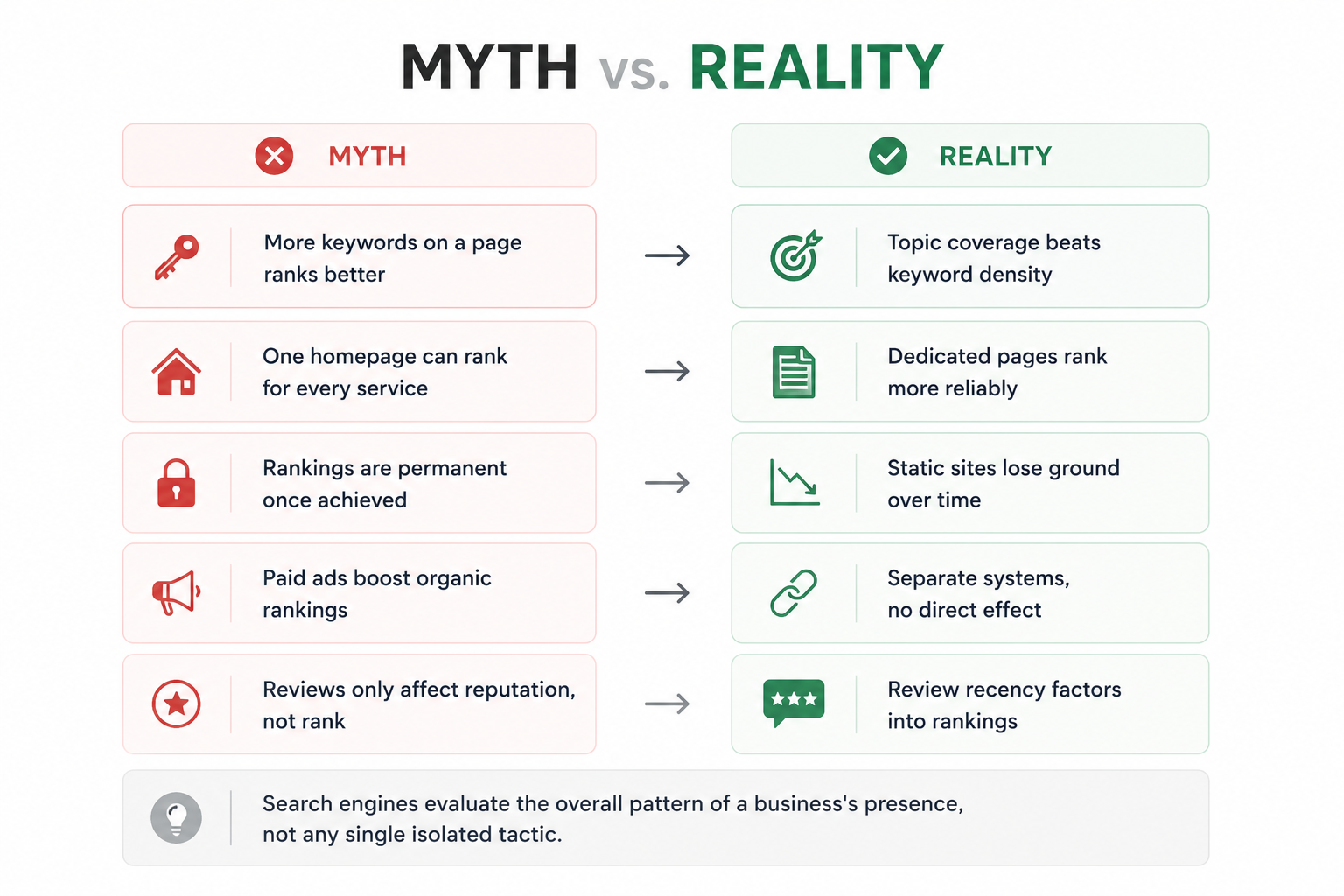
Myth 1: More Keywords on a Page Means Better Rankings
There exists an old philosophy according to which the best strategy for improving ranking on search engine results is the use of various types of keywords such as “kitchen remodeling,” “kitchen renovation,” and “kitchen makeover” on each web page. The search engines are getting smarter with regards to the measurement of content relevancy.
What actually performs better:
- Content that thoroughly answers the questions a homeowner might have about a specific service
- Natural language that reads well for actual visitors, not just search algorithms
- Supporting content addressing related questions (permits, timelines, material choices)
Pages that are written purely to hit a certain keyword limit will not only fail to read well but are also likely to perform worse than pages which take into account the visitor’s real concerns, even if those pages use fewer target keywords.
Myth 2: A Single Homepage Can Rank for Every Service
Many contractors offering multiple services — roofing, siding, windows, general renovation — rely on one homepage to represent the entire business, expecting it to rank for searches across all of those categories simultaneously. An effective SEO strategy generally requires dedicated pages for each core service, since a single page competing across many distinct search terms rarely ranks as well as focused pages built around each specific service area.
| Approach | Typical Outcome |
| One general homepage covering all services | Ranks inconsistently across service categories |
| Dedicated page per service | Ranks more reliably for each specific search term |
Myth 3: Rankings Are Permanent Once Achieved
Some contractors treat search visibility as a one-time project — build the website, publish some content, and consider the work finished. However, the truth is that there are still other competitors who publish their updated content on their sites, conduct review and update their site, and therefore static sites start losing importance without making any effort at all.
Ongoing factors that affect rankings over time:
- Competitor content updates and expansion
- Accumulating review counts among competing businesses
- Algorithm updates that reweight existing ranking factors
- Citation and directory information that can drift out of date
Myth 4: Paid Ads Improve Organic Search Rankings
However, one misconception is that placing sponsored advertisements in search engine results will increase the position of a website in the organic results beneath them. Both systems are completely distinct from each other, and the expenditure of money on advertising does not affect the organic position of a site in any way.
Myth 5: Reviews Only Matter for Reputation, Not Rankings
Many contractors see reviews simply as an indication of trustworthiness for future customers looking at their business page, while ignoring the fact that the number of reviews, freshness, and rating always go into the ranking of the business in the context of its competitors in the search engines. In many cases, the business with fewer and less fresh reviews is placed lower in the search results despite having equal service quality as its competitors.
Why These Myths Persist
Most of these misconceptions trace back to tactics that carried more weight in earlier iterations of search algorithms, or to advice borrowed from unrelated industries where different ranking factors apply. Contractors relying on outdated guidance often invest significant effort into practices — keyword stuffing, one-time website builds, assuming paid ads help organic rankings — that produce limited or no measurable improvement, while overlooking factors search engines currently weigh far more heavily.
A more correct view on the concept of Home Improvement SEO sees it as a process-based multi-faceted approach: creating targeted content based on specific service areas and questions from homeowners, constant creation of reviews, citations, and content refreshment to keep up with competitors and algorithms alike. None of these elements alone assures high rankings; however, if neglected while being focused on the other elements, such an approach will not deliver good results due to the fact that today search engines do not focus on any one particular element of business presence.
Moving Past Outdated Assumptions
Contractors who periodically reassess their approach against current ranking factors — rather than continuing practices based on advice that may be years out of date — tend to adapt more effectively as algorithms evolve. Letting go of these persistent myths in favour of a more accurate, ongoing approach to local visibility tends to produce steadier, more durable results than chasing outdated tactics that stopped working long ago.