


























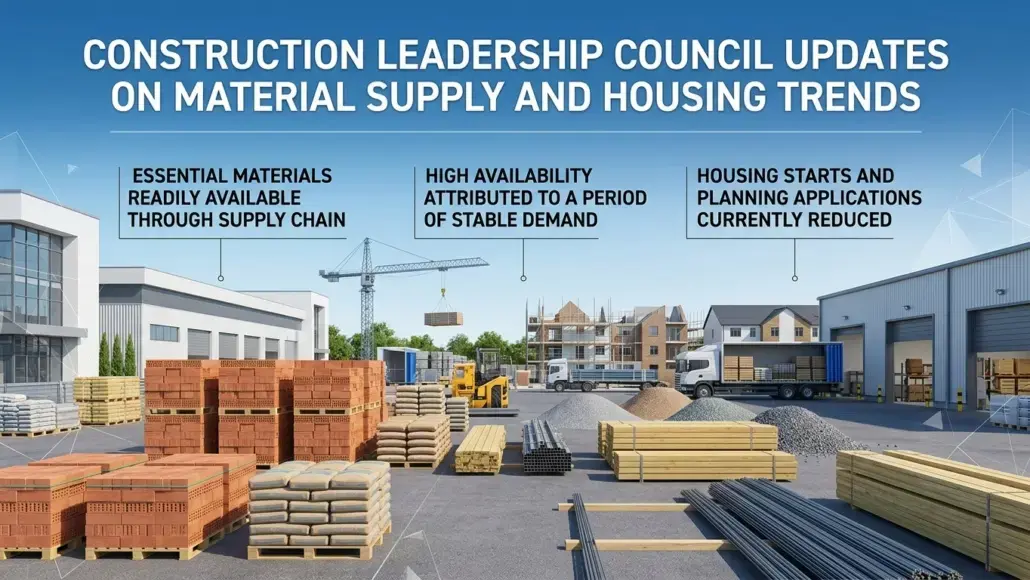


The Construction Leadership Council’s (CLC) Material Supply Chain Group has released a comprehensive update regarding the current state of the industry’s resources and demand levels. According to John Newcomb, CEO of the Builders Merchants Federation, and Peter Caplehorn, CEO of the Construction Products Association, who co-chair the group, most essential materials remain readily available throughout the construction supply chain. This high level of availability is attributed to a period of subdued demand, as fewer developers and contractors are currently active in the procurement market. While the sector recorded a 1.6% growth in output during the three months leading up to April, a market adjustment is anticipated, with a projected decline of 2-2.5% for the remainder of 2026. This shift is largely driven by a cautious consumer base and a decrease in mortgage approvals on both a month-on-month and year-on-year basis.
Diverging Trends in Housing and Infrastructure
The residential sector continues to be a primary influence on the demand for core materials, including bricks, steel, and cement. Despite the government’s ambition to construct 1.5m new homes during the current parliament, registration data from the National House Building Council (NHBC) suggests that figures remain on a downward trend. During Q1 2026, only 26,959 new homes were registered for construction, representing a 6% decrease from the same period in 2025. However, other areas of the industry are demonstrating resilience; highway maintenance and repair remain robust, and the digital infrastructure sector, including data centres, continues to expand. These growing segments provide a stable counterweight to the residential market’s current trajectory, which remains a focal point for the construction supply chain.
Navigating Regulatory Shifts and Trade Constraints
Industry participants are also managing the transition toward new regulatory standards and international trade adjustments. While recent regulations are intended to enhance project standards, there are concerns regarding the potential for increased administrative complexity and operational costs. Additionally, the industry is monitoring changes in the steel market, where tariff-free quotas have been reduced by half and import duties have risen to 50%, leading to discussions regarding potential product availability. Daniel Pearce, corporate strategy director at NHBC, offered an analysis of the current environment: “Our latest figures indicate house builders are taking a cautious approach to registering new plots as fragile consumer confidence, affordability challenges and global economic uncertainty continue to impact demand.”
He further elaborated on the complexities facing developers, stating, “It’s a perfect storm – the market is subdued, mortgage rates are rising and cost pressures on households are in full effect, exacerbated by geopolitics and recent conflicts. Resolving affordability challenges for homebuyers remains the key to unlocking demand. The market is crying out for some targeted stimulus, such as a new buyer incentive, to help those who need it most get on the housing ladder.” Pearce also noted that, “At present, there is little incentive for developers to accelerate building. Easing certain regulatory requirements, at a time when other costs are rising beyond their control, is a lever that could be pulled to support home builders, particularly SMEs. Accelerating planning reforms is also crucial to help house builders deliver high-quality new homes at volume. The impact of the recent planning changes has yet to be felt.”