
























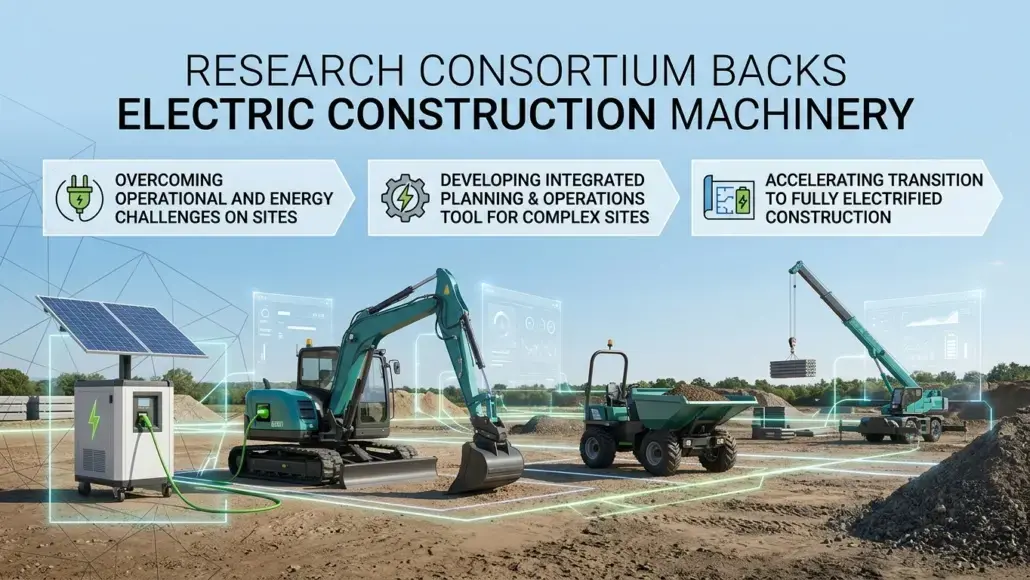


A new research initiative in Germany is seeking to accelerate the transition to Electric Construction Machinery by addressing the operational and energy challenges that continue to limit the use of fully electrified construction sites. The ForBat@Bau project, led by the Technical University of Munich (TUM), brings together academic institutions and industry partners to develop an integrated planning and operations tool designed for complex construction environments. The consortium believes that progress toward locally emission-free and energy-efficient construction sites has been slowed by insufficient coordination between stakeholders and fragmented planning processes.
According to TUM, the barriers extend beyond the availability of electric equipment. Construction projects frequently face constraints including limited electrical power supply on-site, lengthy charging requirements, undersized grid connections, and the lack of a coordinated framework linking machinery, energy storage systems and construction workflows. The consortium argues that simply replacing diesel-powered equipment with electric alternatives does not provide a workable solution, particularly for large-scale projects and machinery segments that require significant power. As a result, the project is focused on creating a broader system that combines construction operations, charging infrastructure, battery storage and grid integration.
Project leader Prof. Markus Lienkamp from the TUM Chair of Automotive Technology said: “We do not simply want to replace diesel engines in construction equipment. We view the construction site as a complete system, including construction processes, the connection to the power grid, and intermediate battery storage. By leveraging digitalization, we aim to make economically viable electric construction site operations possible in the future.”
The ForBat@Bau consortium aims to support fully electrified construction sites through a software-assisted and economically viable approach that improves planning reliability. Rather than treating individual machines separately, the project will integrate construction processes, charging infrastructure, machinery fleets, energy storage systems and grid connections into a unified operating model. Alongside TUM, academic partners include the University of Applied Sciences Landshut and the Ostbayerische Technische Hochschule Regensburg. Industry participants comprise the Bavarian Construction Industry Association, the Bavarian Construction Academy, and companies representing machinery manufacturing, construction operations, distribution grid management, measurement and simulation. Participants include Liebherr, Wacker Neuson, Strabag and Zeppelin Rental. The three-year programme has secured approximately €1.9 million in funding from the Bavarian Transformation and Research Foundation and is intended to advance the practical deployment of Electric Construction Machinery across future construction projects.