





















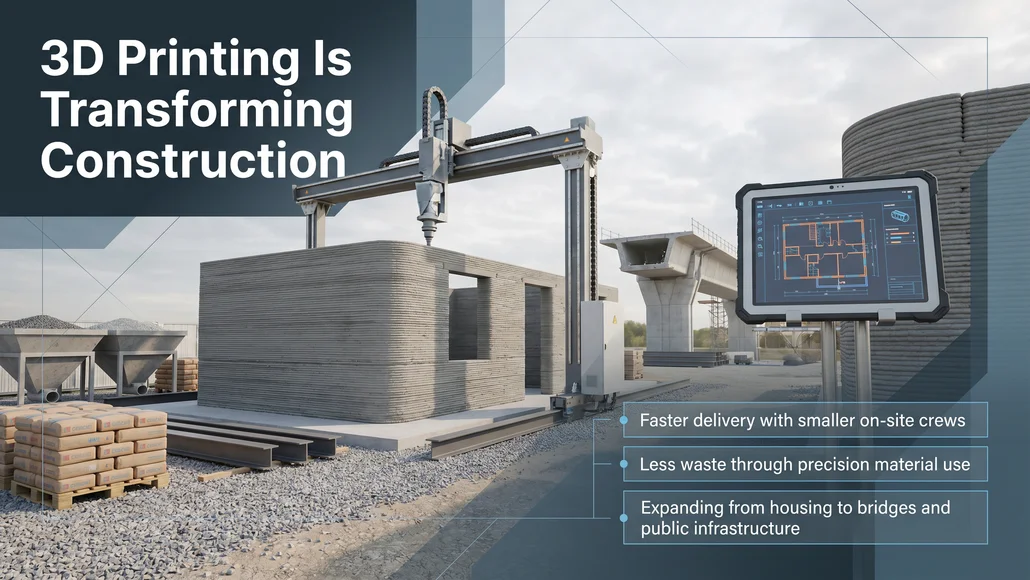


The global construction sector is undergoing a significant technological transformation as automation, robotics, and digital manufacturing technologies increasingly reshape traditional building processes. Among the most disruptive developments is the adoption of 3D printing in construction, a technology that is rapidly gaining traction as governments, developers, and infrastructure companies search for faster, more sustainable, and cost-efficient construction methods.
3D printing in construction market is expected to witness exceptionally strong growth through 2033, registering a compound annual growth rate (CAGR) of 94.55% during the forecast period. Rising labor shortages, increasing material costs, sustainability pressures, and the growing need for faster project delivery timelines are accelerating global interest in automated construction technologies. What was once viewed as an experimental innovation is now being applied across residential housing, commercial developments, military infrastructure, disaster-relief shelters, bridges, and modular construction projects.
Construction 3D printing uses automated additive manufacturing systems to build structures or building components layer by layer using materials such as concrete, cement composites, geopolymers, recycled materials, clay, and bio-based compounds. The technology typically relies on robotic systems guided by CAD (Computer-Aided Design) and BIM (Building Information Modeling) software to improve design accuracy and reduce manual intervention during construction processes.
The industry is increasingly shifting toward extrusion-based printing systems, where concrete-like materials are deposited through robotic nozzles in successive layers to create structural forms. Other technologies including powder bonding, robotic assembly printing, and hybrid modular systems are also gaining attention as companies explore scalable automated construction models capable of supporting larger and more complex projects.
Housing Demand and Labor Shortages Supporting Adoption
One of the primary factors driving adoption of 3D printing in construction is the growing global housing shortage. Many countries continue to face significant deficits in affordable housing, while traditional construction methods often struggle to meet rising urbanization demands within compressed timelines.
Automated construction technologies are increasingly being viewed as a solution capable of reducing labor dependency while accelerating project completion. 3D printing enables faster housing delivery, minimizes material waste, and allows developers to complete structural work using smaller on-site labor teams. Countries including the United States, India, Saudi Arabia, the UAE, and Mexico are expanding investments in alternative construction technologies as part of broader housing and infrastructure modernization initiatives.
The construction industry is also experiencing persistent shortages of skilled labor, including masons, formwork specialists, and concrete crews. Automation and robotic printing systems are helping reduce reliance on labor-intensive processes while improving consistency and operational efficiency across projects.
Sustainability Pressures Accelerating Market Growth
Environmental sustainability is becoming another major catalyst supporting the expansion of construction 3D printing. The global construction industry remains one of the largest contributors to carbon emissions and material waste, placing increasing pressure on developers to adopt more sustainable building practices.
3D printing technologies can reduce overproduction, lower transportation requirements, optimize material usage, and minimize waste generation through precision-based construction methods. Researchers and material developers are also expanding work on low-carbon and sustainable construction compounds, including carbon-negative concrete, recycled aggregate blends, geopolymers, hemp-based materials, and bio-composite alternatives.
The ability to create optimized structural geometries using less material is also improving the long-term sustainability profile of additive manufacturing in construction applications.
AI, Robotics, and Infrastructure Projects Expanding Market Scope
Artificial intelligence and robotics integration are becoming increasingly important across construction printing operations. AI-powered systems are helping optimize material flow, structural integrity, robotic path planning, and real-time quality control during printing processes. Automated monitoring systems are also improving scalability by reducing defects and increasing operational precision.
The market is evolving beyond residential housing projects into larger infrastructure applications including bridges, warehouses, schools, data centers, marine structures, and public infrastructure developments. Governments in multiple regions are supporting pilot programs focused on automated infrastructure development and smart construction technologies.
Modern construction printing systems are also enabling multi-story printed structures, reinforced building designs, and more complex architectural geometries that were previously difficult to achieve using earlier generations of the technology.
Regional Analysis
North America currently represents one of the leading regional markets due to strong startup activity, venture capital investment, military applications, and government-supported housing innovation projects. The United States remains a major hub for residential and commercial construction printing initiatives.
Europe is focusing heavily on sustainable construction and circular economy initiatives, with countries including the Netherlands, Germany, and Denmark expanding investments in environmentally focused printed construction technologies.
Asia-Pacific is expected to emerge as one of the fastest-growing markets due to rapid urbanization, population growth, smart city initiatives, and infrastructure expansion across China, India, and other regional economies.
The Middle East is also becoming an important growth region, particularly as the UAE and Saudi Arabia continue investing in smart infrastructure, futuristic urban developments, and automated construction systems.
Key Industry Opportunities
- Construction robotics and automated building systems
- Sustainable and recyclable construction materials
- Affordable housing projects
- Infrastructure printing applications
- BIM and AI-powered print management software
- Modular construction integration
Challenges Affecting Market Expansion
Despite strong growth potential, the industry continues to face challenges related to evolving building regulations, material approvals, structural testing frameworks, and equipment costs. Industrial-scale construction printers still require substantial capital investment, while operator training and maintenance remain barriers for some developers.
Scalability also remains a challenge in certain regions due to logistics constraints, regulatory uncertainty, material supply chain limitations, and shortages of trained operators.
Future Outlook
The future outlook for the 3D printing in construction market remains highly positive as automation, artificial intelligence, and sustainable building technologies continue transforming global construction practices. Industry participants are increasingly exploring fully autonomous construction sites, AI-managed building systems, advanced sustainable materials, and large-scale printed communities.
As governments and developers continue prioritizing faster, greener, and more cost-efficient construction methods, 3D printing technologies are expected to become an increasingly important component of next-generation infrastructure and urban development strategies.