


























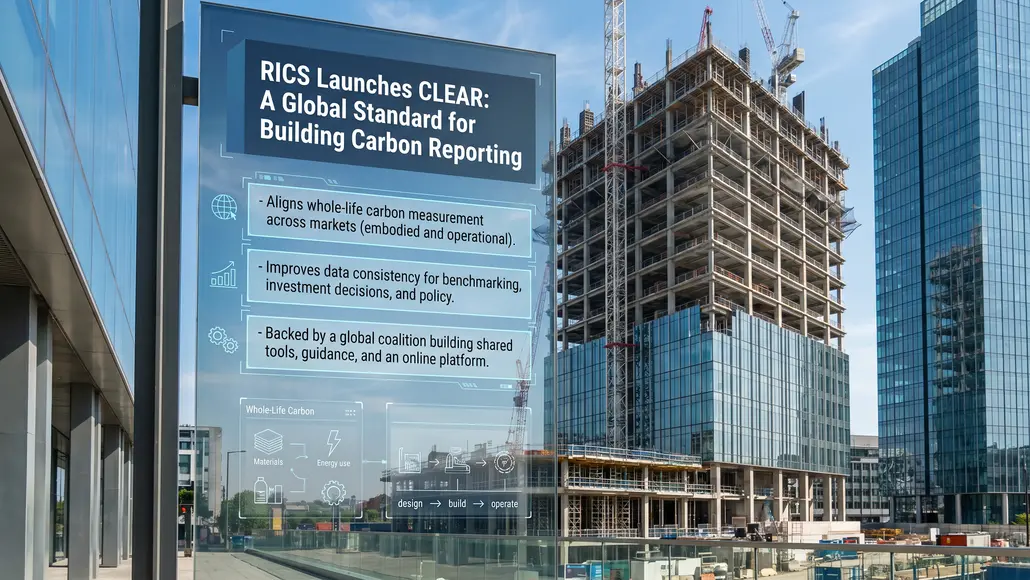


The Royal Institution of Chartered Surveyors (RICS) has introduced a new global coalition aimed at standardising building carbon reporting across the built environment, marking a significant step toward harmonised emissions measurement. The initiative, named the Coalition for Life Cycle Emissions Alignment and Reporting (CLEAR), was formally unveiled during the Sustainable Buildings and Construction Summit held from April 20 to 22 in Lausanne. The coalition brings together key organisations to establish a unified approach to whole-life carbon accounting, with the objective of strengthening data reliability and accelerating decarbonisation efforts across global construction and infrastructure sectors.
CLEAR is designed to resolve long-standing inconsistencies in how carbon emissions are measured throughout a building’s lifecycle, including both embodied and operational emissions. Despite increasing industry awareness, fragmented methodologies have continued to hinder benchmarking and decision-making. By aligning building carbon reporting practices across jurisdictions and markets, the initiative seeks to enable more accurate comparisons and informed policy development. As part of this effort, CLEAR will evaluate current frameworks, identify discrepancies, and develop a globally applicable system supported by technical tools, digital resources, and an online platform aimed at driving adoption.
The coalition is being led by RICS alongside co-founders World Business Council for Sustainable Development and Global Building Data Initiative, with Autodesk acting as sponsor. It also includes participation from major industry stakeholders such as AECOM, Arcadis, Avison Young, Heidelberg Materials, Morgan Sindall, OneClickLCA and Turner & Townsend. The initiative builds on established standards including RICS’ own guidance, as well as the International Cost Management Standards and International Property Measurement Standards, while leveraging data transparency efforts such as the Built Environment Carbon Database.
“The choices we make now will impact generations to come. The CLEAR initiative is a timely measure that will create shared trust, inspire confidence in carbon reporting, and empower the sector to shape a resilient, low-carbon future.” – Nick Maclean, RICS President.
“We see early signals of real estate markets adopting Whole Life Carbon approaches to manage transition risk and drive decarbonization strategies, driven by investor demand, emerging city planning requirements, and industry calling for consistent and comparable carbon assessment as a demand driver for low-carbon solutions. While these approaches will be developed and adopted nationally and regionally, based on local needs and realities, it is important to ensure consistency and comparability of assessments, as well as ease of use for widescale adoption. CLEAR will provide the blueprints and guidance to move Whole Life Carbon from early adoption to scale.” said Roland Hunziker, Director Built Environment, WBCSD.
“The CLEAR initiative is a timely and important opportunity to align carbon assessment and reporting across the built environment – and GBDI is excited to support it! Together with the CLEAR partners, we are looking forward to further developing the open building data format (OpenBDF) and advancing this global standard for easy, open exchange of building material inventory and life cycle impact data.” – Martin Röck, GBDI Executive Director.