






















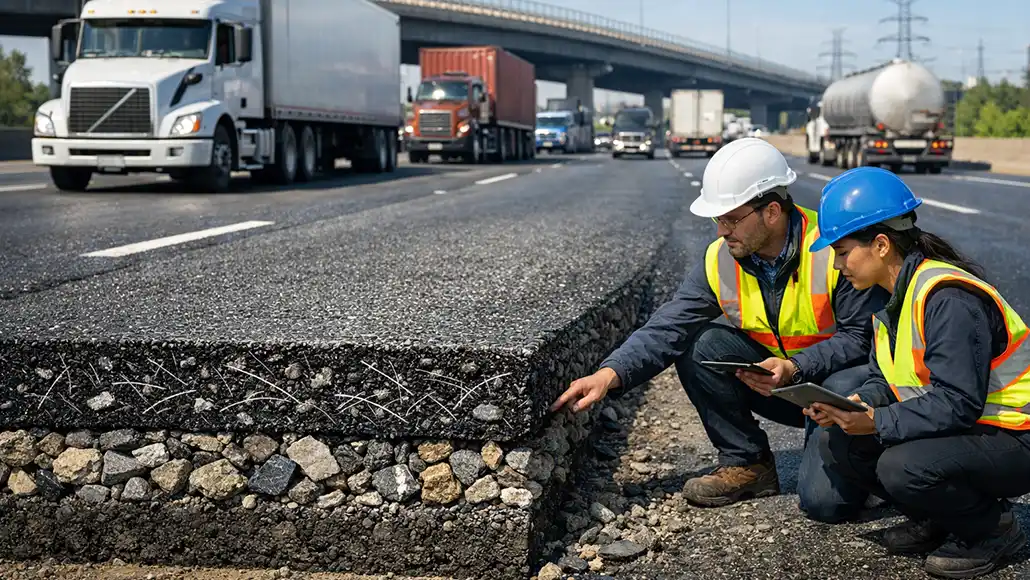


High-traffic environments, such as roads and pavement, subject asphalt to extreme mechanical stress. Highways, freight corridors, ports and industrial parking areas experience continuous loading from heavy vehicles, temperature fluctuations and environmental exposure. Over time, these forces lead to rutting, fatigue cracking, moisture damage and surface deformation, affecting maintenance costs and disrupting transportation networks.
The best materials to improve the lifespan of asphalt in high-traffic areas typically enhance the binder, reinforce the aggregate structure or create an internal matrix that resists cracking and deformation. Construction professionals must consider the most effective material technologies currently used in pavement engineering and compare leading manufacturers that supply these solutions.
Improve Asphalt in High-Traffic Areas With These 5 Materials
Evaluate the five best materials to improve the lifespan of asphalt and the most established innovators in the field.
1. Best Overall Reinforced Fiber Asphalt – FORTA
FORTA has established a strong reputation in the reinforcement fiber sector through decades of manufacturing and product development focused on infrastructure durability. It specializes in engineered reinforced fiber systems designed for integration into construction materials, particularly asphaltic and concrete applications.
The brand’s operations center on producing synthetic fibers with consistent geometry, tensile strength and dispersion characteristics that perform reliably during mixing and paving operations. The company’s material products are practical to implement with straightforward delivery and integration. Contractors can add fibers during normal batching processes without specialized machinery.
The FORTA-FI® product line features a proprietary blend of synthetic macro- and microfibers designed for strengthening asphalt. When mixed into the aggregate, these distribute evenly throughout the material, creating a three-dimensional reinforced network. This internal structure helps stabilize aggregates, preventing particle movement that can lead to the rutting, fatigue cracking and surface deformation usually associated with heavy traffic.
Key Features
- Unique product: FORTA-FI® fiber reinforcement system
- Material technology: Synthetic macro and micro fibers integrated into asphalt mixes
- Innovative technology model: Three-dimensional mechanical strength throughout matrix
- Product lifespan: Demonstrated improvement in flexible pavement fatigue life and service longevity
- Company perspective: “Through continuous investment in research and development, we remain at the forefront of construction technology setting new benchmarks, driving sustainable practices, and shaping the future of reinforcement.”
2. Durable Asphalt Additive Support – BASF
BASF operates as a global supplier of construction chemicals and infrastructure materials. It has a long history of developing performance additives for infrastructure projects worldwide. The company’s additive portfolio includes advanced binder modifiers that improve the mechanical properties of pavement mixes.
Its chemical modifiers enhance binders, increasing stiffness at high temperatures while maintaining sufficient flexibility to resist cracking. The result is improved resistance to rutting under heavy traffic loads, making it suitable for transportation projects, including highways, freight lanes and industrial yards. The brand’s portfolio includes other chemical products for multiple industries that focus on sustainability goals, making it a suitable choice for eco-friendly contract requirements.
Unlike structural fibers, binder modifiers work at the molecular level. They strengthen the chemical profile itself, stabilizing the material so it holds aggregates together more effectively. BASF’s best-known technology is seen in the B2Last® additive. It is a binder that modifies and strengthens mixes, improving stability.
Key Features
- Unique product: B2Last® binder additive
- Material technology: Chemical binder modification
- Innovative technology model: Stabilized binder structure for improved durability
- Product lifespan: Extended service life through improved rutting resistance
- Company perspective: “BASF is actively addressing these challenges by developing more durable construction materials that simplify building and maintenance. Our innovations are helping the construction industry to be more energy-efficient and better protect our environment.”
3. Most Elastic Polymer Network Technology – DuPont
DuPont has long been a leader in advanced materials science. Its additive technology focuses on polymer modification to enhance the structural resilience of pavement systems and improve resistance to cracking. Its materials are widely used in polymer-modified bituminous systems for highways, airport runways and other transportation infrastructure exposed to heavy and repetitive loading.
The products integrate into standard production workflows and blend with the binders during mixing, allowing contractors and asphalt plants to produce a modified material without altering conventional processes. Its compatibility with existing infrastructure supports the widespread adoption of polymer-modified paving in major road construction projects.
DuPont’s Elvaloy® reactive elastomeric terpolymer (RET) forms a chemical bond with binder components during mixing. This reaction produces a permanent polymer network inside the mixture. This network increases elasticity while maintaining strength. The result is a more flexible surface that can handle heavy loads and return to its original shape without cracking.
Key Features
- Unique product: Elvaloy® RET polymer additive
- Material technology: Polymer-modified asphalt binder
- Innovative technology model: Chemically bonded elastomer network inside the bituminous mix
- Product lifespan: Significant improvement in fatigue resistance and cracking prevention
- Company perspective: “Our passion for, and proven expertise in, science and innovation enable us to partner with our customers to create sustainable solutions for the complex challenges facing our world.”
4. Strongest Polymer Fiber Additive – Surface Tech
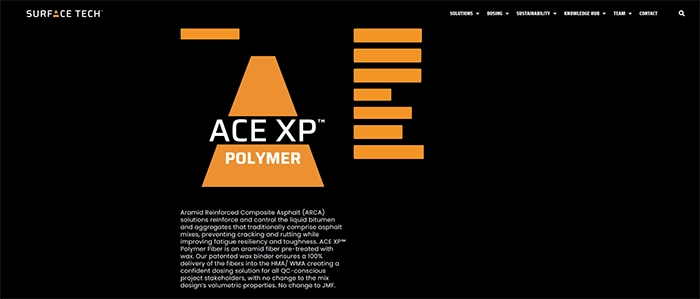
Surface Tech specializes in high-performance road-mix additives designed to increase pavement strength and durability. It has built a reputation by applying high-performance materials traditionally used in aerospace and protective equipment to transportation infrastructure. The company’s flagship technology uses aramid fibers the same material used in ballistic protective equipment.
The ACE XP™ fiber system introduces chopped aramid fibers into asphalt mixtures for a low-carbon alternative. These fibers distribute throughout the material, creating a network with increased tensile strength. The optimized flexibility helps pavement resist crack propagation from heavy traffic loading and environmental stress. By reinforcing the internal structure rather than modifying the binder chemistry, the technology stabilizes aggregates, limiting movement.
Aramid fibers have a high strength-to-weight ratio and resistance to deformation. In mixtures, they act like micro-reinforcement strands that support the aggregate structure and prevent internal shifting.
Key Features
- Unique product: ACE XP™ fiber aramid strengthening
- Material technology: Aramid fiber additive
- Innovative technology model: High-tensile micro-reinforcement network
- Product lifespan: Designed to extend durability in high-load applications
- Company perspective: “We fiercely adhere to the fundamentals of sound design and engineering. We live, eat and breathe the challenges our customers face every day.”
5. Highly Modified Asphalt Binder – Kraton Corporation
Kraton Corporation develops polymers used extensively in the production of chemically modified asphalt for engineering sectors. The company’s styrenic block copolymers serve as a foundational ingredient in many high-performance bituminous binders, boosting mechanical performance and thermal resilience.
Styrenic block copolymers enable the production of highly modified asphalt, offering exceptional elasticity and durability. Specialized binders stretch under load rather than cracking, allowing applications to tolerate repeated traffic stress. The result is an adaptive binder that features improved elasticity, recovery and resistance to deformation, which reduces cracking and rutting in roads. The surface behaves more like a flexible membrane than a brittle layer.
Kraton’s core contribution to road engineering lies in its styrenic block copolymer (SBC) technologies, which form the flexible network within the binder. The elastic recovery equates to longer road life and reduced maintenance costs.
Key Features
- Unique product: Styrenic block copolymer systems
- Material technology: Polymer-modified asphalt binder formulation
- Innovative technology model: Elastic binder with high recovery after load deformation
- Product lifespan: Extended durability in high-stress environments
- Company perspective: “Kraton, a sustainable chemical manufacturer, innovates, produces, and markets specialty polymer and biobased chemicals that deliver exceptional value with innovative and sustainable solutions that differentiate our customers’ products and enhance lives worldwide through a diverse range of end-use markets.”
Comparing the Best Materials Providers
Engineers often compare asphalt and concrete when choosing pavement materials. Bituminous surfaces offer flexibility, faster installation and easier maintenance, while concrete provides high compressive strength. Flexibility allows it to absorb loads more effectively, but reinforcement additives are often necessary in high-traffic applications.
Industry professionals can compare leading materials providers offering asphalt reinforcement solutions.
| Company | Primary Technology | Key Benefit | Best For |
| FORTA | Synthetic fibers | 3D mechanical structure | Overall surface improvement, resisting rutting and cracking |
| BASF | Chemical binder modifier | Binder stabilization | Improving rutting resistance in major highways |
| DuPont | Polymer additive | Elastic network formation | Flexible surfaces in extreme climates |
| Surface Tech | Aramid fiber reinforcement | High tensile strength | Crack-resistant structures |
| Kraton Corporation | Styrenic block copolymer additives | Enhanced elasticity | High-demand systems |
Methodology for Selecting Top Asphalt Material Providers
Selecting the best materials to extend pavement lifespan requires evaluating several technical factors. The top five materials were chosen based on engineering performance, industry adoption and documented results in high-traffic infrastructure projects. Key evaluation criteria include:
- Proven performance: Field studies, engineering reports and long-term monitoring evidence
- Reinforcement mechanism: Scientific method, per additive, to improve asphalt durability
- Industry reputation: Manufacturer credibility, product testing history and adoption within sectors
- Application versatility: Highways, commercial parking areas, intersections
Material Choices and Challenges of Commercial Asphalt
Engineering fosters resilience technologies designed to address longevity and durability challenges. Additives such as fibers, polymers and chemical modifiers strengthen bituminous mixtures internally, improving strength and structural stability under repeated loading cycles. Consider the following when working with commercial asphalt.
Choose the Right Mix
Traditional hot-mix asphalt relied primarily on aggregates and bitumen binders. Today’s pavement mixtures incorporate advanced additives that improve structural integrity, temperature tolerance and resistance to repeated weight loading. Knowing which to add comes down to the intended use.
| Material Category | What It Is | How It Functions | Typical Use in High-Traffic Areas |
| Additives | A broad category of materials blended into asphalt mixes to modify performance characteristics. | Additives adjust properties such as workability, adhesion, moisture resistance or compaction behavior. They influence how the binder interacts with aggregate and how the mix performs during production and placement. | Used when engineers need to optimize mixing, compaction or durability characteristics without fundamentally altering binder chemistry. |
| Binders | The bituminous component that coats and holds aggregate together in mixtures. | Binders create cohesion within the structure and transfer loads between aggregates. Modified binders may improve stiffness, elasticity or temperature tolerance, depending on formulation. | Selected based on climate conditions, expected traffic loading and performance grade requirements. |
| Fibers | Discrete strands are mixed throughout the blend. | Fibers create a distributed network that stabilizes aggregate structure and limits crack propagation, deformation and rutting under repeated loading. | Often used in heavy-traffic systems where structural and crack resistance are critical. |
| Polymers | Synthetic compounds are blended into binders to alter the mechanical behavior of the resulting material. | Polymers increase elasticity, recovery and deformation resistance, allowing the surface to flex under load while maintaining structural cohesion. | Common in polymer-modified asphalt for highways, intersections and infrastructure exposed to significant traffic stress. |
Understand Pavement Limitations
Pavement faces challenges, which is why adding and modifying the composition can become a technical requirement for reliable applications to meet quality inspections. Some of the challenges include:
- Thermal changes: In colder regions, it may experience brittle cracking at subzero Binders may soften in extremely hot environments, leading to rutting under pressure.
- Load bearing: Traffic volume is another major factor. High-load areas such as freight routes or airport taxiways experience repeated stress from vehicles weighing several tons. Without reinforcement, road surfaces gradually deform under this weight.
- Material shortage: With natural resources at a premium, manufacturers may resort to recycling, using reclaimed asphalt pavement (RAP) to produce new materials. Asphalt is highly recycled, and RAP makes up around half of new mixtures used for roads.
Make the Most of Recycling
Recycling creates an opportunity to integrate materials during mixing. Fibers, polymers and chemical modifiers can enhance the final material, restoring mechanical properties lost during asphalt’s aging process. It is also a sustainable way to improve traditional bitumen-binder mixes, enhancing longevity and durability.
Recent studies highlight the growing importance of material innovation in durability, with variable mixes of RAP, minerals and binders accounting for better performance. Advanced technologies now represent a key strategy for extending roadway service life and reducing life cycle maintenance costs.
Proper Installation and Material Synergy
Even the best materials require proper engineering design and installation practices. Durability depends on several factors, including aggregate quality, mix design, compaction procedures and site preparation. Reinforcement materials should complement these fundamentals rather than replace them. Engineers typically integrate additives into the mixing process to ensure uniform distribution and consistent performance.
Routine maintenance also impacts the preservation of reinforced pavement systems. Contractors must consider upkeep, including crack sealing, surface inspections and preventive maintenance. When construction teams combine quality materials with strong installation practices, systems achieve significantly longer service life and reduced maintenance cycles.
The Future of Asphalt
Research into pavement materials continues to expand as transportation infrastructure comes under increasing pressure. Engineers are exploring a range of technologies that could further improve the performance of road materials and transform transport networks into more efficient systems.
Smart systems now incorporate embedded sensors capable of monitoring structural stress and temperature changes in real time. These sensors can provide early warning signs of potential structural damage and improve maintenance schedules.
Other research focuses on environmentally sustainable materials. Recycled microplastics show promise with thermal properties and may reduce environmental impact while maintaining durability. Photoluminescent technology also represents an emerging innovation. Experimental road surfaces that glow at night may improve visibility and driver safety without requiring additional illumination. Together, these developments demonstrate how material science continues to transform civil projects.
Frequently Asked Questions
Find answers to common questions about asphalt and additives.
Q: How do materials improve asphalt quality in high-traffic areas?
A: Reinforced materials strengthen mixtures internally. Fiber systems create a structural matrix that bonds aggregates together to prevent cracking. Polymer modifiers enhance binders, allowing pavement to flex under heavy loads without breaking or deforming.
Q: Are these additives a substitute for proper asphalt thickness?
A: No. While additives enhance the performance of asphalt mixtures, they do not replace structural design requirements. Engineers must still install layers based on expected traffic loads, climate conditions and subgrade stability.
Q: Can these materials be used for road repair?
A: Most material choices work best when incorporated into asphalt during production. Contractors can use specialized patching mixtures containing additives, but the greatest performance benefits occur when reinforcement technologies are incorporated into new pavement construction.
Best Materials to Improve the Lifespan of Asphalt in High-Traffic Areas
Improving pavement durability in high-traffic environments requires more than standard mixes. Reinforcement materials such as fibers, polymer modifiers and advanced binder technologies strengthen the internal structure of asphalt and improve resistance to rutting, cracking and deformation, extending the serviceable life of road surfaces. The right material choices help engineers deliver long-lasting roadways and reduce long-term maintenance demands.