































Key Takeaways
- Takt time planning aligns construction workflow rhythms with demand, eliminating overproduction and streamlining labor flow
- Lean construction principles reduce waste by up to 40%, improving project profitability and timeline predictability
- Assembly line sequencing of construction trades prevents waiting, rework, and disruption inherent in traditional site management
- Continuous improvement methodologies systematically identify and eliminate bottlenecks across construction processes
- Manufacturing-based scheduling compresses timelines by 30-40% through optimized sequencing and resource allocation
- Construction productivity growth accelerates when industrial manufacturing discipline replaces traditional ad-hoc site management
For over a century, construction has remained stubbornly resistant to productivity improvements that transformed manufacturing. Manufacturing industries embraced assembly line principles, process optimization, and systematic efficiency improvements. Productivity in manufacturing doubled since 2005. Over the same period, construction productivity remained essentially flat. This disparity reflects a fundamental difference in approach—manufacturing applies systematic, repeatable processes while construction traditionally treats each project as a unique undertaking requiring custom solutions and ad-hoc management.
The emergence of industrial manufacturing principles in construction represents a paradigm shift with profound implications for productivity, profitability, and project delivery reliability. Rather than managing construction as a complex coordination problem where multiple trades sequence work reactively based on current conditions, industrial principles reorganize construction around production systems where work flows predictably, trades operate rhythmically, and bottlenecks are systematically eliminated. Organizations implementing these approaches report productivity improvements of 30-40%, timeline compression exceeding expectations, and profitability enhancements that provide competitive advantage.
The Productivity Crisis in Construction
The construction industry faces a productivity crisis that threatens its viability. While manufacturing productivity nearly doubled over two decades, construction productivity stagnated. This represents not just an efficiency problem but an existential challenge as construction costs escalate while labor becomes increasingly scarce.
The root causes reflect fundamental differences between construction and manufacturing. Manufacturing operates under standardized conditions where processes repeat thousands of times, enabling optimization impossible with one-off productions. Manufacturing facilities control their environment, eliminating weather and site variability that complicate construction. Manufacturing sequences work following optimized schedules rather than adapting reactively to site conditions.
Construction has historically accepted inefficiency as inherent. Weather delays were inevitable. Site coordination complexity was unavoidable. Labor waiting and downtime were normal. These assumptions, while reflecting historical reality, increasingly become problematic as construction demand accelerates and labor becomes scarce. The industry must embrace productivity improvements matching those achieved in manufacturing.
Takt Time Planning: The Rhythm of Production
Takt time—a manufacturing concept derived from German word meaning “pulse” or “beat”—represents one of the most powerful productivity tools applicable to construction. In manufacturing, takt time establishes the rate at which products must complete to meet customer demand. A factory producing 10,000 units weekly during a 50-hour work week must produce one unit every 1.8 seconds. Takt time becomes the heartbeat synchronizing the entire operation.
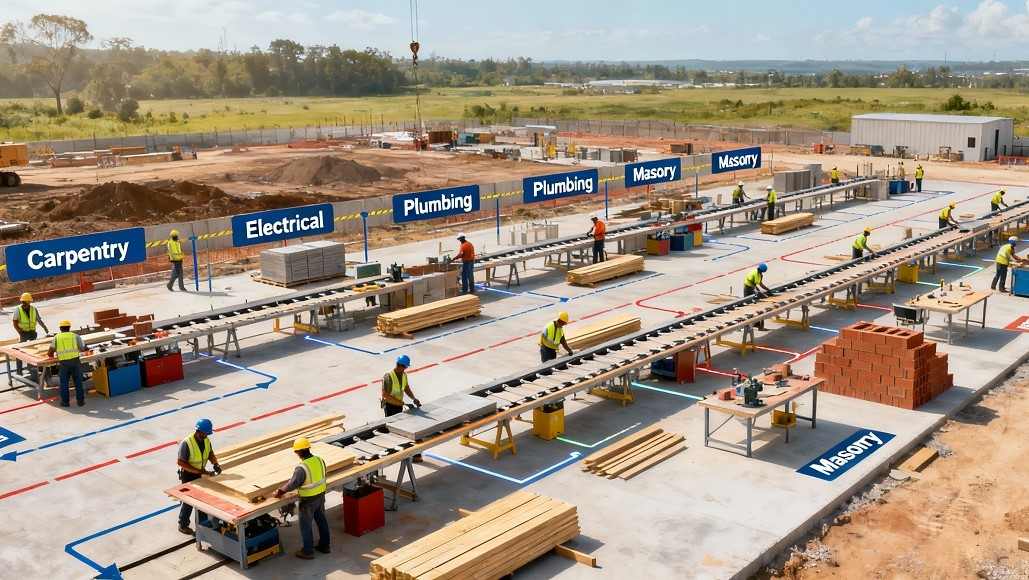
Construction applies takt time similarly, establishing the rhythm at which work must progress through defined zones to complete projects on schedule. Rather than allowing trades to work at individual paces creating congestion and waiting, takt time establishes a consistent beat. Carpentry crews move through construction zones at predetermined intervals, completing defined work in standardized timeframes. Following carpentry, electrical crews flow through zones on the same takt beat, completing their work as carpenters leave.
This systematization eliminates the chaos inherent in traditional construction management. Rather than carpenters waiting for plumbing to finish, or electrical trades standing idle until mechanical work completes, takt time ensures sequential flow where each trade enters zones at precisely the right moment, completes defined work, then exits for the next trade. No waiting. No rework due to trade interference. No bottlenecks stalling progress.
The benefits prove dramatic. Traditional construction projects where trades sequence reactively might progress at average rates of 20-30% productivity, with workers waiting 50-60% of time due to trade congestion. Takt-driven construction approaches achieve 70-80% productivity, with workers engaged productively most of the time. This translates to faster project delivery, lower labor costs per unit of work, and more predictable scheduling.
Implementing takt time requires discipline. Project planners must analyze work content and identify cycle times for different construction activities. They must establish a consistent takt beat that’s achievable with available resources. They must design zones or areas where trades execute defined work during each takt cycle. Finally, they must manage the plan rigorously, addressing delays through recovery planning that maintains takt integrity rather than allowing schedule slippage.
Lean Construction and Systematic Waste Elimination
Lean manufacturing principles, developed at Toyota, focus on eliminating seven forms of waste: defects, overproduction, waiting, non-utilized talent, transportation, inventory, and motion. These principles apply equally to construction, where similar waste patterns undermine productivity.
Lean construction systematically identifies and eliminates these wastes. Defect prevention through quality planning and control eliminates rework that wastes labor hours and extends timelines. Preventing overproduction—the waste of doing work before it’s required, creating storage and coordination problems—through pull systems that sequence work based on actual progress rather than optimistic schedules. Eliminating waiting through takt planning and trade flow optimization.
Non-utilized talent represents significant waste in construction. Workers possess skills and capability that project management often fails to leverage. Lean approaches involve workers in planning, empowering them to identify bottlenecks and propose solutions. This engagement improves decision quality while increasing worker ownership of results.
Transportation waste in construction includes unnecessary material movement, inefficient supply chain logistics, and traffic patterns within sites. Lean approaches optimize material staging, reduce unnecessary handling, and organize site layouts to minimize movement.
Motion waste encompasses inefficient work methods, unnecessary reaching or walking within work zones, and poorly designed work sequences. Systematic analysis identifies motion waste and redesigns work processes to eliminate unnecessary movements.
Inventory waste in construction reflects excess materials on site, creating storage costs, damage risks, and coordination problems. Just-in-time material delivery, coordinated with takt time planning, eliminates excess inventory while ensuring materials arrive precisely when needed.
Construction productivity research indicates that reducing these seven waste forms can improve overall productivity 30-40%. The math is compelling: if construction sites operate at 30-40% productivity (as research suggests), reducing waste to improve productivity to 50-60% represents productivity improvements of 25-50%.
Assembly Line Sequencing and Trade Flow Optimization
Traditional construction management sequences trades reactively based on site conditions and availability. Plumbing completes when able. Electrical starts when plumbing finishes. Mechanical begins when space becomes available. This reactive sequencing creates inevitable congestion as trades interfere with each other, causing delays and rework.
Assembly line principles reorganize construction around predetermined sequences ensuring smooth trade flow. Rather than reacting to conditions, trades follow established patterns where each trade completes defined zones in specified timeframes, then moves to the next zone while subsequent trades enter behind them.
This approach requires detailed planning. Project managers must decompose the project into zones or sections where meaningful work occurs in standardized timeframes. They must sequence trades to minimize interference and waiting. They must identify critical path activities that constrain overall progress and focus management attention on preventing delays to these critical activities.
The results prove remarkable. Construction projects implementing assembly line sequencing achieve consistent daily progress with minimal variability. Projects that might traditionally extend 18 months compress to 12 months or less. Labor productivity improves as workers spend less time waiting and more time working productively. Quality improves as repetitive work enables process refinement and standardization.
Continuous Improvement and Systematic Optimization
Manufacturing facilities operating under lean principles implement continuous improvement programs where workers systematically identify process inefficiencies and implement improvements. These small improvements accumulate into major productivity enhancements.
Construction rarely embraces systematic continuous improvement. Projects complete, teams disperse, and organizations rarely capture learning for subsequent projects. Even within single projects, inefficient work methods persist when discovered rather than being systematically corrected.
Industrial manufacturing principles applied to construction establish continuous improvement cultures where teams identify inefficiencies, implement corrections, and measure results. Daily crew briefings provide forums for surfacing problems and implementing rapid solutions. Project postmortems capture lessons for future applications. Systematic measurement tracks productivity metrics, enabling teams to identify trends and root causes of poor performance.
The compounding effect proves powerful. A construction company implementing continuous improvement might achieve 2-3% productivity improvement annually as small enhancements accumulate. Over a decade, this compounds into 20-30% overall improvement—the difference between profitability and struggling with margins.
Production Scheduling and Resource Optimization
Traditional construction scheduling typically produces critical path schedules identifying constraint activities that determine project duration. However, critical path methods often ignore resource constraints, assuming adequate labor and equipment will be available when needed.
Manufacturing production scheduling addresses both time and resource constraints simultaneously. Planners identify available labor capacity, equipment availability, and material supply constraints. They schedule work recognizing these constraints rather than assuming they’ll be available when needed.
Construction applying manufacturing scheduling discipline develops resource-leveled schedules that work within actual labor and equipment availability rather than optimistic assumptions. This often compresses timelines by revealing that traditional schedules are impossible given actual constraints. Realistic scheduling that acknowledges constraints enables accurate project planning and reduces the delays that plague traditional construction.
Implementation Frameworks for Industrial Principles
Successfully applying industrial manufacturing principles to construction requires systematic implementation. Organizations should begin by establishing current performance baselines, identifying the productivity metrics they’ll track to demonstrate improvement. These might include output per worker hour, schedule variance percentage, quality metrics, or safety performance.
Next, organizations should select specific projects as test cases for industrial principle implementation. Full company transformation is ambitious and risky. Pilot projects allow experimenting with new approaches, learning what works in specific contexts, and building confidence in results before broader application.
Implementation typically begins with takt planning and trade flow optimization. These require detailed project planning and management discipline but deliver rapid results. Early success builds momentum and organizational commitment to broader lean principles.
Gradually, organizations expand to comprehensive lean implementation including systematic waste elimination, continuous improvement programs, and resource optimization. This evolution typically occurs over 2-3 years as organizations build capability and culture change.
Competitive Advantage Through Industrial Discipline
Organizations systematically applying industrial manufacturing principles to construction build competitive advantages rivals struggle to match. Superior productivity enables lower costs while maintaining profitability. Faster timelines enable higher project throughput with existing resources. Better quality reduces warranty costs and client dissatisfaction. More reliable schedules strengthen client relationships and reputation.
These advantages compound over time. Superior financial results enable investment in employee training and development, strengthening capabilities further. Reputation attracts better projects and clients willing to pay premiums for reliable delivery. Organizational culture emphasizing continuous improvement creates learning organizations that systematically outperform competitors.
The construction industry stands at a crossroads. Organizations continuing traditional approaches face increasingly difficult competitive situations as labor becomes scarce and clients demand faster delivery at lower costs. Organizations embracing industrial manufacturing principles position themselves to thrive in the evolving construction landscape. The future belongs to construction companies thinking like manufacturers, applying proven productivity principles to an industry desperately needing transformation.