




























Key Takeaways
- Real-time monitoring systems provide continuous temperature and stress data throughout the concrete curing process, eliminating guesswork about strength development and enabling informed construction decisions.
- Embedded sensor networks with high-precision temperature measurement allow contractors to optimize formwork removal timing, reducing project delays and ensuring structures achieve required strength before being subjected to loads.
- Wireless IoT technology streamlines data collection and analysis, converting complex thermal and hydration information into actionable insights that support predictive maintenance and long-term structural performance assessment.
- Integration of maturity-based strength estimation methods with real-time temperature data enables early identification of anomalies in the curing process, preventing costly quality issues before they manifest.
Introduction to Real-Time Concrete Monitoring
The construction industry has long struggled with the challenge of determining when concrete reaches adequate strength for next-phase construction activities. Traditional approaches relied on standard curing timelines and periodic destructive testing, methods that offered limited visibility into actual in-situ conditions and often led to either premature loading or unnecessary construction delays. Real-time monitoring technologies have fundamentally changed this landscape by enabling continuous observation of concrete behavior during the critical curing period.
Real-time concrete monitoring technology represents a paradigm shift in how engineers approach quality assurance and structural integrity verification. Rather than waiting for laboratory results from test cylinders or relying on calendar days, construction teams can now access minute-by-minute data reflecting the actual thermal and strength development of placed concrete. This technological advancement addresses one of construction’s most persistent challenges: balancing the need for rapid project progression with the absolute requirement for proper concrete maturation.
The Foundation: Understanding Concrete Strength Development
Concrete strength development is fundamentally a function of the hydration process the chemical reaction between cement, water, and aggregates. This hydration process is highly temperature-dependent, meaning that environmental conditions significantly influence how quickly concrete gains strength. In traditional construction, engineers would make assumptions about these conditions based on average weather patterns, often leading to either conservative estimates that delayed project timelines or optimistic projections that risked structural inadequacy.
The hydration of cementitious materials generates heat, creating an internal temperature rise distinct from ambient conditions. In mass concrete applications, this heat of hydration can create substantial temperature differentials between the concrete’s interior and its surface. Understanding these temperature profiles is critical because the rate of strength gain correlates directly with the cumulative thermal history the concrete experiences. Real-time monitoring technologies capture this thermal story in granular detail, providing engineers with the information needed to make precise, data-driven decisions about construction progression.
Core Components of Modern Monitoring Systems
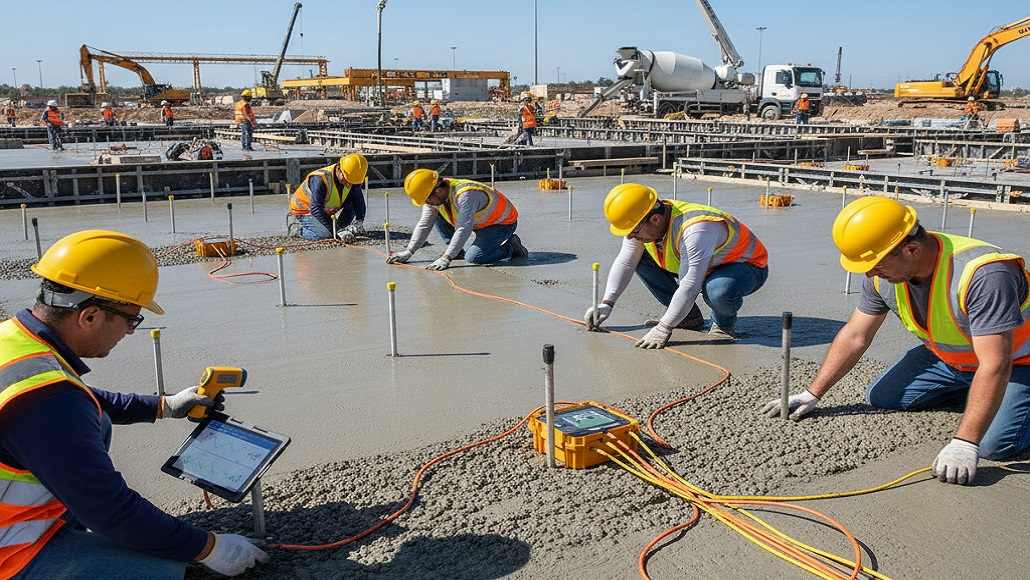
Contemporary real-time monitoring infrastructure comprises several integrated technologies working in concert to provide comprehensive structural insight. These systems begin with embedded temperature sensors high-precision devices capable of measuring thermal conditions from the moment concrete is placed through the entire curing period. Modern sensors offer accuracy within fractions of a degree and can be distributed at multiple depths and locations to create a three-dimensional temperature profile of the placed concrete.
The sensor network connects to data acquisition hardware that continuously records temperature readings at user-defined intervals, typically every fifteen to thirty minutes. Rather than requiring manual observation or physical presence at the construction site, wireless communication capabilities enable remote data transmission. Engineers and project managers can access real-time information through dedicated software platforms, monitoring concrete performance from offices or remote project locations. This democratization of access ensures that construction decisions benefit from current data rather than assumptions about typical conditions.
Beyond temperature sensors, advanced systems incorporate additional monitoring parameters that provide more complete understanding of concrete behavior. Strain sensors measure the mechanical response of concrete as it develops strength and responds to environmental conditions. Accelerometers detect vibration responses that can indicate structural performance characteristics. When integrated together, these multiple data streams create a holistic picture of concrete development that goes far beyond simple temperature measurement.
Integration with Strength Prediction Methodologies
The true power of real-time monitoring emerges when sensor data connects with established strength prediction methodologies. The maturity method, standardized in ASTM C1074, represents the most widely adopted approach for converting temperature history into strength estimates. The method recognizes that concrete strength development depends on both time and temperature according to well-established mathematical relationships. Two primary maturity functions the Nurse-Saul model and the Arrhenius equation enable engineers to predict in-place strength with sufficient accuracy for construction decision-making.
When implementing maturity-based strength prediction, engineers must first establish a maturity-strength curve specific to the concrete mix being used. This calibration occurs in the laboratory, where concrete cylinders equipped with embedded temperature sensors cure under monitored conditions. As the cylinders cure, their strength is tested at specific intervals typically at one, three, seven, fourteen, and twenty-eight days and simultaneously, the thermal history of each sample is recorded. This data establishes the mathematical relationship between cumulative temperature exposure and concrete strength for that particular mix design.
During actual construction, embedded sensors in the placed concrete continuously record temperature data. Software systems apply the previously established maturity-strength curve to this real-time temperature history, producing ongoing estimates of in-place strength development. These estimates allow formwork to be removed precisely when concrete reaches the required strength, not when a calendar says it should be ready. The practical implications are substantial: premature formwork removal risks structural damage, while excessive retention delays subsequent construction phases and increases project costs.
Real-Time Advantages in Quality Control
Traditional quality control approaches for concrete construction typically rely on destructive testing of cored samples or strength testing of companion cylinders. These methods provide reliable results but offer inherent limitations they destroy portions of the structure to test strength, they provide only snapshots at specific moments rather than continuous data, and they cannot identify localized anomalies that might exist in particular sections of a concrete placement.
Real-time monitoring transforms quality control by enabling continuous, non-destructive assessment across the entire structure. If temperature monitoring reveals that a particular section of the concrete placement is developing significantly more slowly than expected, engineers can investigate potential causes inadequate concrete consolidation, poor ambient conditions, or material quality issues before these problems lead to structural inadequacy. Early detection of anomalies enables immediate corrective action rather than discovering problems after concrete has fully cured and become part of the structure.
The comprehensive nature of real-time data also enables identification of curing problems that might not appear in standard quality control procedures. For instance, if concrete in one area consistently maintains lower temperatures than adjacent sections, this pattern suggests either inadequate insulation, poor placement technique, or environmental conditions that require attention. The specificity of this information allows targeted quality improvements rather than broad-based modifications that might affect the entire project.
Optimization of Construction Scheduling
One of the most immediately valuable applications of real-time concrete monitoring is optimization of construction schedules. In any major construction project, concrete curing time represents a critical path activity. Delays in concrete development delay subsequent activities formwork removal, structural loading, floor placement, and building progression. Even single-day delays in concrete curing can cascade through project timelines, extending overall duration and increasing costs substantially.
By providing accurate, real-time strength data, monitoring systems enable just-in-time formwork removal and load application. Rather than waiting for a standard curing period that might vary from actual conditions by days or weeks, construction teams can proceed to the next phase precisely when structural conditions permit. This precision scheduling maintains project momentum while ensuring structural safety. In projects with multiple concrete placements on compressed schedules, the cumulative impact of optimization across numerous curing cycles can reduce overall project duration by meaningful percentages.
Different construction scenarios benefit differently from real-time monitoring optimization. In cold weather construction, heating or insulation strategies can be validated through real-time temperature data, ensuring that concrete develops adequately despite challenging environmental conditions. In warm weather, monitoring can confirm that concrete is not curing too rapidly, which might compromise long-term strength and durability. Mass concrete applications large foundations, thick walls, or substantial structural elements benefit particularly from real-time monitoring because their significant thermal mass creates complex curing patterns that cannot be accurately predicted without detailed temperature measurement.
Early Detection and Problem Prevention
Perhaps the most critical function of real-time monitoring is enabling early detection of developing problems before they become structural issues. Temperature monitoring reveals when concrete development is progressing abnormally, providing opportunity for investigation and remediation. If embedded sensors indicate that concrete is not developing expected strength despite adequate time passage, engineers can drill cores for laboratory testing to verify actual strength, investigate potential mix design problems, or assess whether placement or consolidation issues have compromised the concrete quality.
This early detection capability extends to environmental challenges that affect concrete durability. Real-time monitoring can identify when concrete is experiencing temperature differentials that might lead to thermal cracking a problem particularly relevant in mass concrete and cold-weather construction. By recognizing these patterns early, engineers can adjust curing strategies to minimize stress development, preventing crack initiation rather than attempting to remediate cracking after the fact.
The data collected through real-time monitoring also builds institutional knowledge for future projects. By recording detailed thermal and strength development histories for each concrete placement, construction organizations develop increasingly sophisticated understanding of how their materials and methods perform under various conditions. This experiential knowledge, accumulated across multiple projects and seasons, enables progressively better predictions and more informed decision-making on subsequent construction efforts.
Implications for Long-Term Structural Performance
The benefits of real-time monitoring extend far beyond the curing period. By ensuring that concrete properly develops and is not subjected to loading or stress before adequate strength exists, real-time monitoring supports superior long-term structural performance. Premature loading or stress application can damage concrete at the microscopic level, creating internal stresses and potential cracking that reduce structural capacity and durability. By guaranteeing that concrete reaches required strength before such stresses are applied, real-time monitoring prevents this preventable degradation.
Furthermore, data accumulated through continuous real-time monitoring provides a valuable baseline for ongoing structural health assessment throughout the building’s service life. Long-term monitoring systems can reference the curing-phase data collected through real-time monitoring systems, enabling better understanding of how the structure evolves over time. Structures with well-documented strength development histories offer engineers better information for assessing performance, planning maintenance, and predicting remaining service life.
The comprehensive nature of real-time monitoring data also supports validation of design assumptions and material specifications. By confirming that concrete actually develops strength at the rate designers anticipated, engineers gain validation that design approaches are sound. When actual performance diverges from predictions, the detailed data enables root cause analysis and methodology refinement. This continuous learning cycle elevates construction quality and design accuracy across the industry.
Implementation Considerations and Best Practices
Effective implementation of real-time monitoring requires careful attention to several technical and procedural considerations. Sensor placement is critical sensors must be positioned to capture representative temperature profiles at locations that are structurally or environmentally critical. For thick concrete sections, sensors typically extend from the center through to the surface, capturing the temperature gradient that develops during hydration. For structures exposed to extreme environmental conditions, sensors in the most exposed areas provide the most relevant data for strength prediction.
Sensor installation must occur with sufficient care to ensure reliable long-term performance. Sensors require secure mounting to prevent movement during concrete placement and vibration, which could affect accuracy of readings. Cable routing must protect sensors from damage during concrete consolidation. When using wireless systems, signal strength and transmission reliability must be verified before relying on data collection. These seemingly mundane implementation details prove critical to obtaining accurate, reliable data that supports confident construction decisions.
Calibration of the maturity-strength relationship is essential for accurate strength prediction. Organizations using real-time monitoring should develop mix design-specific calibration curves through controlled laboratory testing. Generic or assumed relationships might provide reasonable estimates but lack the specificity required for truly optimized construction progression. Some organizations invest in establishing calibration curves for multiple concrete mix designs commonly used in their construction programs, building a library of relationships that supports efficient implementation across diverse project types.
Staff training ensures that real-time monitoring data translates into appropriate construction decisions. Engineers and project managers must understand the capabilities and limitations of the monitoring systems being used, the validity of strength predictions based on maturity methods, and the appropriate criteria for making decisions like formwork removal or load application timing. Overconfidence in monitoring data or misunderstanding its implications could lead to inappropriate decisions despite having excellent information.
Future Evolution of Monitoring Technology
Real-time monitoring technology continues to advance in capability and sophistication. Emerging applications include direct electrical measurement of concrete hydration, fiber optic sensors that provide both temperature and strain data with exceptional spatial resolution, and artificial intelligence algorithms that analyze complex sensor data patterns to predict not only strength development but also long-term durability performance. These advanced approaches promise even more detailed structural insight and increasingly sophisticated decision support.
Integration of real-time monitoring with Building Information Modeling and digital construction management systems is creating seamlessly connected information environments. Rather than collecting monitoring data separately from project management systems, integrated platforms combine real-time structural information with scheduling, cost tracking, and resource management data. This integration enables more sophisticated optimization that considers structural readiness alongside project resource availability and downstream activity requirements.
