






















Key Takeaways
- Lifecycle cost analysis reveals that sustainable upfront investments deliver significant long-term financial benefits
- Material selection emphasizing durability and low maintenance reduces lifecycle costs and environmental impact
- Energy-efficient design integrated during planning phases reduces operational costs over decades
- Designing for material recovery and reuse at end-of-life aligns construction with circular economy principles
- Comprehensive lifecycle thinking prevents short-sighted decisions that create expensive maintenance burdens later
Modern construction traditionally emphasizes upfront costs and completion timelines, with decisions focused on delivering projects rapidly and cost-effectively. However, this narrow perspective creates substantial hidden costs that emerge during operational decades when building systems deteriorate, maintenance expenses escalate, and inefficient operation wastes resources unnecessarily. Sustainable infrastructure development demands a fundamentally different approach one that extends decision-making horizons to encompass the complete lifecycle spanning initial design through decades of operation and eventual decommissioning. This expanded perspective reveals that apparently expensive upfront investments often generate dramatic returns through reduced lifecycle costs and environmental impact, transforming how construction professionals approach their work.
Lifecycle thinking acknowledges that infrastructure investments create long-term obligations and consequences extending far beyond construction project timescales. A bridge designed for twenty-year design life deteriorates rapidly once that period ends, transitioning from minor maintenance into major rehabilitation or replacement. A building constructed with inferior envelope integrity experiences perpetual moisture problems and excessive heating and cooling costs throughout its operational life. Materials selected for lowest initial cost but poor durability require frequent replacement, consuming resources and generating waste. Conversely, infrastructure designed with comprehensive lifecycle considerations delivers superior long-term value and environmental performance.
Understanding Lifecycle Cost Analysis and Long-Term Value
Lifecycle cost analysis evaluates the total cost of infrastructure ownership from initial capital expenditure through decades of operation to final decommissioning. This comprehensive analysis includes initial construction costs, ongoing maintenance expenses, energy consumption costs, equipment replacement costs, labor for maintenance and operations, and eventual demolition or renovation costs. While initially constructed buildings obviously require upfront capital expenditure, the subsequent thirty to fifty years of operational costs often dwarf initial construction costs, sometimes exceeding them by multiples of three or five times.
Consider a building exterior wall system selected during initial design. An inexpensive wall assembly with minimal thermal performance requires substantial heating and cooling energy consumption throughout the building’s operational life. The cumulative cost of excess energy consumption over fifty years often exceeds the initial cost savings from selecting the cheaper exterior system. A more expensive wall assembly with superior thermal performance and durability reduces operational energy costs, eventually paying for itself through energy savings while also reducing the building’s environmental footprint.
This lifecycle perspective transforms procurement decisions from cost-minimization exercises into value optimization. Rather than asking “what is the lowest initial cost,” the relevant question becomes “what approach delivers the lowest total lifecycle cost?” Answering this question requires detailed analysis of operational characteristics, maintenance requirements, durability, and eventual end-of-life disposition. Professionals conducting lifecycle cost analysis reveal situations where initially expensive options become most economical when long-term consequences are evaluated comprehensively.
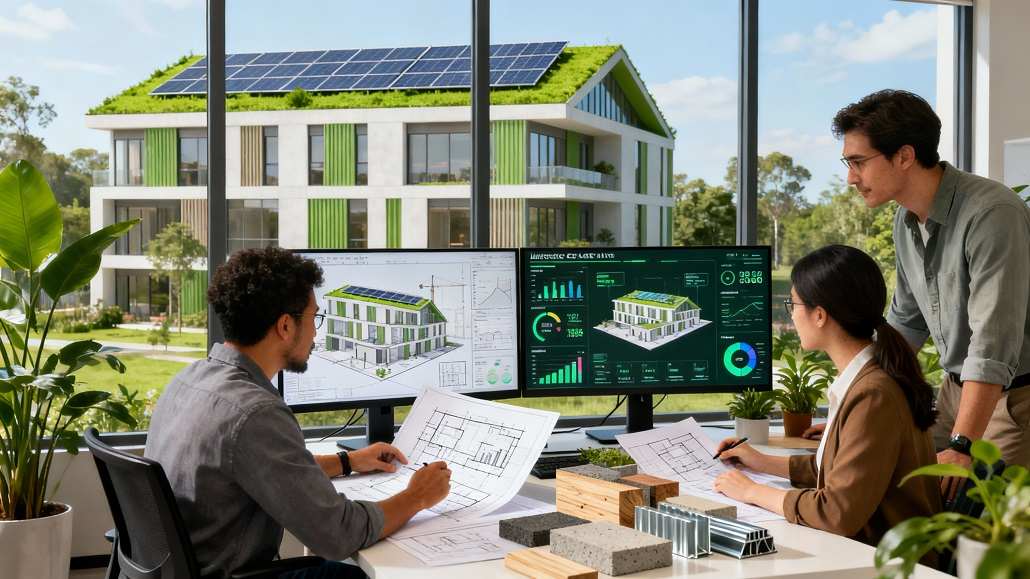
Building Information Modeling and lifecycle costing software enable detailed lifecycle cost analysis that previously required extensive manual effort. Digital models enable rapid evaluation of alternative design scenarios, calculating operational energy costs, maintenance requirements, and lifecycle expenses for each alternative. This analytical capability allows designers to compare competing approaches objectively rather than relying on assumptions or historical precedent.
Material Selection Emphasizing Durability and Sustainability
Sustainable infrastructure development depends on selecting materials that will perform reliably for the intended design life without excessive maintenance or premature failure. Durability represents a critical sustainability metric materials that persist in service for decades require replacement less frequently, reducing resource consumption and waste generation compared to materials requiring replacement every ten or fifteen years.
Low-carbon materials increasingly become available as building industry focuses on reducing embodied carbon the carbon emissions generated through material extraction, manufacturing, transportation, and installation. Supplementary cementitious materials replace portions of Portland cement in concrete, reducing carbon emissions by thirty to fifty percent while often improving concrete durability. Recycled aggregate sourced from demolition waste reduces virgin resource consumption while avoiding landfill disposal of demolition debris. Geopolymer concrete manufactured from industrial byproducts can reduce carbon emissions by eighty percent compared to conventional concrete.
Locally sourced materials reduce transportation emissions while supporting regional economies. A building constructed with materials sourced within a few hundred kilometers requires substantially less transportation energy compared to materials imported internationally. Additionally, local sourcing often creates opportunities to use regional materials that perform optimally in local climates materials developed through generations of local experience prove particularly well-suited to the environmental conditions they will encounter.
Recycled and reclaimed materials offer environmental and aesthetic benefits alongside cost advantages. Salvaged structural timbers from demolished buildings incorporate decades of aging that improves their properties compared to new timber. Reclaimed brick, stone, and architectural elements possess character impossible to replicate in new materials. Beyond aesthetics and performance, using reclaimed materials diverts waste from landfills while reducing virgin resource extraction.
Biodegradable and natural materials increasingly find applications in sustainable infrastructure. Cork insulation, wool fibers, natural latex, and other renewable materials offer environmental advantages compared to petroleum-derived synthetic alternatives. These materials typically can be recycled or composted at end-of-life rather than requiring disposal in landfills, aligning construction with circular economy principles.
Designing for Operational Efficiency and Minimal Maintenance
Energy efficiency design integrated from the beginning of the design process creates buildings that require less operational energy consumption. Passive design strategies emphasizing natural ventilation, daylighting, and thermal mass reduce reliance on mechanical systems. Orientation optimized for climate conditions minimizes heating and cooling requirements. Building envelopes with high thermal performance and low air leakage reduce energy consumption dramatically. Heat recovery systems capture energy that conventional buildings waste.
When properly designed, sustainable buildings achieve operational energy reductions of thirty to fifty percent compared to code-minimum alternatives. Over a fifty-year operational life, these savings accumulate to tremendous value millions of dollars of reduced energy expenses and proportionally reduced environmental impact. The initial cost premium for superior design typically represents only two to five percent additional capital cost, readily justified by the long-term operational savings.
Maintenance accessibility influences both maintenance costs and system longevity. Building systems designed with maintenance in mind with accessible filters, replaceable components, and clear service paths experience lower maintenance costs and longer service lives compared to systems difficult or impossible to service. A roof designed with accessible components that can be easily inspected, maintained, and replaced lasts longer and costs less to maintain than a roof where servicing requires substantial deconstruction.
Building envelope design that prevents water intrusion protects the interior from moisture damage that causes deterioration, mold growth, and occupant health problems. Rather than accepting building envelopes as perpetual sources of leakage requiring continuous patching, durable envelope design incorporates redundant protection layers and drainage systems that shed water rather than allowing it to accumulate. The initial design investment in robust envelope systems prevents years of water damage and maintenance.
Planning for Long-Term Maintenance and Adaptation
Sustainable infrastructure development requires planning for maintenance and adaptation needs extending across the design life. Rather than treating maintenance as an afterthought, professional building design explicitly addresses maintenance accessibility, spare part availability, and scheduled maintenance requirements. Building owners provided with comprehensive maintenance plans that clearly describe required tasks, optimal timing, and resource requirements can plan maintenance budgets and execute preventive maintenance that extends system lifespans.
Functional obsolescence where buildings become unsuitable for their intended use despite physical condition presents a challenge for sustainable infrastructure. Rather than accepting buildings as fixed-use facilities locked into original purposes, sustainable design incorporates adaptability enabling buildings to accommodate changing uses. Flexible interior spaces that can be reconfigured, robust structural systems accommodating substantial mechanical and electrical systems, and modular building components that can be readily replaced enable buildings to serve multiple purposes across decades.
Resilience design anticipates environmental challenges including climate change impacts. Buildings designed for the climatic conditions of decades past may prove inadequate for future conditions. Rather than designing for historical climate data, forward-thinking professionals incorporate margin for anticipated climate changes, designing cooling systems adequate for higher temperatures, drainage systems accommodating increased precipitation, and structural systems resistant to increased wind speeds.
Incorporating Circular Economy Principles
Sustainable infrastructure development increasingly embraces circular economy principles recognizing that the linear model of extraction, manufacturing, use, and disposal creates unsustainable resource consumption and waste. Circular economy approaches envision products returning to service multiple times rather than becoming waste after single-use periods.
Designing for material recovery and reuse at end-of-life represents a critical circular economy practice. Rather than designing buildings that are expensive and difficult to deconstruct when eventually demolished, buildings designed for deconstruction allow systematic separation of materials that can be recovered and reused. Structural systems that use mechanical connections rather than adhesives are easier to deconstruct. Materials selected for their ability to be recycled or composted rather than requiring disposal reduce end-of-life environmental impact.
Material passports detailed documentation of materials incorporated in buildings enable future recovery efforts by identifying what materials are present, where they are located, and how they can be recovered. As deconstruction technologies advance and material values increase, buildings documented with material passports become repositories of valuable materials readily recovered for reuse rather than waste.
Implementation Strategies and Organizational Commitment
Implementing lifecycle-focused construction practices requires organizational commitment extending beyond individual projects. Organizations that excel at sustainable infrastructure development train professionals in lifecycle thinking, incorporate lifecycle cost analysis into standard project evaluation procedures, and establish procurement criteria favoring durable, low-impact materials. They measure success not merely on project completion but on lifecycle performance metrics evaluated years after project completion.
Building owner education represents an important implementation lever. Owners who understand lifecycle value provide adequate resources for quality materials and design, support higher upfront investments generating long-term savings, and commit to professional maintenance extending system lifespans. Owners treating buildings as permanent assets worthy of long-term stewardship make decisions optimizing lifecycle value rather than minimizing immediate construction cost.
Policy and regulatory frameworks supporting sustainable infrastructure provide context encouraging lifecycle-focused practices. Building codes that establish durability standards and energy efficiency minima, green building standards that value lifecycle performance, and procurement policies favoring sustainable materials create market incentives encouraging providers to develop and offer sustainable alternatives.
The Imperative for Lifecycle Thinking
Infrastructure lives for decades after initial construction, affecting communities throughout that extended existence. Decisions made during design and construction phases establish trajectories that ripple through that operational life. Choosing durable materials prevents early replacement. Designing for energy efficiency reduces operational costs and environmental impact for decades. Planning for maintenance enables buildings to serve their communities reliably. Incorporating circular economy principles reduces end-of-life environmental impact.
Sustainable infrastructure development ultimately recognizes that construction professionals bear responsibility extending beyond project delivery to encompassing long-term consequences of their decisions. Through lifecycle-focused practices that optimize long-term value while minimizing environmental impact, construction professionals create assets that serve communities sustainably across generations, demonstrating that economic and environmental objectives reinforce rather than contradict one another.
