


























Key Takeaways
- Self-healing concrete uses bacteria or capsules to autonomously repair cracks, significantly extending structure lifespans
- 3D-printed concrete enables complex designs while minimizing material waste and compressing construction schedules
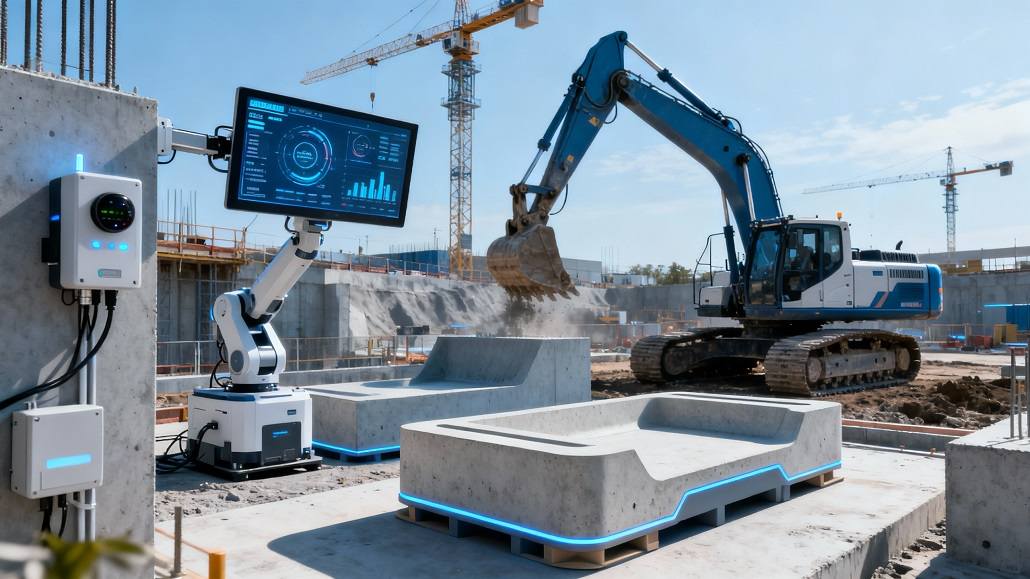
- Smart concrete with embedded sensors enables real-time structural monitoring and predictive maintenance
- Ultra-high-performance concrete delivers exceptional strength enabling lighter, more efficient structures
- Technology adoption success depends on workforce training, supply chain development, and practical implementation planning
The construction industry stands at the threshold of technological transformation as profound as the transition from manual labor to mechanized equipment that occurred throughout the twentieth century. Emerging technologies including self-healing materials, three-dimensional concrete printing, smart structures equipped with embedded sensors, and artificial intelligence-powered design optimization promise to fundamentally reshape how construction professionals design, build, and maintain structures. Understanding these emerging construction technologies, evaluating their practical implications, and developing adoption strategies enables forward-looking organizations to harness innovation’s benefits while navigating the inevitable challenges accompanying technological transformation.
The drivers of technological advancement in construction emerge from fundamental industry challenges that innovation promises to address. Labor shortages and escalating labor costs create pressure for construction automation reducing dependence on manual work. Environmental concerns drive development of low-carbon materials and construction processes. Quality and safety challenges inspire technologies providing better control and visibility. Schedule pressure motivates innovations compressing construction durations. These drivers converge to create favorable conditions for technological adoption among forward-thinking construction organizations willing to experiment with emerging approaches.
Self-Healing Concrete: Autonomous Durability Extension
Among emerging concrete construction technologies, self-healing concrete represents perhaps the most promising advancement in extending infrastructure longevity. Rather than accepting concrete as a material that inevitably cracks as loads and environmental stresses accumulate, self-healing concrete contains mechanisms enabling the material to repair micro-cracks autonomously when exposed to moisture.
Self-healing mechanisms employ two primary approaches. Bio-based methods incorporate dormant bacterial spores into the concrete matrix. When cracks form and water penetrates the previously sealed material, bacteria activate and consume calcium compounds within the concrete. As a byproduct of their metabolic processes, bacteria produce calcium carbonate precipitate that deposits in cracks, effectively sealing them. This biological process can continue for extended periods, with some research suggesting bacteria remain viable for decades within concrete, capable of multiple healing cycles.
Capsule-based self-healing embeds micro-capsules containing healing agents within the concrete. When cracks initiate stress relief that ruptures the capsules, healing agents are released into the crack space where they chemically react with concrete components or polymerize to seal the fissure. This approach provides faster healing compared to biological methods, though the number of healing cycles is limited by the quantity of encapsulated healing agent.
The implications of self-healing concrete extend far beyond simple crack repair. Structures employing self-healing concrete can extend service lives by decades compared to conventional concrete. The reduced need for expensive repairs diminishes maintenance burdens and costs throughout the structure’s lifetime. Environmental impact decreases because structures require less maintenance intervention and replacement. Structures in harsh environments coastal areas experiencing salt spray, structures exposed to freeze-thaw cycles, or corrosive industrial settings benefit particularly from self-healing capabilities that address the deterioration mechanisms inherent to those environments.
Currently, self-healing concrete remains primarily in research and limited commercial application phases. Scaling production to commercial volumes, developing cost-competitive formulations, and establishing performance standards and testing protocols represent necessary steps before widespread adoption. However, continued research investment and growing environmental consciousness suggest that self-healing concrete will progressively move toward practical construction application during coming years.
Three-Dimensional Concrete Printing: Enabling Design Freedom
Three-dimensional concrete printing represents another emerging construction technology with transformative potential. Rather than utilizing conventional formwork systems that constrain concrete geometry to rectangular, column-grid layouts, three-dimensional printing extrudes concrete in arbitrary geometries layer by layer, enabling architects to realize complex organic designs previously impossible or prohibitively expensive.
The practical implications of 3D-printed construction extend beyond aesthetic possibilities to include substantial economic and environmental benefits. Complex shapes can be optimized for structural efficiency, utilizing material only where required and eliminating unnecessary mass. Material waste decreases dramatically compared to conventional casting, where formwork constraints often force designs incorporating excess material. Construction speed accelerates because extrusion systems can operate continuously at high deposition rates, eliminating the delays associated with conventional forming, placing, finishing, and curing.
Current 3D-printed construction demonstrates promising capabilities for residential structures, bridges, and specialized facilities. Demonstrated projects show that printed concrete achieves strength and durability comparable to conventionally cast concrete. Equipment manufacturers are developing large-scale printing systems capable of printing major structural elements. As equipment capabilities mature and operator experience accumulates, 3D printing will enable construction approaches radically different from methods dominant for decades.
Implementation barriers include equipment capital costs that remain high relative to conventional forming systems, specialized operator training requirements, and the need to develop design methodologies optimized for printing constraints and capabilities. Additionally, building codes and industry standards must evolve to encompass 3D-printed concrete, establishing quality metrics and acceptance criteria. As these barriers progressively decrease, 3D-printed concrete will transition from experimental technology to practical construction methodology.
Smart Concrete with Integrated Sensing Systems
Smart concrete embedding sensors throughout the material matrix represents an emerging technology enabling real-time monitoring of structural behavior. These sensors track temperature, humidity, stress, and other parameters throughout a structure’s operational life, providing data that informs maintenance scheduling and enables early detection of developing problems.
The benefits of smart concrete extend across infrastructure lifecycle phases. During construction, sensors verify that concrete achieves design strength and that curing proceeds appropriately. During the operational phase, sensors provide continuous monitoring of structural condition without requiring visual inspection or testing. Data from sensors enables transition from preventive maintenance which performs work on fixed schedules regardless of actual condition to condition-based maintenance where work is performed only when sensor data indicates actual needs.
Current smart concrete implementations demonstrate feasibility, though widespread adoption faces challenges. Sensor cost, durability, and energy requirements remain barriers to pervasive monitoring throughout entire structures. Data management and interpretation requires sophisticated analysis capabilities currently beyond many practitioners’ expertise. Wireless communication between sensors and data collection systems requires reliable networks often unavailable in operational structures. As sensor technology matures and costs decrease, these barriers will progressively diminish.
Ultra-High-Performance Concrete and Advanced Material Composition
Ultra-high-performance concrete (UHPC) represents an emerging category of advanced materials delivering strength and durability far exceeding conventional concrete. UHPC achieves compressive strengths of 20,000 psi or higher through carefully engineered material composition incorporating steel fiber reinforcement, supplementary cementitious materials, and optimized water-cement ratios. This exceptional strength enables construction of elements far thinner and lighter than conventional concrete would permit.
The implications for emerging construction technologies include smaller, more efficient structural members enabling reduced material quantities and weight. In bridge construction, UHPC enables longer spans with thinner deck structures, reducing dead load and expanding bridge design possibilities. In high-rise buildings, UHPC allows use of thinner columns and walls, creating additional rentable floor area. The exceptional durability of UHPC, with research suggesting performance lives exceeding 100 years with minimal deterioration, provides long-term value justifying the cost premium of UHPC over conventional concrete.
Current limitations on UHPC adoption include higher material costs compared to conventional concrete and the specialized mixing, placing, and curing procedures required for optimal performance. As production scales and greater experience accumulates, costs will progressively decrease and procedures will become more standardized.
Nanotechnology and Carbon-Absorbing Innovations
Nanotechnology introduces materials at molecular scales that fundamentally alter concrete properties. Nanoparticles filling voids and enhancing bonding between concrete components increase compressive strength and reduce permeability. Self-healing properties emerge as nanotechnology enables novel material mechanisms. Enhanced durability results from nanotechnology’s ability to reduce water absorption and improve resistance to chemical attack.
Carbon-absorbing concrete represents another emerging technology addressing environmental concerns. Rather than treating concrete as an environmental problem due to cement production’s carbon emissions, carbon-absorbing innovations capture CO2 during concrete’s manufacturing and curing processes. Some approaches embed captured atmospheric carbon within the concrete matrix, permanently sequestering carbon while building structural material. Other approaches modify cement production to enable direct CO2 incorporation. While individual structures capture relatively modest carbon quantities, scaled deployment across building industries could contribute meaningfully to climate change mitigation.
Building Information Modeling and AI-Powered Optimization
Emerging technologies transforming concrete and structural construction extend beyond material innovations to encompass design and planning methodologies. Building Information Modeling enables comprehensive project representation capturing structural design, mechanical/electrical/plumbing systems, cost data, and schedule information within unified digital environments. This integrated model enables identification of design conflicts before construction, coordination of trade activities, and accurate material and labor requirement forecasting.
Artificial intelligence increasingly augments design professionals’ capabilities, analyzing massive quantities of data to optimize designs for structural efficiency, construction cost, and operational performance. Machine learning algorithms trained on historical project data can forecast costs with greater accuracy than traditional estimating methods. Generative design systems can explore millions of design alternatives, identifying solutions optimizing multiple competing objectives that human designers might never conceive.
Readiness Assessment and Adoption Strategies
Successfully adopting emerging construction technologies requires thoughtful evaluation of adoption readiness and strategic planning for implementation. Organizations beginning with pilot projects in controlled environments can develop expertise before deploying technologies on critical commercial projects. Starting with applications where emerging technologies offer clearest benefits such as self-healing concrete in harsh environments or 3D printing in situations where design complexity justifies the technology investment enables value capture while building organizational capability.
Workforce training and capability development represent critical adoption requirements. Technologies remaining primarily within specialized centers of excellence fail to deliver industry transformation. Broad workforce adoption requires training that extends beyond equipment operators to encompass designers, estimators, and project managers who must understand technology capabilities and limitations.
Supply chain development proves essential for technology maturation. Material suppliers must develop stable production capabilities enabling cost reduction as volume increases. Equipment manufacturers require customer orders creating volume justification for product development investment. Industry standards must evolve to encompass new technologies, establishing quality metrics and acceptance criteria.
Timeline Expectations and Realistic Planning
While emerging construction technologies promise transformative capabilities, realistic timelines must acknowledge that technology maturation requires years of development, testing, and practical application before technologies transition from innovation to standard practice. Self-healing concrete and 3D printing, both active research areas for over a decade, remain primarily in demonstration and early commercial phases. Ultra-high-performance concrete, while established in some applications, remains specialized rather than mainstream. Smart concrete remains largely experimental.
Twenty-year planning horizons provide more realistic timeframes than assuming rapid adoption. Technologies that appear revolutionary today may find niches but not displace dominant methodologies for decades. Alternatively, unexpected breakthroughs might accelerate adoption. Successful organizations remain informed about technological developments, experiment with emerging approaches, and develop expertise enabling pragmatic deployment decisions guided by project-specific circumstances rather than technology enthusiasm.
The Path Forward
Emerging concrete construction technologies promise genuine transformation of construction practices, delivering enhanced performance, reduced environmental impact, and accelerated project delivery. The concrete and structural construction industry will look dramatically different fifty years hence compared to contemporary practice. However, the transition from emerging innovation to practical standard requires sustained research investment, thoughtful experimentation, workforce development, and realistic expectation management. Construction professionals who engage thoughtfully with emerging technologies while maintaining critical evaluation of genuine versus overstated benefits position themselves and their organizations to benefit from innovation while serving clients’ needs effectively.
