




























Mortar deterioration is one of those problems that rarely announces itself dramatically. It happens gradually, often over years, and because the bricks themselves look intact, many homeowners assume nothing serious is wrong. By the time mortar failure is obvious enough to be impossible to ignore, it has usually been quietly doing damage for much longer than anyone realized.
Understanding how mortar fails, what the stages look like, and when the situation crosses from routine maintenance into something that needs prompt attention is genuinely useful for any homeowner with a brick exterior, regardless of the age of the home.
What Mortar Actually Does
Mortar serves a more complex function than most people give it credit for. It bonds bricks together, yes, but it also acts as the sacrificial layer in a masonry wall. It’s designed to be softer than the brick on either side of it, which means that when stress occurs, whether from settling, thermal expansion, or freeze-thaw cycling, the mortar accommodates that movement by cracking or eroding rather than the brick itself failing.
This is intentional. Mortar is replaceable. Brick is not, or at least not easily. A well-designed masonry wall sheds mortar over decades so the bricks can remain intact indefinitely. The problem is that once the mortar is gone, the bricks start taking the stress instead, and that’s when the more expensive repairs begin.
Mortar also channels water. Properly formed mortar joints slope slightly to direct rainwater away from the wall face. When joints fail, that drainage function disappears and water begins sitting against the brick surface and working its way inward.
How Mortar Deteriorates: The Stages
Stage One: Surface Erosion
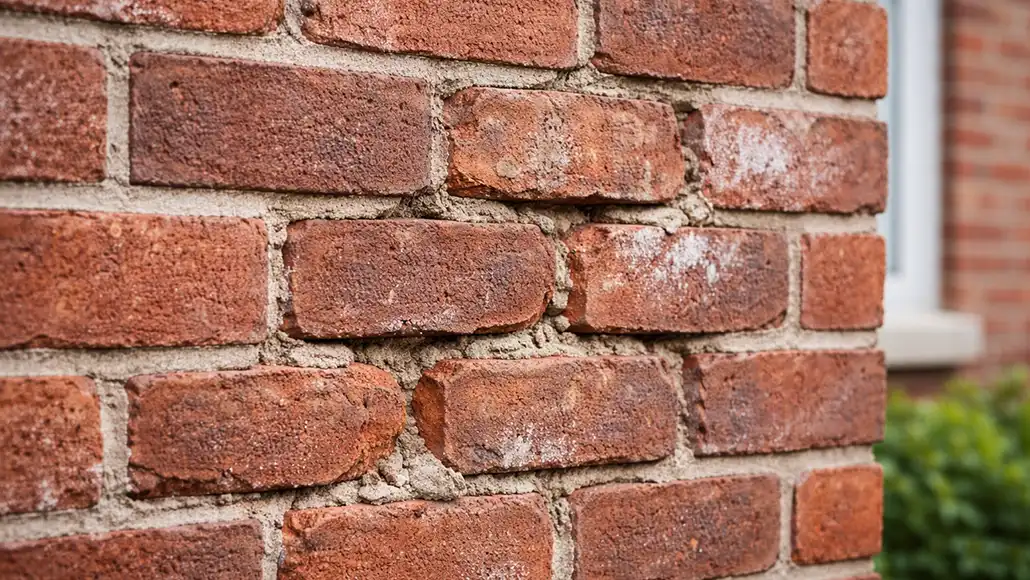
Early mortar deterioration looks like slight recession of the joint below the face of the brick. The mortar surface becomes rough, sandy, or chalky. At this stage the joint is still doing its job structurally, but it has lost some density and is becoming more porous. Water is beginning to penetrate more easily than it did when the mortar was fresh.
This stage is where tuckpointing delivers its best return. The existing mortar is still bonded to the brick, which means new mortar has a solid surface to key into. The repair is clean, relatively quick, and extends the life of the wall by a significant margin.
Stage Two: Joint Recession
As erosion continues, the joint recedes further behind the brick face. At 6mm or more of recession, the joint has lost meaningful structural contribution. Water is now pooling in the joint channel rather than shedding off it, and freeze-thaw cycles are beginning to work at the brick edges directly.
This is the stage where most professionals consider tuckpointing genuinely necessary rather than merely advisable. The window for a straightforward repair is still open, but it is starting to close. Delay from this point onward accelerates damage rather than simply deferring it.
Stage Three: Cracking and Fragmentation
Mortar at this stage has cracked through, fragmented, or is loose enough to be removed with finger pressure. Individual sections may be missing entirely. The wall is now exposed to direct water ingress at those points, and in winter conditions, ice formation inside the joint is actively pushing at the surrounding brickwork.
At Stage Three, tuckpointing is still the right tool, but the scope has expanded. More material needs to be removed and replaced, and the mason needs to assess whether any bricks adjacent to the worst joints have been compromised by the water exposure. The job takes longer and costs more than it would have at Stage One or Two.
Stage Four: Structural Compromise
When mortar failure has progressed to the point where bricks are shifting, a section of wall is bowing, or cracks are running diagonally through both mortar and brick, the situation has moved beyond tuckpointing into structural territory. At this point, the wall may need partial rebuilding rather than repointing, and an engineer’s assessment may be warranted before any masonry work begins.
Stage Four is uncommon in well-maintained homes but is regularly encountered in properties that have been neglected for extended periods, or in older homes where the original mortar was a softer lime-based formulation that has fully exhausted its service life without ever being repointed.
What Makes Ontario’s Climate Particularly Hard on Mortar
Toronto and the broader GTA sit in a climate zone that delivers some of the most punishing conditions for masonry in North America. The specific problem is freeze-thaw cycling: the number of times per year temperatures cross above and below zero degrees Celsius. Each crossing is a cycle, and each cycle puts stress on any porous material that holds water.
Southern Ontario averages somewhere between 50 and 80 freeze-thaw cycles per year, concentrated in the shoulder seasons of late fall and early spring when temperatures fluctuate around zero repeatedly over short periods. A single bad week in March, with days above zero and nights well below it, can do more cumulative damage to deteriorated mortar joints than a month of sustained cold.
This is why mortar failure in GTA homes tends to accelerate visibly after the 20 to 30 year mark. The first two decades of freeze-thaw cycling erode the mortar slowly. Once the joints have receded enough to hold standing water, each subsequent cycle compounds the damage more rapidly than the ones before it.
The Real Cost of Deferring Tuckpointing
The practical argument for addressing mortar failure promptly is financial as much as structural. Tuckpointing at Stage One or Two is a relatively contained job. A mason removes the deteriorated material to a consistent depth, cleans the joints, and applies new mortar matched to the existing profile and colour. On a standard detached home in Toronto, that work might run $1,500 to $4,000 depending on how much of the wall is affected and the accessibility of the work area.
Deferring to Stage Three means more material to remove, more time on site, and the possibility that individual bricks need replacement in addition to the mortar work. The same house that needed $2,000 of tuckpointing at Stage Two might need $4,000 to $7,000 of combined brick repair and repointing at Stage Three.
Reaching Stage Four means the conversation shifts from maintenance to reconstruction. Partial wall rebuilds on a single elevation can run well into five figures depending on the scope, and the disruption to the home is significantly greater. The math on early intervention is not subtle.
How to Assess Your Own Mortar Joints
A basic self-assessment doesn’t require any tools or expertise. Walk the perimeter of your home and look at the mortar joints between bricks at eye level and as high as you can reasonably see. A few things to check:
- Run your finger along several joints. If mortar comes away as powder or crumbles with light pressure, Stage Two or Three has arrived.
- Look for joints where the mortar surface is visibly lower than the brick edges on both sides. Any recession you can see clearly without a tape measure is worth professional attention.
- Look for cracks running along the joint line, particularly horizontal cracks that run continuously across multiple bricks. These suggest the joint has failed through its full depth.
- Note any white staining (efflorescence) on the brick surface. This is salt being carried out by water moving through the wall and is a reliable indicator that moisture is already working its way through the mortar.
- Check around window and door frames, where mortar joints are often thinner and more vulnerable, and along the bottom courses near grade, where splash-back from rain and proximity to soil moisture accelerate deterioration.
If your self-assessment turns up consistent concerns across multiple areas, it’s worth having a masonry contractor walk the property before committing to a scope of work. A professional can distinguish between surface weathering that can wait another season and joint recession that needs attention before the next winter.
Tuckpointing vs. Full Repointing: Knowing the Difference
The terms tuckpointing and repointing are often used interchangeably, but they refer to slightly different processes. Repointing is the general term for removing deteriorated mortar and replacing it. Tuckpointing traditionally refers to a specific decorative technique where two colours of mortar are used to create the appearance of fine joints, but in common usage across North America it has become a synonym for repointing.
What matters practically is the depth of removal. Standard repointing removes mortar to a depth of about 19mm and fills with new material. When joints have failed more deeply, or when the existing mortar has hardened more than the brick (which can happen when modern high-Portland mixes were used on older soft brick), a different approach is needed. A contractor doing a thorough job will assess joint depth and mortar hardness before starting rather than applying a standard process uniformly across the wall.
For homeowners researching options, tuckpointing services cover a range of scopes depending on how the deterioration has progressed. Understanding roughly which stage your mortar is at before getting quotes helps you evaluate whether the recommendations you’re receiving are proportionate to the actual condition of the wall.
Timing Tuckpointing Work in the GTA
Like all mortar work, tuckpointing requires temperatures above 5°C during application and for several days afterward during curing. The practical window in Ontario runs from late April through mid-October. Spring is the preferred time for most homeowners because it allows the full extent of winter damage to be assessed before the repair window opens, and it puts the new mortar through a full warm season before the next freeze cycle tests it.
Booking in advance matters. Tuckpointing is one of the most in-demand masonry services in the GTA during spring, and the better contractors fill their schedules quickly once the season turns. Homeowners in areas like Toronto masonry work and the inner suburbs, where older brick stock is concentrated, often find that waiting until May to start looking means booking into July at the earliest.
If an assessment in fall reveals Stage Two or Stage Three deterioration, it’s worth scheduling the repair for early the following spring rather than letting another winter pass. Each additional freeze season compounds the damage that’s already present.
Choosing a Contractor for Tuckpointing Work
Tuckpointing quality is highly variable, and a poor job can be worse than no job at all. Mortar that’s too hard for the existing brick will cause the brick faces to spall as stress transfers from the joint to the unit. Mortar that’s the wrong colour will be visible from the street for the life of the repair. Joints that aren’t cleaned to adequate depth before filling will delaminate within a few seasons.
When assessing contractors, ask specifically about the mortar mix they plan to use and why it suits your home’s existing brick. Ask how they determine joint depth and how they match mortar colour. A contractor who can answer those questions concretely, rather than vaguely, has the technical knowledge to do the job right. Brick restoration done properly starts with mortar that’s matched to the wall it’s joining, not whatever happens to be on the truck.
FAQ
How often does tuckpointing need to be done?
Well-applied mortar in a standard GTA home typically lasts 25 to 30 years before repointing becomes necessary. Homes in higher-exposure locations, with north-facing walls that stay damp, or with drainage issues that keep the foundation wet, may need attention sooner. Homes that were repointed with mortar that’s too hard for the existing brick may see accelerated failure regardless of age.
Can tuckpointing be done in sections, or does the whole wall need to be done at once?
Sectional tuckpointing is common and perfectly acceptable. If one elevation is deteriorating faster than the others due to weather exposure or drainage, that section can be addressed without doing the entire house at once. The main consideration is mortar colour matching: new mortar applied to a section of an older wall will be slightly lighter until it weathers, and that difference is visible for a period after the repair.
What’s the difference between tuckpointing and caulking around windows and doors?
They’re addressing different things. Tuckpointing replaces failed mortar in the joints between bricks. Caulking seals the gap between the brick or mortar and the window or door frame, which is a different joint that experiences more movement and requires a flexible material rather than rigid mortar. Both are maintenance items, and both should be checked during a general exterior inspection.
Will new mortar match my existing brick exactly?
Mortar colour can be closely matched but rarely perfectly matched to aged existing joints. Fresh mortar is lighter than cured mortar, and even well-matched material will look slightly different until it weathers for a season or two. A skilled mason should show you mortar samples before starting and explain what the match will look like both fresh and after weathering. On a full-wall repoint, the entire surface weathers together, so colour consistency is less of a concern than on partial repairs.
