























Key Takeaways
- Certified equipment operators demonstrate higher safety records and improved equipment productivity
- Comprehensive training combining theory, simulation, and practical experience develops true operator competency
- Ongoing certification and refresher training maintain operator capabilities as equipment technology evolves
- Investment in operator training reduces equipment damage costs and extends machinery lifespan
- Safety-focused training cultures establish habits that protect both operators and surrounding work teams
Construction equipment has evolved dramatically over recent decades, transforming from relatively simple machines requiring basic operational knowledge into highly sophisticated systems incorporating advanced controls, integrated sensors, and complex hydraulic networks. This technological evolution demands that equipment operators possess skills and knowledge far exceeding those required for earlier generations of machinery. The gap between traditional construction skills and the competencies required to operate advanced equipment effectively represents a fundamental challenge for construction organizations seeking to maximize equipment value while maintaining safety and productivity standards.
The shift toward advanced equipment operation reflects broader industry transformation. Excavators now feature proportional hydraulic controls enabling fine-tuned precision previously impossible. Loaders incorporate load-sensing technologies that automatically adjust engine power based on actual load conditions, improving fuel efficiency while reducing operator error. Bulldozers feature GPS guidance systems that achieve grading accuracy far exceeding manual operation capabilities. Cranes equipped with load moment indicators provide real-time feedback preventing overload conditions. Modern motor graders incorporate sophisticated control systems enabling fine-grade establishment that meets strict specification requirements. Each equipment type embodies technological advancement that transforms operation from manual skill exercise into a profession requiring formal training, demonstrated competency, and ongoing capability development.
Establishing Comprehensive Training Frameworks
Effective training strategies for operating advanced construction equipment must balance multiple competing objectives. Training must deliver sufficient theoretical knowledge that operators understand equipment systems and can troubleshoot basic problems. Practical training must develop the hand-eye coordination and muscle memory essential for smooth equipment operation. Safety training must establish habits and awareness that prevent injuries to operators and surrounding workers. Training must be efficient enough to minimize disruption to project schedules and training costs, yet comprehensive enough to truly develop competency rather than merely providing surface-level familiarity.
Modern training approaches recognize that different learning modalities work effectively for different individuals. Some operators learn equipment operation best through hands-on practice with actual equipment, while others benefit from initial simulator training that builds foundational skills without equipment risk. Classroom instruction establishes theoretical understanding of equipment systems, hydraulics, mechanical principles, and safety regulations. Combining these modalities into integrated training programs proves more effective than any single approach alone.
Initial equipment operator training typically requires substantial time investment. Comprehensive programs extending 400 to 600 hours provide the depth necessary for true competency development. This extended timeframe accommodates classroom instruction on equipment systems and safety protocols, simulator training building fundamental skills in risk-free environments, and hands-on field training where operators practice under supervision. Rushing this process by compressing training into shorter timelines produces operators lacking true proficiency, creating safety risks and reducing equipment productivity.
Classroom Instruction and Theoretical Foundation
Equipment operator training begins with classroom instruction establishing the theoretical foundation upon which practical skills develop. Operators must understand basic hydraulic principles explaining how fluid pressure transmits power throughout the equipment. They need knowledge of load limits and stress calculations, understanding how equipment capacities vary with boom angles and load positioning. Safety regulations and industry standards establish minimum competency expectations. Equipment-specific manuals detail control locations, system operation, maintenance procedures, and troubleshooting approaches.
Classroom instruction also addresses the broader context of equipment operation within construction projects. Operators must understand grade requirements, recognize when grades deviate from specifications, and appreciate quality standards for grading work. Understanding communication systems that enable coordination with spotters, crane operators, and project managers proves essential for safe, efficient operation. Knowledge of site-specific hazards, including underground utilities, overhead obstacles, and other workers in proximity to equipment operation zones, informs safe work practices.
Instructor qualifications significantly impact training effectiveness. Experienced equipment operators with substantial field experience provide credible instruction because they understand practical challenges that classroom-only instructors might overlook. They can describe how theoretical principles actually apply in real-world conditions, answering operator questions about situations that classroom instruction might not address. Training programs incorporating experienced practitioners as instructors achieve superior outcomes compared to programs relying exclusively on classroom educators.
Simulator Training and Skill Development
Simulator training represents a relatively recent innovation in construction equipment operator development, yet evidence consistently demonstrates its value in developing competency efficiently. High-quality equipment simulators reproduce realistic operating environments, equipment responses, and work scenarios with sufficient fidelity that skills developed in simulations transfer effectively to actual equipment operation.
Simulators offer distinct advantages for initial skill development. Operators develop basic proficiency without risking equipment damage, which is inevitable during the learning process. Repeated practice of specific operations bucket positioning, smooth boom control, precise digging movements can occur without concern for site productivity pressures. Operators develop confidence before attempting operations on actual equipment where errors become costly. Simulators can replicate scenarios that would be dangerous to practice on site, such as emergency procedures or handling edge cases requiring quick decision-making.
Effective simulator training incorporates progressive difficulty, beginning with basic equipment familiarization and advancing through increasingly complex scenarios. Early scenarios might involve simple bucket operation on flat ground. Intermediate scenarios challenge operators with sloped terrain, obstacles, and coordination requirements. Advanced scenarios present time pressures, complex loading sequences, or equipment limitations requiring skilled operation. This progressive approach mirrors natural skill development, building confidence alongside competency.
The most effective simulator programs integrate performance measurement and feedback. Operators receive immediate feedback about precise control movements, understand how small adjustments improve efficiency, and recognize when operations deviate from optimal practices. Digital recording of simulator sessions enables instructors and operators to review performance, discuss improvements, and reinforce correct techniques. This feedback loop accelerates skill development compared to training without structured feedback.
Hands-On Field Training and Supervised Operation
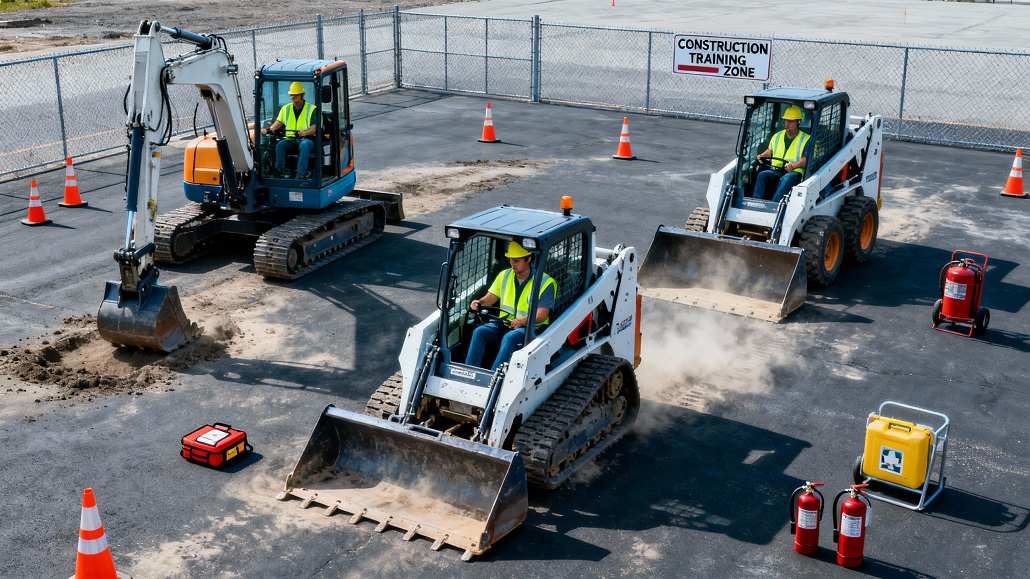
Despite the value of classroom and simulator training, actual equipment operation under real-world conditions remains essential for developing true competency. Field training with experienced supervisors provides the real-world context, unexpected situations, and environmental variables that simulators cannot fully replicate. Surface variations, material characteristics, equipment responses to actual loads, and coordination with surrounding workers all contribute experiential knowledge essential for expert operation.
Structured field training typically involves progressive responsibility increases. Initial field sessions focus on smooth basic operation under close supervision. As operators demonstrate competency with fundamental movements, training progresses to more complex scenarios requiring greater precision or coordination. Supervisors provide real-time feedback, correcting problems immediately while they occur. Operators practice repeatedly under varying conditions until operations become smooth and confident.
The quality of field training supervision determines much of its effectiveness. Experienced supervisors who combine technical knowledge with teaching ability can accelerate operator development significantly. They recognize subtle control issues that require correction, understand when operators are ready to progress to more challenging scenarios, and provide encouragement that builds confidence. Supervising on-the-job training requires patience and communication skills that not all experienced operators possess, suggesting that selection and preparation of field training supervisors deserves explicit organizational attention.
Safety emphasis throughout field training establishes habits and awareness that carry forward throughout operators’ careers. Supervisors who consistently reinforce safety practices, recognize unsafe behaviors immediately and correct them, and treat safety as non-negotiable create cultures where operator safety becomes habitual rather than a compliance box to check. This safety-focused training approach proves particularly valuable because established habits often persist longer than formal safety policies.
Certification and Competency Assessment
Formal certification demonstrates that operators have achieved established competency standards. Certification typically requires successful completion of written examinations testing theoretical knowledge and practical skills assessments verifying capability to operate equipment safely and effectively. Different jurisdictions and equipment categories maintain varying certification requirements, with some governmental regulatory agencies requiring specific certifications while others rely on industry standards and employer credentialing.
Written examinations assess knowledge of equipment systems, safety regulations, operational procedures, and troubleshooting approaches. Practical assessments require operators to demonstrate specific capabilities establishing grades meeting specifications, positioning loads precisely, maneuvering in confined spaces, or performing emergency procedures. Performance standards for practical assessments must balance realistic expectations with safety requirements, recognizing that developing perfect operation takes experience beyond initial training periods.
Certification programs maintain credibility through consistent standards and periodic assessment maintenance. High-quality certification programs establish clear performance benchmarks, train assessors to evaluate against consistent standards, and regularly review and update assessments to maintain relevance as equipment technology evolves. Certification that lacks these characteristics eventually loses credibility because it fails to ensure consistent competency standards.
Specialization and Equipment-Specific Training
The diversity of construction equipment types means that comprehensive training must address specific equipment categories. While operators might develop foundational competencies applicable across multiple equipment types, operating specialized machinery like cranes, pile drivers, or material handling equipment requires focused training addressing equipment-specific requirements.
Crane operation represents the most tightly regulated equipment category in most jurisdictions, with specific certification requirements and ongoing training mandates. The catastrophic consequences of crane operation errors dropped loads causing fatalities, structural collapses, equipment damage justify rigorous training standards and continuing education requirements. Specialized training addressing load calculations, rigging practices, communication protocols, and safety procedures develops the competency required for responsible crane operation.
Excavator operation, while generally less heavily regulated than cranes, still benefits from focused training addressing equipment-specific control systems, bucket positioning techniques, and soil interaction principles. Grading equipment like motor graders or bulldozers requires training emphasizing grade establishment, slope construction, and precision control. Material handling equipment requires training focused on load positioning, stability considerations, and material protection. Specialized training acknowledging equipment differences ensures that operator development remains efficient and effective.
Continuing Education and Capability Maintenance
Equipment operator training should not be viewed as a one-time event after which operators require no further development. Construction equipment technology continues evolving, introducing new features, control systems, and capabilities that operators must understand. Workplace safety standards change, incorporating emerging knowledge about hazard prevention and injury protection. Operators benefit from periodic refresher training that reinforces fundamentals, updates knowledge about evolving equipment and regulations, and prevents skill degradation from extended periods without specific equipment operation.
Many jurisdictions mandate periodic continuing education for operators holding certain certifications. These requirements recognize that maintaining competency over long careers requires ongoing learning. Organizations that support operator continuing education benefit through improved operator capabilities, enhanced safety records, and equipment productivity increases that justify training investments.
Building Workforce Capability Through Training Investment
Organizations that excel at equipment operator development view training investment as essential rather than optional. They recruit training-focused supervisors who can effectively develop operator skills. They invest in quality training infrastructure including simulators and classroom facilities. They establish advancement pathways where operators who develop superior skills gain opportunities for advancement to supervisory or training roles. They create cultures where continuous improvement in equipment operation skill receives recognition and reward.
The return on training investment extends beyond direct productivity improvements. Operators with strong foundational training demonstrate greater safety awareness, make better decisions in challenging situations, and operate equipment more smoothly reducing unnecessary stress on mechanical systems and extending equipment lifespan. Equipment that operates smoothly experiences less wear and requires less maintenance compared to equipment operated by less-skilled operators. Over project lifespans, these efficiency and longevity improvements often exceed training costs, making equipment operator training an economically rational investment rather than merely a safety or compliance requirement.
Training strategies for operating advanced construction equipment require recognizing that modern equipment’s complexity demands more than basic operational familiarity. Comprehensive training combining classroom instruction, simulator practice, and hands-on field experience develops true competency. Formal certification verifies achievement of competency standards. Specialization addresses equipment-specific requirements. Continuing education maintains capabilities throughout long careers. Organizations that implement these comprehensive training strategies build workforces capable of maximizing equipment value while maintaining the safety and productivity standards essential for successful construction operations.
