



























Trailers are the most useful and least controlled products of transportation and logistics operations, and can be an important part of an investment. Trailers are often left unattended, transferred, or left parked at the location of the customer, unlike powered vehicles, which are actively tracked and registered. Such inconsistent visibility has a direct impact on turnaround time, availability, and the overall asset productivity, forming inefficiencies that cannot easily be diagnosed without dependable data.
With margins thinning and supply chains becoming tight, organisations can no longer afford slow trailer cycles or unused equipment taking up capital without adding any value. Enhancing the speed at which trailers come back into service and their utilisation during deployment has become a performance priority and not an afterthought. The GPS-based tracking brings a sense of operational clarity to the management of trailers as assets that can be managed as dynamic and measurable entities rather than passive equipment that vanishes between handoffs.
Why Trailer Movement Is Hard to Control
There is a tendency to have fragmentation of operations in terms of location, teams, and external partners in trailer operations. A single trailer can be taken through yards, ports, customer locations, and to third-party facilities without uniform reporting and ownership at each point. Paper-based check-ins, out-of-date yard maps, and slow status reporting provide blind spots that make retrieval slow, lead to planning complexity, and restrict accountability.
These blind spots gradually build up to systemic ineffectiveness. The hesitation by the dispatcher to assign equipment, the availability is not predictable, and the drivers waste time to find empty or usable trailers, and the planners overestimate the fleet size to cover the absence of assets. This has caused the longer turnaround cycles and poor utilisation, not due to a lack of trailers but due to a poor understanding of their movement and dwell time.
Turning Location Data into Cycle-Time Reduction
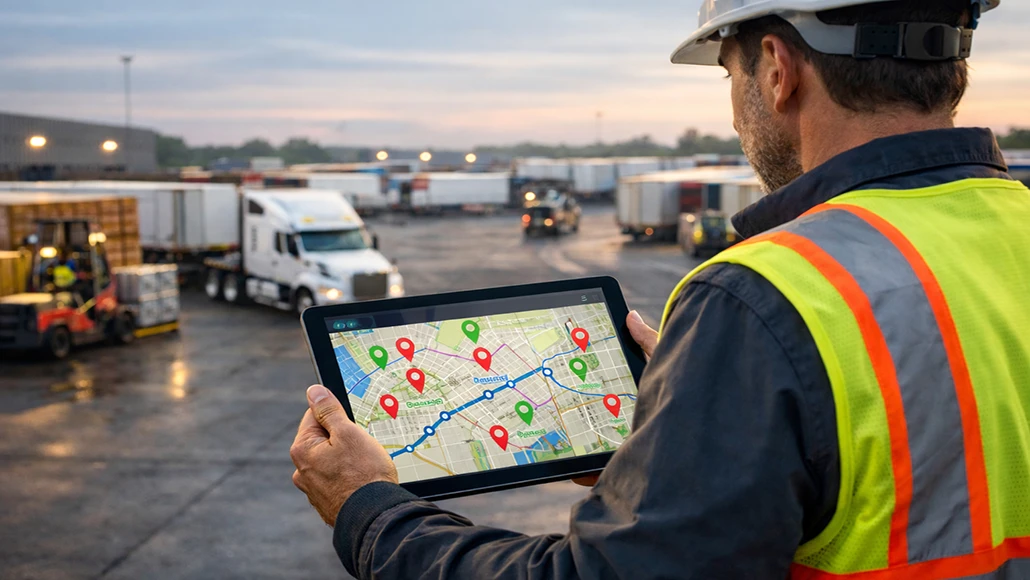
Location awareness has a fundamental shift in the management of trailers in the day-to-day operations. A trailer gps tracking unit gives continuous visibility of the location of equipment, its durability in an inactive position, and its intended re-use. His current action enables teams to take action before excess capacity causes systemic waste or compelling such purchases of unnecessary equipment.
- Quicker trailer pickup through the detection of the long dwell time at the customer locations and yards.
- Better dispatching decisions on the basis of real-time availability and proximity information.
- Reduced congestion of the yard by searching inactive trailers without a physical search.
- Increase asset utilisation by shortening idle periods and accelerating redeployment.
Once these measures are put in place repeatedly, trailer downtime is reduced, and the productivity of assets increases. Organisations lengthen the usefulness of every trailer as well as enhance turnaround performance, rather than investing in insurance by overbuying equipment, by preaching disciplined control that is supported by data.
Utilisation Gains Without Fleet Expansion
Probably one of the quickest payoffs of tracking is finding untapped capacity. Most of the fleets possess more trailers than they require at any given time due to the fact that there is no certainty when some will be available. Having the correct data on a trailer GPS tracking unit, the organisations can safely work with fewer assets and still deliver the services.
Resource use is enhanced not by working harder, but smarter. The reassignment of trailers is made quicker, empty miles are decreased, and dwell thresholds are implemented with data rather than guesswork. This eventually lowers the pressure on capital expenditure and enhances the rate of turnover on the current assets.
Operational Discipline at Scale
Increasing fleets lead to the failure of informal processes. What may be working fine with a few trailers would be impotent when dealing with regions and customers. GPS tracking brings about uniformity because the visibility rules are used on all assets, irrespective of their location or handler.
Such uniformity facilitates better accountability. Where and why equipment is not used, or limit dwells were overshot, the information is displayed. Such transparency facilitates remedial intervention without confrontation and helps maintain stricter collaborations with shippers, yards, and third-party operators.
Conclusion
Trailer GPS tracking enhances the turnaround time by eliminating uncertainty and providing a tangible action. When the organisations have information about the position of trailers and their idle time, they can deal with delays even before they become systemic issues.
Greater visibility leads to better utilisation. With trailers as active, measurable assets, businesses unlock capacity and minimise waste. This boosts efficiency without adding to the fleet or increasing operational demands.
