
























Close
WORLD OF CONCRETE
Sunday, November 30, 2025
JEC WORLD 2026

Concrete reinforced with 3D-printed polymer four times stronger

Note* - All images used are for editorial and illustrative purposes only and may not originate from the original news provider or associated company.

Subscribe

- Never miss a story with notifications

- Gain full access to our premium content

- Browse free from any location or device.

Media Packs

Expand Your Reach With Our Customized Solutions Empowering Your Campaigns To Maximize Your Reach & Drive Real Results!

– Access the Media Pack Now

– Book a Conference Call

Leave Message for Us to Get Back

Related stories

How Modular, Prefabricated HVAC and MEP Systems are Speeding Up Construction

The Transformation of On-Site Construction Modular prefabricated mechanical, electrical, and...

Designing Resilient and Grid-Responsive Buildings for the Next Era

Reimagining Buildings as Grid Partners The traditional relationship between buildings...

How Evolving Building Standards Are Changing Mechanical Systems Design

The Rapidly Evolving Regulatory Landscape Building codes and mechanical standards...
- Advertisement -

A team at the University of California, Berkeley, has developed a type of concrete that uses a lacy polymer lattice that allows it to bend without cracking and at the same time reduce its carbon emissions.

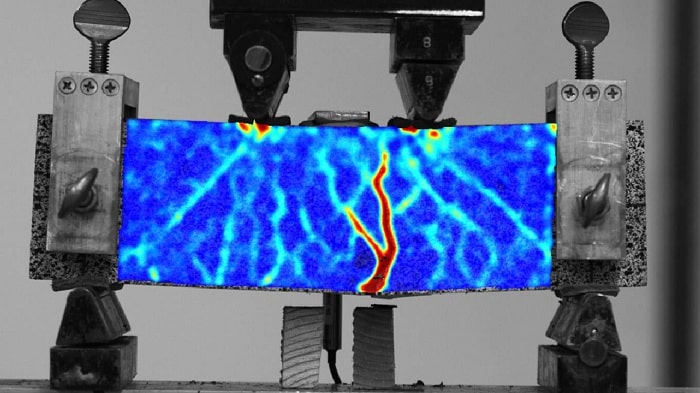
A paper published in the journal Materials & Design describes how printed plastic lattices can be filled with ultra-high performance concrete.

According to the team’s research, the finished material performs four times better than conventional concrete in compression and bending tests.

Claudia Ostertag, a professor of civil and environmental engineering who co-authored the paper, said: “When a material is brittle, it can hold up to a certain peak load and then it fails. In this case, we did not observe that failure. It got stronger and stronger. For those of us interested in concrete, this is amazing. You are rendering something very brittle into something very ductile.

She added: “Cracks are very clever: they will choose the path of least resistance. However, in this case the cracks are no longer able to avoid the reinforcement due to its uniform 3D arrangement.”

In future, researchers will test to see how different designs of lattices work with different forms of concrete and in particular applications.

Latest stories

Related stories

How Modular, Prefabricated HVAC and MEP Systems are Speeding Up Construction

The Transformation of On-Site Construction Modular prefabricated mechanical, electrical, and...

Designing Resilient and Grid-Responsive Buildings for the Next Era

Reimagining Buildings as Grid Partners The traditional relationship between buildings...

How Evolving Building Standards Are Changing Mechanical Systems Design

The Rapidly Evolving Regulatory Landscape Building codes and mechanical standards...

The Rise of Integrated Building Automation Transforming Construction Delivery

Building Automation as Construction Catalyst Integrated building automation systems have...

Subscribe

- Never miss a story with notifications

- Gain full access to our premium content

- Browse free from any location or device.

Media Packs

Expand Your Reach With Our Customized Solutions Empowering Your Campaigns To Maximize Your Reach & Drive Real Results!

– Access the Media Pack Now

– Book a Conference Call

Leave Message for Us to Get Back

Translate »