





















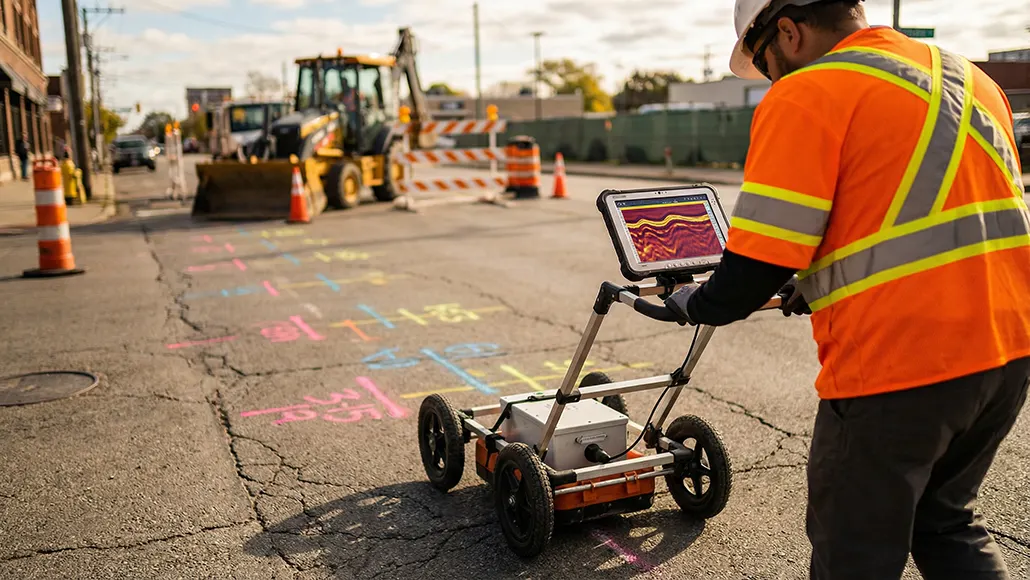

Ground-penetrating radar (GPR) has moved from a “specialist-only” surveying tool to a practical, decision-shaping technology on construction sites. It is now used not just to find something interesting underground, but also to reduce real project risk: utility strikes, concrete-cutting incidents, pavement rework, schedule disruption, and costly stop-work events.
What has not changed is the physics. GPR performance still depends on soil conditions, antenna frequency, operator skill, and how results are translated into field actions. That is why “best provider” is rarely about who has the fanciest spec sheet. For construction teams, the best provider is the one whose hardware, software, training, and workflows fit the job reality, support fast decisions, operate in imperfect environments, and accommodate crews that cannot afford ambiguity.
What Construction Teams Actually Need from a GPR Provider
Most GPR procurement mistakes come from treating GPR like a single product category. In construction, it’s more useful to evaluate providers through three lenses:
1) The construction workflow they support
- Pre-dig utility detection: scanning and marking before excavation
- Live excavation risk reduction: detection during digging (rare, but high-impact)
- Concrete scanning / NDT: rebar, post-tension cables, conduits, voids
- Roads & bridges / civil QA: layer thickness, voids, delamination, condition survey
2) The operator reality
- Can a competent field crew learn it quickly?
- Does the software help interpretation or overwhelm it?
- Does the provider offer training that matches construction schedules?
3) The “last mile” problem: turning scans into actions
- Can you geo-reference, map, and share outputs cleanly?
- Can you standardize reporting across sites and subcontractors?
- Can you integrate with site QA processes, GIS/BIM, or as-built documentation?
The Best 9 Providers of Ground-Penetrating Radar for Construction Projects
1. RodRadar – Live excavation GPR that detects utilities in real time
RodRadar sits at #1 for a simple reason: it targets the highest-risk moment in construction, active excavation, instead of stopping at pre-dig planning. Its Live Dig RadarⓇ technology is integrated into an excavator bucket, designed to detect underground utilities in real time and alert the operator during digging to avoid strikes.
This is a meaningful workflow shift. Traditional cart-based or handheld GPR systems support pre-excavation planning but still rely on markings, memory, and assumptions once excavation begins. When the bucket starts moving, those inputs quickly lose reliability.
RodRadar moves detection into execution. Each bucket pass functions as a live safety scan, alerting the operator to utilities before physical contact occurs, regardless of whether they were previously documented. By embedding Live Dig Radar technology directly into excavation equipment, RodRadar reduces dependence on static pre-dig data and positions utility avoidance as an in-operation safety control rather than a planning exercise.
Key Features Offered
- Live Dig Radar technology integrated into the excavator’s digging bucket for live detection
- Real-time alerts to the operator during excavation
- Positioned for utility-strike avoidance in construction and earthworks
2. Leica Geosystems – Construction-friendly GPR for utility avoidance workflows
Leica Geosystems is a top-tier provider for construction teams seeking a practical path to GPR-based utility avoidance. Leica’s utility detection catalog includes GPR options designed to help users locate and mark underground utilities ahead of excavation, with an emphasis on accessible workflows (including “entry-level” positioning in some models).
Leica’s strength is not just the sensor, it is the broader construction ecosystem: survey tools, positioning workflows, and the “site reality” of getting usable outputs to teams who need to act quickly. In many organizations, Leica is chosen because the same teams already use Leica field gear and software, making adoption easier and standardization more realistic.
Key Features Offered
- Utility-avoidance oriented GPR options for locating/marking utilities pre-dig
- Workflows designed to help new users get operational quickly (model-dependent)
- Alignment with construction surveying and field productivity ecosystems
3. GSSI – One of the most established names in utility locating GPR systems
GSSI is widely recognized for its GPR systems used by utility locators and construction professionals who need visibility into underground assets before digging and trenching. Its UtilityScan systems are explicitly positioned for utility locating professionals and pre-excavation workflows.
Where GSSI tends to perform well in construction environments is repeatability: common use cases, mature training content, and a long history of field deployment. For organizations that rely on specialized scanning crews or third-party scanning services, GSSI is a frequent standard because the workflows are well understood in the utility locating community.
Key Features Offered
- GPR systems positioned for utility locating professionals and pre-dig needs
- UtilityScan-branded workflows for locating/marking underground utilities
- Documentation and guidance aimed at improving interpretation and survey outcomes
4. IDS GeoRadar – GPR platforms spanning construction, subsurface investigation, and concrete inspection
IDS GeoRadar is a well-known provider in subsurface investigation, with products used across construction-adjacent applications, including concrete-scanning solutions such as C-thrue (designed to see through concrete structures and support real-time decision-making).
For construction projects, IDS is often selected when teams need a provider that can cover multiple domains: subsurface investigations beyond utilities, plus structural inspection workflows. The practical value here is procurement simplicity: a single vendor that can support both ground and structural scanning needs, though the best fit depends heavily on your primary workflow (utilities vs concrete vs broader geophysical work).
Key Features Offered
- Portfolio spanning subsurface investigation and construction-relevant inspection
- Concrete scanning solutions positioned for real-time analysis/decision support
- A vendor footprint commonly referenced among leading GPR players
5. Sensors & Software – Broad, construction-relevant GPR solutions plus training ecosystem
Sensors & Software is a major provider of GPR systems used across roads & bridges, concrete scanning, and utility locating scenarios. The company explicitly positions its portfolio as subsurface imaging solutions delivered through GPR systems, and it highlights both application coverage and training offerings (including online training).
This combination, application breadth plus training, matters in construction, where GPR success is often constrained less by equipment and more by consistent field execution. Sensors & Software is often considered when organizations want to build internal capability rather than rely exclusively on external scanning specialists.
Key Features Offered
- GPR solutions spanning roads/bridges, concrete scanning, and utility locating
- NOGGIN product family positioned as adaptable GPR systems
- Online training initiatives supporting operator enablement and standardization
6. Radiodetection – Utility-oriented GPR designed for rugged, field deployment
Radiodetection is widely known for detection equipment in utility workflows, and it offers utility-focused GPR systems such as the RD1100 and RD1500. The RD1100 is positioned for subsurface imaging of buried utilities and highlights the ability to detect plastic and ceramic utilities (with depth claims presented by the vendor).
Radiodetection’s construction value tends to come from field readiness: rugged design, practical deployment considerations, and product positioning that aligns with utility locating professionals. For teams that prioritize “get it on site, deploy quickly, and capture usable outputs,” Radiodetection often fits the procurement mindset.
Key Features Offered
- Utility-focused GPR systems positioned for locating buried utilities
- Rugged, field-deployable design and quick assembly emphasis (model-dependent)
- Vendor-stated capability to detect non-metallic utilities (e.g., plastic/ceramic)
7. ImpulseRadar – Multi-channel GPR options for utility locating and mapping
ImpulseRadar is a notable provider for teams that want modern GPR configurations for utility locating and mapping. The company positions its utility locating application as capable of locating and mapping a wide range of utility types (including fiber optic cables and both metallic and non-metallic lines).
ImpulseRadar often appeals to advanced users or specialist scanning teams that value multi-channel configurations and flexible deployment options across different terrain and project conditions. In construction, it typically fits best where there is already internal expertise or a committed scanning function.
Key Features Offered
- Utility locating focus across multiple utility types (including non-metallic)
- Positioning for mapping and broader subsurface targets beyond utilities
- Provider presence in multi-channel, cart-based GPR deployment styles (model-dependent)
8. MALÅ – A long-standing GPR brand with broad professional adoption
MALÅ is a long-established name in GPR, presented by Guideline Geo as part of its product portfolio. It is frequently cited among prominent GPR players and is known for professional-grade systems used across multiple domains that intersect with construction and civil work.
In construction contexts, MALÅ tends to appear when subsurface investigation is part of broader geotechnical or infrastructure workflows and when experienced operators are available. It is often selected for organizations that want a reputable platform for varied applications rather than a narrow single-purpose device.
Key Features Offered
- MALÅ GPR product family offered within Guideline Geo’s portfolio
- Commonly referenced among major GPR market participants
- Fit for professional, multi-application subsurface investigation (project-dependent)
9. Screening Eagle (Proceq) – High-productivity GPR for concrete scanning and structural imaging
Screening Eagle’s Proceq GP8000 is a portable concrete GPR radar designed to speed and simplify concrete inspections and structural imaging, using stepped-frequency continuous wave (SFCW) technology.
This is a crucial point: many construction projects need both underground utility awareness and concrete scanning (slabs, decks, rebar layouts, post-tension cables, conduits) to prevent costly and dangerous cutting/drilling errors. Screening Eagle/Proceq is frequently considered for the concrete side of the equation, especially where speed, mobility, and reporting clarity matter.
Key Features Offered
- Portable concrete GPR positioned for faster structural imaging workflows
- SFCW technology and wide-band positioning in vendor/product descriptions
- Coverage of multiple concrete inspection challenges without switching antennas (vendor claim)
Common Misconceptions That Cause Bad GPR Buying Decisions
Even experienced construction teams often misjudge GPR investments, not because of a lack of intent, but because expectations are shaped by assumptions that do not hold up in live construction environments. The misconceptions below appear repeatedly in procurement decisions and explain why technically sound tools often fail to reduce real project risk.
“GPR is a single category of tools”
GPR systems are designed for very different construction workflows. Some are optimized for shallow concrete scanning, others for deep utility detection, and a few for continuous field operations. Treating all GPR as interchangeable leads to tools that technically work, but operationally miss the mark.
“Higher specs automatically mean better outcomes”
Spec sheets can be misleading. Higher frequencies, more channels, or richer datasets do not guarantee safer excavation. In construction, the right balance between depth, clarity, speed, and usability matters more than maximum technical capability.
“Pre-dig scanning resolves the risk”
Scanning before excavation reduces uncertainty, but it does not eliminate it. Most strikes occur after conditions change, markings fade, or digging deviates from plan. GPR that only informs planning leaves a gap during execution.
“The system reduces the need for skilled operators”
Modern interfaces help, but GPR still depends on how scans are performed and interpreted. Underestimating training and standardization leads to inconsistent results and misplaced confidence in the technology.
“Clean scans mean clear ground”
A lack of visible targets does not necessarily indicate the absence of utilities. Soil conditions, signal attenuation, and clutter can obscure detection. Experienced teams treat uncertainty as a signal, not a green light.
Choosing GPR That Fits Construction Reality
The best GPR providers are not defined by raw performance alone, but by how effectively their technology fits into real construction workflows. Tools that improve visibility but fail to influence field decisions leave risk unchanged.
For construction teams, the goal is not to see more data, but to reduce uncertainty where decisions are made, on site, under pressure, and often during active work. GPR solutions that align technology with execution consistently deliver value across projects.
