


























Key Takeaways
- Factory-first construction reduces project timelines by more than a third while improving quality control
- Offsite manufacturing delivers up to 10% cost savings through controlled environments and streamlined processes
- Standardized production methods minimize defect rates to below 5%, ensuring consistent quality across projects
- Labor costs decrease significantly as factories maximize productivity through optimized workflows
- Weather independence and parallel construction enable projects to progress regardless of site conditions
- The global modular and prefabricated construction market is projected to reach $302 billion by 2035, growing at 5.7% annually
The construction industry stands at a critical inflection point. For centuries, building has remained fundamentally unchanged in its approach: workers gathering on-site, managing complex supply chains, battling weather conditions, and coordinating multiple trades in an inherently inefficient environment. Today, this paradigm is shifting dramatically. The factory-first construction model represents one of the most significant transformations in how humans build, moving from the traditional labor-intensive construction site toward controlled, factory-led production environments where precision, quality, and efficiency reign supreme.
This transition is not merely a trend confined to innovative startups or boutique builders. Across the globe, from residential developments in North America to commercial complexes in Asia-Pacific, the factory-first construction approach is becoming the standard. The modular and prefabricated construction market, valued at approximately $112.5 billion in 2025, is projected to surge to $219.2 billion by 2035, reflecting a compound annual growth rate of 6.9%. This explosive growth underscores a fundamental recognition that the future of construction belongs to those who embrace offsite manufacturing and controlled factory environments.
Understanding Factory-First Construction Models
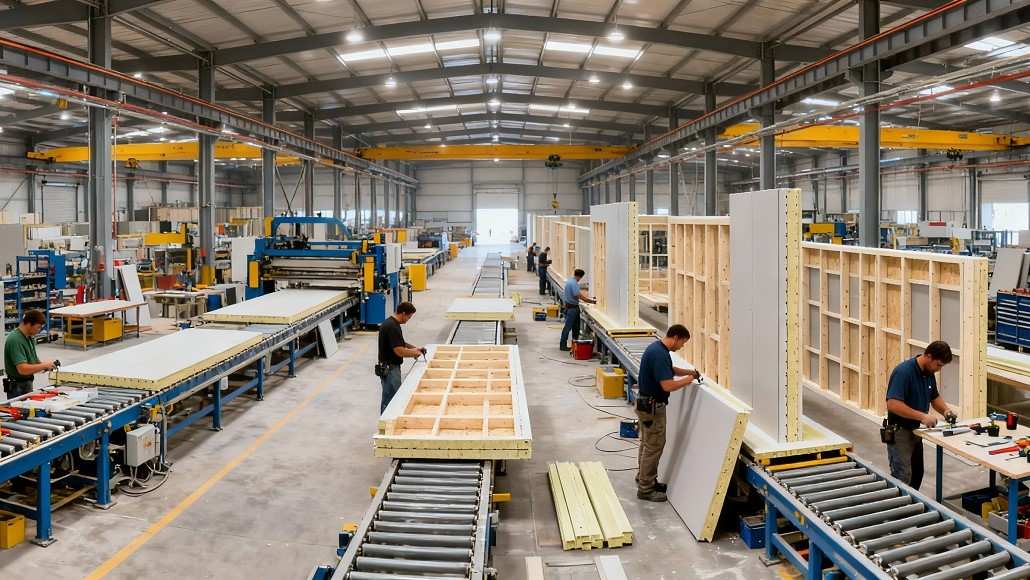
The factory-first construction paradigm fundamentally reorganizes how buildings are produced. Rather than treating a construction site as a unique manufacturing facility, this approach reverses the traditional workflow. Components, subassemblies, and even entire building sections are manufactured in dedicated factory settings where conditions are controlled, quality is standardized, and efficiency is optimized. These prefabricated elements then travel to job sites where skilled workers assemble them into complete structures.
This manufacturing-based construction methodology differs markedly from conventional approaches. In traditional construction, building sequences depend heavily on weather patterns, labor availability, and on-site management capabilities. Conversely, factory-first construction operates on industrial principles where production schedules are predictable, quality standards are consistent, and workflow optimization is paramount.
The Economic Advantages of Offsite Manufacturing
The financial case for factory-first construction models is compelling and substantial. Research from the Boston Consulting Group reveals that offsite construction delivers savings reaching up to 10% on overall construction costs. This reduction manifests across multiple expense categories, fundamentally altering project economics.
Labor costs represent perhaps the most dramatic area of improvement. Controlled factory environments significantly enhance individual worker productivity. When operations are not subject to weather interruptions, site coordination challenges, or logistical constraints, employees accomplish substantially more per hour worked. Manufacturing facilities can organize workflows using lean principles, eliminating waste and maximizing output. In many cases, construction companies report labor cost reductions of 20-30% compared to traditional on-site construction methods.
Material waste reduction provides additional financial benefits. Factory settings enable precise inventory management and controlled waste disposal. Construction waste from on-site building often exceeds 20% of total material costs. Through factory-first approaches, waste typically drops to 5% or lower, as materials are cut precisely, offcuts are systematically recycled, and just-in-time delivery reduces on-site inventory losses.
Transportation and logistics optimization further enhance economic performance. Standardized, containerized shipping of prefabricated components reduces handling costs and damage rates. Parallel construction—where site preparation proceeds simultaneously with factory manufacturing—compresses overall project timelines by more than 30%, accelerating revenue generation and reducing financing costs.
Operational Excellence and Timeline Acceleration
The operational advantages of factory-first construction extend far beyond cost reduction. The ability to compress project timelines while maintaining quality represents a paradigm shift in construction project delivery.
Traditional construction follows a sequential pattern where multiple trades must work in carefully orchestrated phases. Weather delays, permit complications, and labor shortages routinely extend timelines by months or even years. Factory-first construction eliminates weather as a variable—production continues regardless of rain, snow, or extreme temperatures. This consistency creates predictable scheduling, enabling contractors to approach 100% on-time delivery rates, a feat virtually impossible in conventional construction.
The parallel construction methodology particularly accelerates delivery. While site preparation and foundation work proceed, entire building sections are simultaneously manufactured in factory settings. This simultaneous activity compresses schedules dramatically. Projects that might require 18 months in conventional construction often complete in 12 months or less through factory-first approaches. For developers, this means faster returns on investment and earlier revenue generation, particularly valuable for hotel operators, healthcare facilities, and residential developers operating under competitive market pressures.
Quality Control and Defect Reduction
Perhaps no area demonstrates the superiority of factory-first construction more clearly than quality outcomes. Traditional on-site construction occurs in variable conditions with inconsistent workmanship. Weather, seasonal labor variations, and site-specific challenges inevitably impact quality.
Factory manufacturing transforms quality control into a systematic, measurable process. Controlled environments eliminate weather as a quality variable. Standardized procedures, repeated thousands of times, reduce defects dramatically. Best-in-class prefabrication facilities achieve defect-free rates exceeding 95%, while conventional construction typically produces defect-free work at 60-70% rates. This translates to dramatically fewer callbacks, warranty claims, and long-term maintenance issues.
The precision of factory manufacturing also enhances structural integrity. Computer-aided design optimizes connections and load paths. Robotics-assisted fabrication maintains tolerances within millimeters. Quality inspections at multiple production stages catch issues before components ship to job sites. When assembly finally occurs on-site, workers install pre-tested components designed for rapid installation, minimizing assembly errors.
Global Market Forces Accelerating Adoption
Several powerful market dynamics are pushing factory-first construction from an innovative alternative toward the industry standard. Labor shortages represent a primary driver. Construction trades face chronic worker shortages in developed economies. Factory-first construction reduces on-site labor requirements significantly. Manufacturing facilities employing precision machinery and assembly principles require fewer workers than traditional construction, making operations viable even where skilled trades are scarce.
Urbanization and housing pressures particularly in Asia-Pacific create urgent demand for rapid construction solutions. Cities like Shanghai, Delhi, and Bangkok face acute housing shortages. Factory-first construction delivers housing units faster and at lower per-unit costs than conventional methods, making affordability targets achievable. Government policies increasingly support modular construction through zoning reforms and building code modifications that accommodate standardized components.
Sustainability mandates increasingly favor factory-first approaches. Manufacturing facilities implement waste reduction, energy efficiency, and material recycling far more systematically than on-site construction. Supply chains become transparent and measurable. Building codes increasingly mandate sustainable construction practices, requirements more easily met through controlled factory environments than through traditional methods.
Sector-Specific Transformations
The shift toward factory-first construction manifests across diverse building types and sectors. In residential construction, modular housing units manufactured in factories reduce delivery times and costs dramatically. Major developers increasingly integrate modular units into projects as a standard practice rather than a specialty option.
Commercial real estate sees similar transformation. Office buildings, retail spaces, and hospitality facilities increasingly employ prefabricated structural systems, mechanical systems, and interior partitioning. The flexibility of factory-first components allows customization while maintaining cost and timeline benefits.
Industrial facilities benefit particularly from factory-first approaches. Manufacturing plants, logistics centers, and processing facilities require structural systems engineered for specific loads and layouts. Factory-manufactured components precisely meet these specifications, reducing installation time and improving performance.
Healthcare facilities represent an especially promising sector. Hospitals and clinical buildings demand high-quality construction and rapid completion. Factory-first construction delivers both. Entire bathroom pods, mechanical rooms, and patient care units are fully assembled in factories, arriving on-site ready for connection and operation.
The Technology Enablement
Digital technologies increasingly enable and enhance factory-first construction. Building Information Modeling (BIM) allows designers to create detailed digital representations before any physical manufacturing. This technology identifies conflicts, optimizes connections, and generates manufacturing instructions, reducing errors and rework.
Robotics and automation improve precision and consistency throughout manufacturing. Automated cutting systems work to tolerances measured in millimeters. Robotic welding achieves consistent quality impossible for human welders to maintain. Computer vision systems inspect every component before shipment, catching defects before they impact installation.
Internet of Things (IOT) sensors track components throughout manufacturing and delivery, providing complete visibility. Smart logistics systems optimize transportation routes and timing, ensuring components arrive precisely when needed for assembly, reducing on-site storage requirements.
Implementation Realities and Considerations
While factory-first construction models offer substantial advantages, implementation requires careful planning and operational discipline. The shift demands upfront investment in manufacturing facilities and equipment. Organizations transitioning to factory-first approaches must develop new operational capabilities, train workforces, and restructure supply chains.
Transportation logistics require sophisticated planning. Oversized components must navigate city streets and site access constraints. Shipping costs can become significant for distant projects. Regional manufacturing facilities distributed strategically minimize transportation impacts while maintaining efficiency benefits.
Design standardization, while enabling efficiency, requires accepting moderate design constraints. Custom features become more expensive when they deviate from standard component libraries. Architects and designers must work within modular parameters, though modern technology increasingly accommodates customization within standard frameworks.
Building codes and regulations continue evolving to accommodate factory-first construction. While progress accelerates, inconsistencies across jurisdictions create occasional complications. Organizations operating across multiple regions must navigate varying regulatory environments, though standardization trends gradually reduce these barriers.
The Competitive Imperative
The transition to factory-first construction models represents far more than a tactical operational choice. It reflects a fundamental competitive shift where traditional construction methodologies increasingly struggle to compete on cost, quality, and speed. Organizations that successfully implement factory-first approaches gain substantial advantages in project delivery, cost management, and quality outcomes.
The global construction industry, employing nearly 300 million workers and representing one of the world’s largest sectors, faces unprecedented pressure to improve productivity and quality while reducing costs. Factory-first construction and offsite manufacturing provide proven solutions to these challenges. As this paradigm continues spreading globally, organizations that embrace factory-first principles position themselves at the industry’s forefront, ready to capture the growing demand for better, faster, more affordable construction.
The shift from labor-intensive job sites to factory-led production environments represents far more than an efficiency improvement. It embodies a fundamental reinvention of how humans construct buildings, driven by economic necessity, technological capability, and a global recognition that the future of construction belongs to those who harness manufacturing principles. The transition has begun, and the momentum continues accelerating.
