


























Key Takeaways
- Understanding the mechanisms of premature deterioration chloride-induced reinforcement corrosion, freeze-thaw damage, and chemical attack enables engineers to select appropriate mitigation strategies and materials preventing predictable failures.
- Shift from reactive maintenance responding to failures after they occur to proactive strategies detecting deterioration early and addressing problems before major structural damage develops significantly extends infrastructure service life.
- Rigorous quality control during construction, including concrete consolidation verification, reinforcement placement inspection, and curing procedure compliance, proves critical to achieving designed durability in completed structures.
- Comprehensive condition assessment using advanced inspection techniques corrosion surveys, robotic inspection, and non-destructive testing enables prioritization of maintenance activities and optimization of intervention timing and scope.
The Scope and Economic Impact of Infrastructure Durability Challenges
The premature deterioration of concrete and masonry infrastructure represents one of the construction industry’s most persistent and costly challenges. Across Europe, North America, and other developed regions, substantial portions of the civil infrastructure constructed in the post-World War II era are experiencing deterioration requiring expensive repair, rehabilitation, or replacement. Economic analyses document the enormous costs of addressing infrastructure durability problems European estimates suggest annual repair and maintenance costs of billions of dollars devoted to addressing concrete deterioration, costs that could have been substantially reduced through better initial design and construction.
The consequences of infrastructure durability problems extend far beyond financial cost. When bridges or water systems fail prematurely, public safety is endangered, traffic is disrupted, and emergency repairs divert resources from proactive maintenance. The corrosion of reinforcing steel in concrete structures, the spalling of concrete surfaces exposing reinforcement, and the cracking and fragmentation of deteriorated masonry all represent failures to deliver the performance that owners and users expected from these infrastructure investments. Understanding the mechanisms causing these failures and implementing appropriate prevention and mitigation strategies represents an essential responsibility of engineers involved in infrastructure design, construction, and management.
Reinforcement Corrosion: The Primary Durability Threat
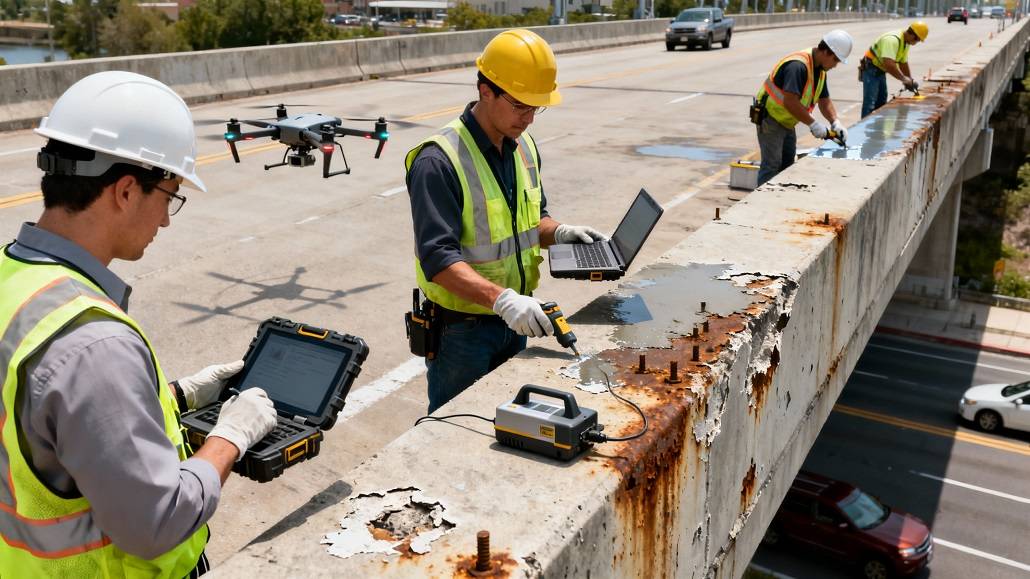
The corrosion of steel reinforcement embedded in concrete represents the most prevalent cause of infrastructure deterioration in many contexts. Steel is susceptible to corrosion in the presence of oxygen and moisture, a combination often present in concrete despite the material’s outwardly impermeable appearance. When corrosion initiates on embedded reinforcing steel, it produces iron oxides that occupy substantially greater volume than the original steel. This volumetric expansion creates pressure on the surrounding concrete, leading to cracking, spalling, and eventually structural inadequacy.
Chloride ions penetrating the concrete create the primary mechanism initiating reinforcement corrosion in many marine and cold-climate environments where deicing salts are employed. These chloride ions, from seawater or de-icing salt application, penetrate concrete through pore structures, gradually working their way inward from the surface. When chlorides reach sufficient concentration at the reinforcing steel level, the protective oxide film normally coating steel in alkaline concrete breaks down, allowing active corrosion to initiate. Once corrosion begins, it often progresses rapidly, particularly in warm climates where electrochemical reactions proceed faster.
Carbonation the reaction of concrete’s internal alkalinity with atmospheric carbon dioxide represents another significant corrosion initiation mechanism. As concrete ages, carbon dioxide gradually penetrates the concrete, consuming the alkaline compounds that normally protect embedded steel. When carbonation progresses to the depth of reinforcing steel, the steel’s protective coating breaks down and corrosion can initiate. In many northern climates where chloride exposure is minimal, carbonation is the primary corrosion initiation mechanism.
Sulfate attack represents a third durability threat, particularly relevant in contexts where concrete contacts sulfate-rich groundwater or soils. Sulfate compounds react with concrete constituents, creating expansive products that crack and disintegrate the concrete. This chemical attack mechanism differs fundamentally from chloride-induced corrosion but results in similarly devastating deterioration if appropriate protective measures are not implemented.
Design Approaches for Durability Enhancement
Recognition of durability threats has evolved design practices substantially. Contemporary concrete design specifications incorporate durability criteria specifying minimum concrete cover—the distance from the concrete surface to the reinforcing steel based on exposure conditions. More aggressive exposures require greater concrete cover ensuring that chlorides or carbonation must penetrate further to reach reinforcement. Similarly, concrete strength and quality requirements vary based on exposure severity, with higher-strength concretes and more protective cement types specified for aggressive exposures.
Water-to-cementitious materials ratio represents one of the most powerful tools for controlling concrete durability. Lower water-to-cementitious materials ratios produce denser concrete with smaller pores, reducing permeability and slowing the rate at which aggressive agents penetrate the concrete. Design specifications now often include maximum water-to-cementitious materials ratios as durability criteria, recognizing that strength alone does not ensure durability. Concrete achieving adequate early strength but incorporating excess water may deteriorate rapidly despite adequate initial strength.
The selection of cement type and supplementary cementitious materials influences durability significantly. Sulfate-resistant Portland cements provide enhanced durability in sulfate-rich environments. Pozzolanic materials fly ash, silica fume, and others reduce concrete permeability and enhance resistance to chloride penetration and sulfate attack through chemical reactions that refine pore structure and bind aggressive compounds. Slag-containing cements similarly provide durability advantages in many exposure conditions. The cost of using specially selected materials is modest compared to the enormous expense of repairing premature deterioration, making material selection for durability a sound economic decision.
Quality Control and Construction Practices
Even the most carefully designed concrete will underperform if construction quality is inadequate. Inadequate concrete consolidation leaves voids and weak zones that accelerate deterioration. Poor protection of reinforcement placement rubble contacting reinforcement or inadequate concrete cover creates zones where reinforcement will corrode rapidly. Curing practices that allow rapid drying prevent complete cement hydration, reducing strength and durability. These quality issues are not inevitable consequences of using concrete; rather, they result from inadequate attention to construction practices.
Specification of concrete curing requirements and diligent verification of curing compliance represent critical quality control measures. Extended curing typically seven to fourteen days of moisture protection significantly enhances concrete strength and durability compared to minimal curing. The cost of providing extended curing through wet burlap, liquid curing compounds, or steam curing is minute compared to benefits achieved. Many durability problems in older concrete infrastructure resulted from inadequate curing in the pre-specification era when curing was left to the discretion of contractors with minimal oversight.
The verification of concrete strength through field testing drilled cores, strength testing of companion cylinders, or other methods ensures that concrete quality meets specifications. When concrete fails to achieve required strength, investigation determines causes and appropriate remedial action. This testing and verification process identifies quality problems while remediation is still possible, preventing the installation of substandard concrete that would deteriorate prematurely.
Detection and Assessment of Deterioration
Detection of deterioration in its early stages enables intervention while damage is still manageable. Traditional visual inspection observation of cracks, spalling, rust stains, and other visible signs of deterioration provides initial indication of problems. However, visual inspection has significant limitations; internal corrosion of reinforcement may progress substantially before surface manifestation occurs. By the time rust stains appear at the concrete surface, corrosion damage is often substantial, and structural problems may be advanced.
Advanced inspection techniques overcome visual inspection limitations. Corrosion survey equipment measures corrosion rate of embedded reinforcement, detecting active corrosion before surface manifestation. Ground-penetrating radar images internal concrete structure, identifying voids, reinforcement locations, and delamination. Robotic inspection systems equipped with cameras can access confined spaces and hazardous locations impossible for human inspectors to evaluate. These advanced techniques provide engineers data enabling more informed assessment of concrete condition and deterioration rate.
The development of concrete deterioration forecasting models enables prediction of future deterioration rate based on current condition and environmental exposure. Rather than waiting for structures to deteriorate to obvious poor condition before acting, forecasting models enable prediction of when maintenance intervention will become necessary. This predictive capability enables proactive scheduling of maintenance conducting work at optimal times rather than responding to failures in emergency fashion.
Repair, Rehabilitation and Prevention Strategies
When deterioration is detected, remedial action options range from minor repairs to major rehabilitation. Concrete spalling and exposed reinforcement require repair preventing continued corrosion and structural deterioration. The approach to repair varies based on deterioration severity and anticipated remaining service life. Minor spalling might be addressed through patching, while more extensive deterioration might require section replacement or structural reinforcement.
Chloride extraction and electrochemical protection represent specialized repair approaches for chloride-induced corrosion. These techniques electrically remove chloride ions from concrete or create conditions preventing corrosion initiation. While specialized and often costly, these approaches sometimes offer attractive alternatives to concrete removal and replacement, particularly for historically significant or structurally important elements.
The prevention of future deterioration must accompany repair of current damage. Application of protective coatings seals the concrete surface, reducing chloride penetration and water ingress. Improved drainage ensures that water does not accumulate in structural elements. Enhanced cathodic protection systems actively prevent corrosion through electrical techniques. These preventive measures, when integrated into comprehensive maintenance strategies, can substantially extend infrastructure service life.
Transition to Proactive Maintenance
A fundamental shift is occurring in infrastructure management from reactive strategies responding to failures after they occur toward proactive approaches preventing deterioration. Reactive maintenance is inherently more expensive than prevention repairing failures after they occur requires emergency mobilization, often includes damage beyond the initial problem, and disrupts service. Proactive maintenance addressing incipient problems prevents escalation to crisis conditions.
Condition-based maintenance employs assessment of current infrastructure condition to schedule preventive work optimally. Rather than maintaining all assets on predetermined schedules, condition-based approaches direct resources to assets most needing attention. This enables more efficient allocation of limited maintenance budgets, concentrating resources where they will have greatest impact. Asset management systems integrating condition data with maintenance planning enable increasingly sophisticated optimization of maintenance strategy.
Large-Scale Infrastructure Program Approaches
For organizations managing large portfolios of infrastructure assets, systematic approaches to durability management prove essential. Bridge management systems employ standardized inspection procedures and condition rating systems enabling comparison of condition across numerous structures. These standardized assessments identify structures requiring priority attention and enable forecasting of future maintenance needs. Similar approaches are being applied to water systems, buildings, and other infrastructure categories.
Developing and implementing comprehensive durability standards ensures that new construction incorporates lessons from existing infrastructure. Design guidelines specify materials, detailing, and quality control measures proven effective in similar contexts. By codifying best practices in standards and specifications, organizations ensure that all new construction incorporates durability considerations rather than relying on individual engineer judgment and experience.
The development of infrastructure databases documenting performance of existing structures provides invaluable information guiding future design and construction. By recording how various material selections, design approaches, and construction techniques perform under specific environmental and loading conditions, organizations accumulate knowledge supporting continuously improving design practices. A structure’s actual performance history becomes the basis for enhanced predictions of future performance under similar conditions.
Emerging Technologies Supporting Durability
Innovative materials and monitoring technologies promise enhanced infrastructure durability. Self-healing concrete incorporating capsules of healing agents or biological systems that respond to crack initiation offers potential for structures to heal minor damage automatically, preventing propagation. Corrosion-resistant reinforcement alternatives epoxy-coated steel, stainless steel, fiber-reinforced composites offer potential for eliminating corrosion-induced deterioration, though current costs limit widespread adoption.
Real-time structural health monitoring systems enable continuous assessment of infrastructure condition, detecting deterioration progression and providing early warning of approaching structural problems. As sensor costs decline and wireless communication capabilities improve, deployment of comprehensive monitoring systems becomes economically feasible even for existing infrastructure. The data provided by these systems supports increasingly refined maintenance decision-making and infrastructure management.
