























The global and urgent imperative to combat climate change has placed the built environment at the absolute center of the world’s energy transition. As buildings are responsible for a significant and outsized portion of global energy consumption and direct carbon emissions, the push for decarbonisation in buildings is no longer just an optional environmental goal or a marketing buzzword it is a mandatory and legally binding requirement for the future-proofing of urban infrastructure. This profound shift is having an impact on mechanical services unlike anything seen since the introduction of electricity.
Mechanical services the complex systems that provide the heating, cooling, filtration, and ventilation essential for modern human habitation are being completely reimagined. Engineers, developers, and facility managers are now tasked with the monumental challenge of moving away from traditional, reliable, but high-emission fossil-fuel-based systems. In their place, the industry is adopting electrified, highly efficient, and deeply integrated solutions that align with the aggressive net-zero targets set by governments and corporate entities worldwide.
The Strategic Electrification of Mechanical Services
A central and non-negotiable theme in current decarbonisation trends is the rapid and total electrification of building systems. Historically, for over a century, space heating and domestic hot water were largely provided by the on-site combustion of natural gas, oil, or even coal. However, as regional electrical grids become increasingly powered by renewable wind, solar, and hydroelectric energy, switching to electric-based mechanical services provides the most direct and reliable path to drastically reducing a building’s operational carbon footprint.
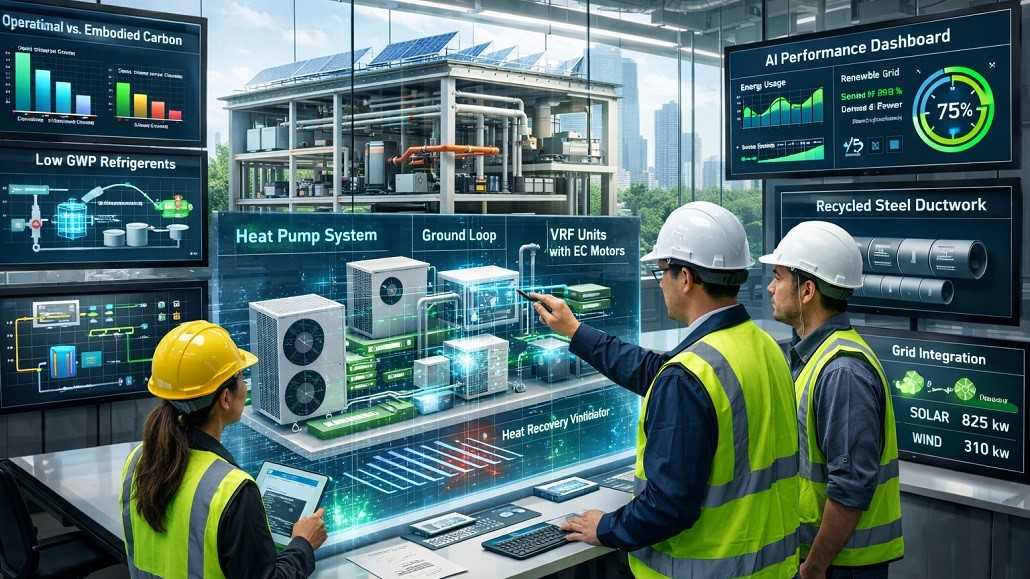
Technologies such as high-efficiency air-to-water and ground-source heat pumps are rapidly replacing traditional boilers as the primary source of thermal energy. These systems offer a way to provide high-quality heat with only a small fraction of the energy input required by combustion. This transition is a key and indispensable component of low carbon construction, as it completely eliminates on-site carbon emissions and allows buildings to benefit automatically from the ongoing greening of the national power sector. As the grid gets cleaner, the building gets cleaner, without requiring any further hardware changes.
Efficiency as a Non-Negotiable Prerequisite for Decarbonisation
While the shift to electrification is vital, it must be paired with extreme, uncompromising energy efficiency to be truly effective and economically viable. Decarbonisation in buildings is not just about changing the color of the energy source; it is about fundamentally reducing the total energy demand of the structure. This realization has led to a intense renewed focus on advanced heat recovery systems. These systems capture waste thermal energy from exhaust air, greywater, or even server rooms and reuse it within the building to pre-heat domestic water or provide space heating.
Furthermore, the widespread use of variable refrigerant flow (VRF) systems and ultra-high-efficiency electronically commutated (EC) motors in fans and pumps ensures that mechanical services only consume exactly the amount of power needed to maintain occupant comfort at any given moment. By prioritizing HVAC sustainability at the component level, developers can create structures that are not only much cleaner but also significantly more economical and predictable to operate in the long term. Efficiency is the bridge that makes the energy transition affordable.
Low Carbon Construction and the Challenge of Embodied Carbon
The impact of modern decarbonisation trends extends far beyond the operational phase of a building to the very materials and components that make up the mechanical services. Embodied carbon the total greenhouse gas emissions associated with the mining, manufacturing, transportation, and installation of building components is rapidly becoming a critical metric in low carbon construction. This is leading to a significant shift in how mechanical systems are specified, sourced, and even designed.
For example, there is an increasing preference for materials with lower embodied carbon footprints, such as recycled steel for extensive ductwork or piping networks. Additionally, the industry is exploring and rapidly adopting natural refrigerants with near-zero global warming potential (GWP) to mitigate the severe environmental impact of refrigerant leakage. This holistic, cradle-to-grave view of the building’s systems is essential for achieving true, verified decarbonisation in buildings. We can no longer ignore the carbon cost of the machinery itself in the quest for operational purity.
The Role of Digitalization and AI in the Energy Transition
Digital tools and artificial intelligence are the silent, invisible enablers of the energy transition within the world of mechanical services. Advanced building information modeling (BIM) and simulation software now allow engineers to model the exact carbon impact of a thousand different design choices before a single pipe is ever installed. This allows for the optimization of the system for both performance and carbon from the very beginning.
Once a building is operational, advanced digital building controls and AI-driven optimization ensure that the mechanical services are functioning at their absolute peak efficiency 24/7. By utilizing data-driven insights, facility managers can fine-tune system performance to match the building’s actual, real-time needs, avoiding the massive, energy-intensive “over-conditioning” that has plagued traditional structures for decades. This perfect synergy between high-performance mechanical hardware and cutting-edge digital intelligence is fundamental to meeting the increasingly stringent emissions targets being set by both regulators and discerning corporate stakeholders.
Regulatory Drivers and the Future of Mechanical Services
The acceleration of decarbonisation trends is being heavily and directly influenced by a rapidly tightening global regulatory landscape. From local building codes that mandate the use of electric heat pumps to national carbon taxes that are making the use of fossil fuels prohibitively expensive, the policy environment is clearly and loudly signaling the end of the high-carbon era for the built environment.
Mechanical services must now be designed with a long-term, thirty-year view in mind, ensuring that they can be easily adapted as new technologies emerge and as emissions targets become even more aggressive. The future of the industry lies in the development of modular, scalable, and highly integrated systems that can support the complex, shifting requirements of a carbon-neutral world. We are building the infrastructure of the future today, and it must be resilient, sustainable, and capable of providing comfort without costing the earth.
