
























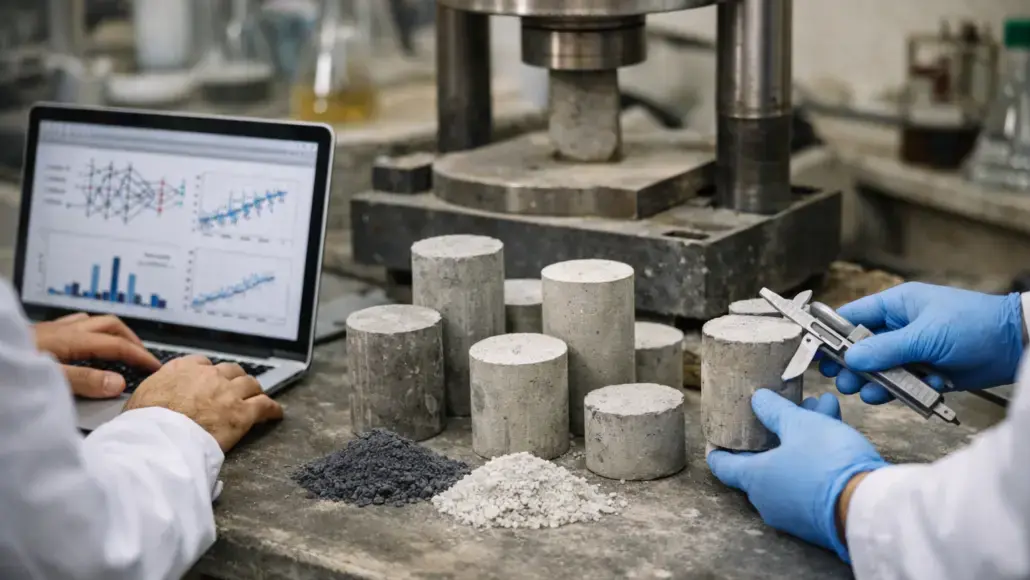

Researchers in Morocco developed a machine-learning framework to predict compressive strength in geopolymers made with fly ash and waste glass. Published in Case Studies in Construction Materials, the study assessed AI-based prediction.
Aymane Elyazidi, Fatiha Berroug, Lahcen Boukhattem and Rachid Bouferra compiled 429 experimental records from 11 peer-reviewed studies. The database covered mortar and paste mixtures and included 14 variables, including fly ash and glass powder quantities, activator composition, precursor oxide content, particle fineness and curing conditions. Recorded strength ranged from nearly zero to 96 megapascals, averaging 17.38 MPa.
The team compared seven algorithms, including neural networks, support vector regression, random forest, AdaBoost, CatBoost, gradient boosting and XGBoost. They used Differential Evolution to tune each model’s hyperparameters. DE-XGBoost achieved an R-squared of 0.9913 on test data, with a root mean squared error of 1.613 MPa and mean absolute error of 1.133 MPa. Conventionally tuned support vector regression recorded an R-squared of 0.8602.
Researchers used SHAP analysis to interpret predictions. Sodium hydroxide molarity emerged as the most influential input, followed by precursor silica content. Higher activator molarity generally increased predicted geopolymer strength, while high silica content was associated with lower values in the dataset. Calcium oxide content and curing age contributed positively.
Partial dependence analysis suggested that mixes commonly used less than about 20% glass powder replacement, an activator concentration near 12 moles per litre and curing temperatures of 60–80°C for roughly 24 hours. The researchers caution that these patterns reflect available records, not universal design limits.
The study identifies limitations, including bulk oxide composition inputs and no source-wise cross-validation. The team proposes optimization balancing strength, cost and embodied carbon, alongside an interactive prediction tool and transfer learning for other geopolymer materials. The findings could help researchers assess geopolymer strength while developing lower-carbon construction materials for more sustainable concrete mix design.