




















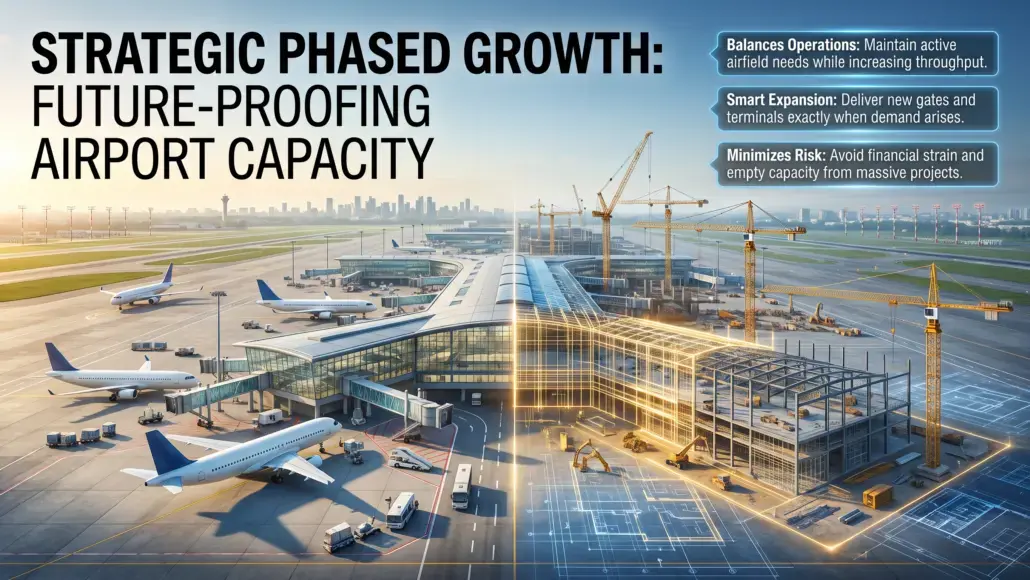


Managing the growth of a major international transit hub requires a delicate balance between increasing throughput and maintaining the daily requirements of an active airfield. The adoption of incremental growth strategies provides a framework for airports to evolve incrementally, ensuring that new gates, terminals, and runways are delivered precisely when they are needed. This approach avoids the financial strain of massive, all at once projects that may result in underutilized capacity if market conditions change. By breaking down a large development master plan into smaller, manageable segments, airport authorities can remain agile, adjusting their timelines based on actual passenger numbers and airline requirements. This methodology is particularly relevant in an era where global travel patterns can shift rapidly, demanding a construction strategy that is both scalable and fiscally responsible.
Balancing Operational Continuity with Infrastructure Growth
The primary challenge of expanding an airport is the need to keep the facility fully functional throughout the construction process. Every hour of downtime for a runway or terminal wing results in significant revenue loss and passenger dissatisfaction. Phased Airport Construction addresses this by isolating construction zones from active passenger areas, often utilizing modular components that can be assembled quickly during off peak hours. This ensures that the footprint of the construction site does not encroach upon the daily operations of the airport. For instance, a new terminal wing might be built in three distinct stages, allowing the first set of gates to open while the second and third stages are still under construction. This incremental opening provides immediate relief to congested areas without waiting for the entire project to reach completion.
Strategic planning is essential to ensure that utility connections and baggage handling systems are designed for future integration. Engineers must ensure that the initial phase includes the necessary core infrastructure to support subsequent expansions. This involves laying extra fiber optic cabling, installing larger capacity water mains, and ensuring that the structural foundations can accommodate additional levels or extensions. By planning for these future needs from day one, the airport avoids the disruptive and expensive process of retrofitting existing structures when the next phase begins. This long term vision allows for a smoother transition between project stages, creating a cohesive facility that feels unified despite being built over several years.
Financial Risk Mitigation through Incremental Development
Funding large scale aviation projects is a complex process that often involves a mix of public grants, private investment, and airport revenue. Committing to a multi billion dollar expansion project in a single phase carries substantial financial risk, as interest rates and construction costs can fluctuate significantly over the life of the project. The use of sequenced development stages mitigates this risk by allowing the airport to secure funding for one phase at a time. This approach makes the project more attractive to investors, as they can see a return on their capital sooner when each phase becomes operational and starts generating revenue. If the aviation industry faces a downturn, the airport has the option to pause or delay future phases without being left with a half finished, non functional building.
Additionally, this incremental approach allows for more accurate budgeting. Estimating the cost of a project that will take ten years to complete is notoriously difficult due to inflation and changes in material prices. By focusing on a two or three year phase, project managers can lock in costs with greater certainty. This leads to fewer budget overruns and more predictable financial performance. The financial flexibility provided by this model allows for the reallocation of funds if one aspect of the project proves to be more costly than anticipated. For example, if soil conditions require more extensive foundation work in one area, the budget for the next phase can be adjusted to maintain overall financial stability.
The revenue generated from the early phases can also be reinvested into the later stages of the development, reducing the overall debt burden on the airport. This sustainable financial model ensures that the airport remains competitive and financially healthy, even as it undergoes significant growth to meet future demands. Investors and lending institutions are typically more comfortable with this staged approach, as it demonstrates a disciplined management of capital and a clear path to operational profitability. By showing success in the early stages, the airport can often negotiate better terms for future financing, further reducing the cost of the expansion. This strategic approach to capital management is a cornerstone of modern aviation infrastructure development, providing a stable foundation for long term growth. Every dollar invested is optimized to provide the maximum benefit to the airport and its passengers, ensuring a high return on investment for all stakeholders.
Strategic Asset Management and Technological Integration
The long duration of airport expansion projects means that technology often evolves faster than the construction can keep pace with. A security system or passenger processing technology that was state of the art when the project was designed might be obsolete by the time the building opens. Phased Airport Construction allows the airport to integrate the latest technological advancements into each new phase. The lessons learned from the operation of the first phase can be applied to the design of the second, leading to continuous improvement in the facility’s performance. This iterative process ensures that the airport remains at the forefront of innovation, providing a superior experience for both passengers and airline partners.
Asset management teams benefit from this phased approach as well, as they can gradually scale up their maintenance operations. Rather than suddenly having to manage a massive new terminal, they can integrate new sections into their maintenance schedules over time. This allows for better training of staff and the optimization of building systems, such as lighting and HVAC, to ensure maximum efficiency. The data collected from the early phases can be used to fine tune the specifications for future construction, ensuring that materials and equipment are selected based on their real world performance in the airport environment. This data driven approach leads to a more durable and cost effective facility that is easier to maintain over its entire lifecycle.
Adapting to Volatile Aviation Market Demands
The aviation industry is subject to numerous external factors, from geopolitical events to changes in global trade policies, all of which can impact passenger volume and aircraft types. Phased Airport Construction provides the flexibility to adapt to these changes in real time. If an airport sees a sudden increase in demand for low cost carriers, it can adjust the design of the next phase to include more efficient, high density gates. Conversely, if there is a shift toward long haul international travel, the expansion can be pivoted to provide more premium lounges and larger gate areas for wide body aircraft. This responsiveness ensures that the airport’s infrastructure always aligns with the needs of the market.
This adaptability also extends to the use of space within the airport. A phase that was originally intended for retail might be converted into additional security screening lanes if regulatory requirements change. By not committing to a rigid, fixed design for the entire expansion at the outset, the airport can make these adjustments with minimal disruption. This flexibility is a key competitive advantage, allowing the airport to react faster than its peers to new opportunities. In a rapidly changing industry, the ability to pivot and adapt is essential for long term success, and phased construction provides the necessary framework to make this possible.
Environmental Sustainability through Modular Implementation
Sustainability is no longer an optional extra in construction; it is a core requirement for any new airport project. Phased Airport Construction supports environmental goals by allowing for the use of more sustainable materials and construction methods as they become available. Each phase can serve as a testing ground for new green technologies, such as solar integrated glass or carbon neutral concrete. The insights gained from these applications can then be scaled up in future phases, leading to a progressively smaller environmental footprint for the entire project. This incremental approach to sustainability is often more effective than trying to implement unproven technologies on a massive scale all at once.
Additionally, phased construction reduces the environmental impact of the site by minimizing the amount of land that is disturbed at any one time. By focusing work in specific zones, the airport can better manage dust, noise, and runoff, protecting the surrounding ecosystem. The use of modular and prefabricated components also reduces site waste, as these elements are manufactured in a controlled environment where materials can be utilized more efficiently. This focus on sustainability not only benefits the environment but also enhances the airport’s reputation with passengers and regulators, who are increasingly looking for aviation hubs that demonstrate a commitment to responsible growth. The implementation of renewable energy sources can also be timed with each phase, allowing for the integration of the latest solar or geothermal technologies as they reach commercial viability. This incremental approach to green energy ensures that the airport does not lock itself into older, less efficient systems during the early years of a long term project.
Environmental monitoring systems can be deployed at each stage to track the impact on local air and water quality. This data allows for the continuous refinement of construction methods to ensure that the airport remains a good neighbor to the surrounding community. For example, if a particular excavation technique is found to produce excessive noise, it can be modified in subsequent phases. This commitment to continuous environmental improvement is essential for securing the necessary permits and social license to operate in an increasingly carbon conscious world. By integrating green principles into every stage of the expansion, the airport can build a facility that is both modern and environmentally sound. Through these combined efforts, the project team can demonstrate that large scale aviation growth does not have to come at the expense of the planet, setting a new standard for responsible infrastructure development.