





















The construction equipment sector is currently undergoing one of the most significant transformations in its history, catalyzed by the rapid evolution of global emission norms. Regulatory bodies across North America, Europe, and Asia have progressively tightened the standards for non-road mobile machinery, moving from basic particulate filters to highly sophisticated exhaust after-treatment systems. For equipment owners and procurement managers, these changes are not merely technical adjustments; they represent a fundamental shift in the cost of doing business. The transition to higher-tier engines such as the EU Stage V or U.S. EPA Tier 4 Final has introduced complexities in maintenance, fuel requirements, and initial capital expenditure. As these norms continue to evolve, they are dictating the roadmap for innovation, forcing manufacturers to explore electrification, hydrogen, and hybrid technologies while simultaneously reshaping the secondary market for older machinery.
Navigating the High Costs of Regulatory Compliance
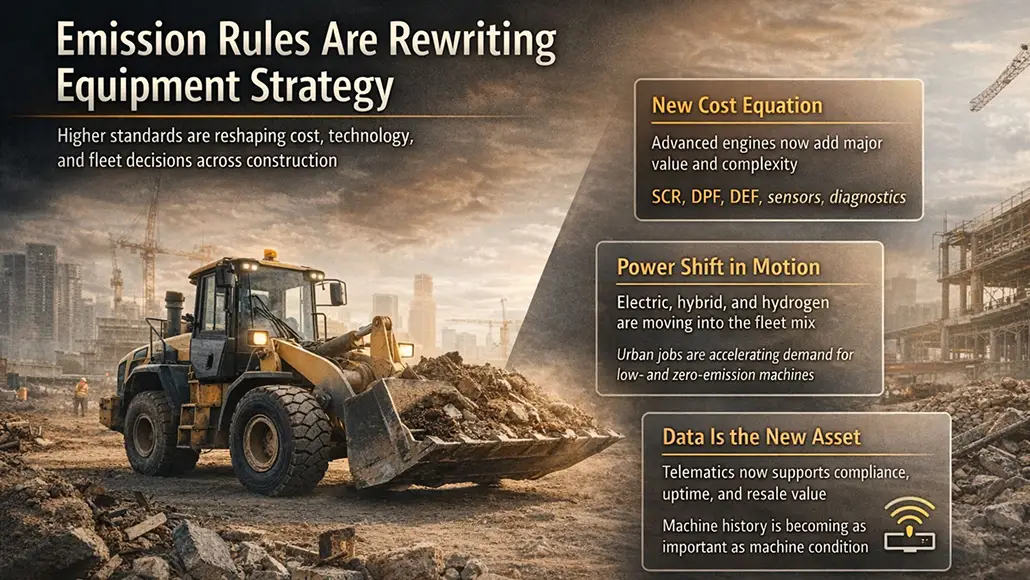
One of the most immediate impacts of modern emission norms is the substantial increase in the initial purchase price of construction equipment. Higher-tier engines require advanced components such as Selective Catalytic Reduction (SCR) systems and Diesel Particulate Filters (DPF). These technologies, while effective at reducing nitrogen oxides and particulate matter, add thousands of dollars to the manufacturing cost of a single excavator or bulldozer. Furthermore, the operational costs have also climbed. Machines equipped with SCR systems require Diesel Exhaust Fluid (DEF), adding another layer to the supply chain and on-site logistics. For small to mid-sized contractors, the financial burden of upgrading a fleet to meet the latest standards can be daunting. This has led to a noticeable shift in procurement strategies, where many firms are opting for long-term leasing or rental agreements rather than outright ownership to avoid the high upfront costs and the risks associated with technological obsolescence.
The Total Cost of Ownership (TCO) Paradigm Shift
In the era of stringent emission norms, the calculation of the Total Cost of Ownership (TCO) has become significantly more complex. In the past, TCO was primarily a function of fuel consumption and basic mechanical maintenance. Today, it must account for the cost of DEF, the increased frequency of specialized sensor replacements, and the downtime associated with DPF regeneration cycles. Furthermore, the software-heavy nature of modern engines means that diagnostic tools and subscription-based telematics services are now essential line items in the budget. Procurement officers must now look beyond the sticker price and evaluate the long-term serviceability of a machine. A lower-cost machine with a poorly optimized after-treatment system can quickly become a financial liability if it requires frequent interventions by specialized technicians, highlighting the need for a more holistic approach to equipment investment.
Fuel Quality and Infrastructure Requirements
Modern emission-compliant engines are notoriously sensitive to fuel quality. The use of high-sulfur diesel can lead to catastrophic failure of the DPF and SCR systems, resulting in repair bills that can reach tens of thousands of dollars. This necessitates a robust fuel management strategy, especially for projects in remote locations where fuel quality may be inconsistent. Contractors must invest in high-quality storage and filtration systems to ensure that only Ultra-Low Sulfur Diesel (ULSD) enters the engine. This infrastructure requirement adds another layer of complexity to site logistics, as the maintenance of clean fuel streams becomes just as important as the maintenance of the machines themselves. The dependency on ULSD also limits the mobility of modern fleets, as they cannot be easily moved to regions where such fuel is unavailable without risking permanent damage.
The Acceleration of Fleet Electrification and Innovation
The stringent nature of current emission norms has acted as a powerful tailwind for the development of alternative power sources. In many urban environments, particularly in Europe, local “low emission zones” go beyond national standards, often requiring zero-emission equipment for specific projects. This has pushed manufacturers to accelerate their R&D efforts in battery-electric and cable-connected machinery. While compact equipment like mini-excavators and small wheel loaders were the first to see widespread electrification, the industry is now seeing prototypes for much larger, high-tonnage machines. The challenge remains the energy density required for heavy-duty cycles, but the progress in fast-charging infrastructure and battery technology is closing the gap. This shift is creating a two-tier market: a traditional diesel-powered market for rural and infrastructure projects, and a rapidly growing electric market for urban and indoor construction, each governed by different procurement priorities.
Hybrid and Hydrogen Alternatives for Heavy Duty
For heavy-duty applications where battery-electric power is currently insufficient, manufacturers are exploring hybrid and hydrogen-based solutions. Hybrid machines, which combine a smaller diesel engine with an electric motor and energy recovery system, offer a significant reduction in fuel consumption and emissions without the range anxiety of pure electric units. Meanwhile, hydrogen combustion engines and fuel cells are being positioned as the long-term solution for the largest excavators and haul trucks. These technologies allow for rapid refueling and high power output, though the infrastructure for hydrogen production and distribution remains a significant hurdle. For the construction equipment market, these diverse propulsion technologies represent a “multi-path” approach to meeting future emission norms, requiring procurement teams to stay informed about a wide range of emerging technologies.
The Global Reshaping of the Secondary Equipment Market
The uneven global adoption of emission norms has created a complex and fragmented secondary market for used construction equipment. Machines that are no longer compliant in “highly regulated” markets like the EU or the US are often exported to “less regulated” regions where emission standards are more relaxed or non-existent. However, this flow is becoming increasingly difficult. High-tier engines are designed to run on ULSD; if they are operated on lower-quality fuel common in developing regions, the sensitive after-treatment systems can be permanently damaged. This “fuel mapping” issue means that modern used machines cannot simply be shipped anywhere in the world without expensive modifications or “de-tiering” kits, which are themselves subject to legal and ethical scrutiny. As a result, the resale value of modern equipment is becoming highly dependent on the local infrastructure and regulatory environment of the destination country, complicating the depreciation models used by fleet managers.
Strategic Procurement in a Fragmented Regulatory Landscape
For global construction firms, managing a fleet across different jurisdictions requires a highly strategic approach to procurement. A machine purchased for a project in a Stage V region may not be the most cost-effective choice for a project in a region with lower standards, yet maintaining a fragmented fleet increases parts inventory and training costs. To navigate this, many companies are developing a tiered fleet strategy, where the newest, most efficient machines are rotated through high-regulation urban centers, while older, more robust equipment is utilized for heavy earthmoving in remote areas. This lifecycle management requires a deep understanding of upcoming regulatory changes, as being caught with a non-compliant fleet can lead to exclusion from major government contracts and large-scale infrastructure tenders that increasingly prioritize sustainability and carbon reduction.
Telematics as a Compliance and Management Tool
The rise of telematics has been instrumental in helping contractors manage the complexities of modern emission norms. By providing real-time data on engine health, DEF levels, and idling time, these systems allow for proactive maintenance and more efficient fleet utilization. From a compliance perspective, telematics can provide the necessary documentation to prove that a project met specific emission targets, which is increasingly required for public sector contracts. For the equipment market, this means that a machine’s data history is becoming almost as valuable as its physical condition. A used machine with a transparent, telematics-backed maintenance record will command a higher price in the secondary market, further incentivizing the adoption of these digital tools.
Future Trends and the Drive Toward Zero Emissions
Looking ahead, the trajectory of emission norms suggests that the industry is moving toward a post-diesel era. While hydrogen combustion and fuel cells are still in the relatively early stages for heavy equipment, they offer a promising solution for the high energy demands of large-scale construction. We can also expect to see a greater emphasis on “carbon accounting,” where the emissions produced during the operation of a machine are integrated into the overall project’s environmental impact report. This will further incentivize the adoption of the cleanest available technology. The procurement of construction equipment is no longer just about horsepower and bucket capacity; it is about regulatory compliance, digital integration, and long-term environmental viability. The firms that successfully adapt to these emission norms will not only reduce their environmental footprint but also gain a significant competitive advantage in a market that is increasingly defined by green credentials and technological sophistication.