





























The construction industry has historically struggled with a fragmented and opaque supply chain, often resulting in project delays, material waste, and disputes over quality. However, the emergence of smart construction supply chains enhance traceability is fundamentally altering this landscape. By leveraging the power of blockchain, the Internet of Things (IoT), and advanced data analytics, the industry is moving toward a highly transparent and efficient digital ecosystem. This transition allows for real-time visibility of materials from the point of manufacture to their final installation on-site, ensuring that every project is built with the right components, delivered at the right time, and verified for quality and compliance. This digital overhaul is no longer a luxury but a critical requirement for managing the complexity of modern mega-projects.
Breaking Down Fragmentation through Digital Integration
One of the primary challenges in construction logistics is the sheer number of stakeholders involved from raw material suppliers and manufacturers to freight forwarders and sub-contractors. Traditionally, each of these parties operated in their own data silo, leading to a lack of overall coordination. When smart construction supply chains enhance traceability, these silos are bridged by a centralized digital platform. This integration ensures that a change in the construction schedule on-site is instantly communicated back through the supply chain, allowing manufacturers to adjust their production cycles and logistics providers to re-route deliveries. This synchronized flow of information eliminates the “bullwhip effect” that often leads to costly bottlenecks and inventory build-up. It turns the supply chain from a series of reactive handovers into a proactive, data-driven partnership.
The Role of Blockchain in Verifying Material Provenance
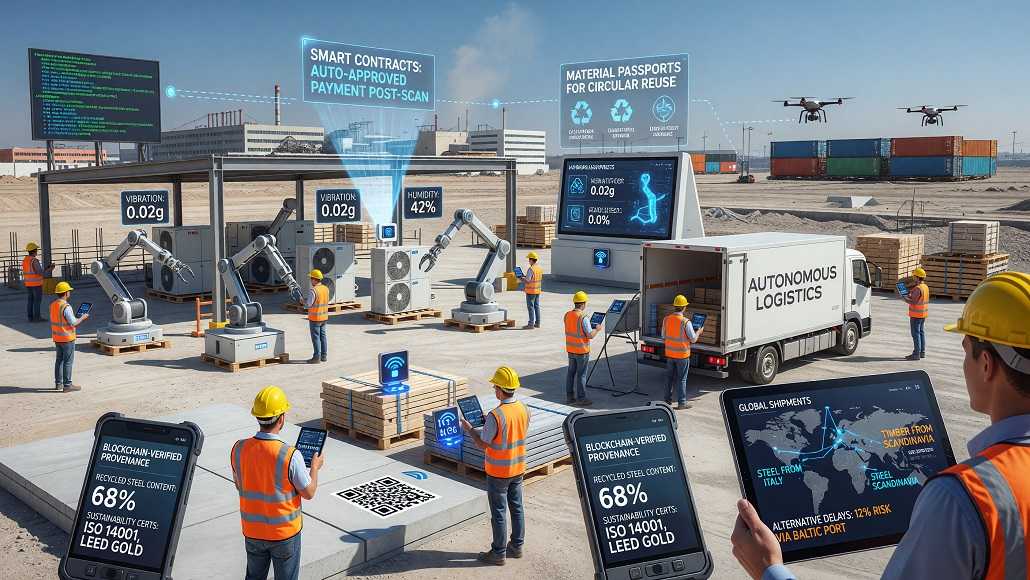
At the heart of a transparent ecosystem lies the need for trust. Blockchain technology is a key driver of how smart construction supply chains enhance traceability by creating an immutable, decentralized ledger of every transaction. This is particularly vital for verifying the provenance and sustainability of materials. For instance, a contractor can use blockchain to verify that the steel they are using was produced with a specific recycled content or that the timber was sourced from a sustainably managed forest. This “digital certificate of authenticity” is tamper-proof, providing project owners and regulators with the high-level assurance they need that the building is compliant with all safety and environmental standards. It essentially creates a “digital thread” that connects the final building back to its origins in the natural world.
IoT and Real-Time Tracking of Critical Components
The “smart” aspect of these supply chains is powered by the Internet of Things (IoT). By attaching GPS and RFID tags to critical or high-value components, such as pre-cast concrete panels or complex HVAC units, project managers can track their location in real-time. This level of visibility means that smart construction supply chains enhance traceability by allowing for “Just-In-Time” (JIT) delivery. Instead of materials sitting on-site for weeks and risking damage or theft, they arrive exactly when they are needed for installation. Furthermore, IoT sensors can monitor the condition of materials during transport, flagging if a sensitive component has been exposed to excessive vibration, humidity, or temperature fluctuations that might compromise its structural integrity. This real-time feedback loop allows for immediate intervention and prevents the installation of faulty parts.
Digital Procurement and Automated Workflow Efficiency
The administrative burden of construction procurement managing thousands of invoices, purchase orders, and delivery notes is a significant source of inefficiency. Smart construction supply chains enhance traceability by automating these workflows through digital procurement platforms. Smart contracts, built on top of a blockchain, can automatically trigger payments once a delivery has been verified by an on-site sensor or a digital sign-off. This reduces the time spent on manual reconciliation and speeds up the cash flow for suppliers, fostering a more collaborative and stable project environment. Automation ensures that the procurement team can focus on strategic sourcing and relationship management rather than chasing paperwork and resolving payment disputes. It also creates an audit-ready financial record that simplifies project close-outs.
Enhancing Quality Control and Reducing Rework
Rework is one of the biggest drains on construction profitability, often caused by the use of incorrect or substandard materials. When smart construction supply chains enhance traceability, every material has a “digital twin” that contains its full quality record. On-site teams can use mobile devices to scan a component’s QR code and instantly access its test results, installation instructions, and warranty information. This ensures that only verified materials are used and that they are installed according to the manufacturer’s specifications. If a quality issue is discovered later, the traceability system allows for a surgical “recall,” identifying exactly where other components from the same batch were installed across the project. This targeted approach saves thousands of hours in manual inspections and protects the long-term reputation of the contractor.
Sustainability and the Circular Economy Link
Traceability is the essential foundation for a circular economy in the built environment. To reuse materials from a demolished building in the future, we must know exactly what they are and how they were maintained. Smart construction supply chains enhance traceability by creating a “Material Passport” for every component. This record follows the material throughout its life, documenting its maintenance history and any repairs. When a building eventually reaches its end-of-life, this data allows future “urban miners” to safely and profitably recover and reuse the materials, closing the loop and drastically reducing the industry’s reliance on virgin resources. This long-term vision turns the supply chain from a linear “path to the site” into a continuous cycle of material management that spans decades.
Mitigating Risks in Global Supply Chain Logistics
The global nature of construction materials sourcing marble from Italy, electronics from Asia, and timber from Scandinavia introduces significant risks, from geopolitical instability to shipping delays. Smart construction supply chains enhance traceability by providing “predictive logistics.” By integrating weather data, port congestion reports, and global news feeds, the system can predict disruptions before they happen and suggest alternative routes or suppliers. This proactive risk management is what allows complex mega-projects to stay on track even in a volatile global environment. The ability to “see around the corner” is a major competitive advantage, allowing firms to pivot their procurement strategies in response to real-time global events. It transforms risk from a threat into a manageable variable in the project equation.
Strengthening Compliance and Regulatory Reporting
Regulatory requirements for safety and environmental disclosure are becoming increasingly strict. Governments now often require “chain of custody” documentation for critical materials like structural steel and fire-safety equipment. Smart construction supply chains enhance traceability by automatically generating these reports as the project progresses. Instead of a frantic scramble for documentation at the end of a project, the developer has a complete, verified digital record of every material used. This transparency not only ensures compliance but also reduces the cost of audits and insurance, as the firm can prove its adherence to the highest standards of quality and ethical sourcing. It builds a foundation of trust with public authorities and the local community that is essential for long-term business success.
The Role of Data Analytics in Continuous Improvement
The data generated by a traceable supply chain is a goldmine for continuous improvement. By analyzing historical delivery data, a firm can identify which suppliers are the most reliable and which routes are the most efficient. Smart construction supply chains enhance traceability by providing the benchmarks needed to optimize future projects. Machine learning algorithms can predict the likely delivery time for a specific type of component under various conditions, allowing for more realistic project scheduling. This “loop of learning” ensures that every project becomes smarter and more efficient than the last, driving long-term industry productivity. It moves the industry away from “one-off” project thinking toward a more sophisticated, manufacturing-style approach to delivery.
Future Outlook: The Fully Autonomous Supply Chain
As technology continues to evolve, we are moving toward a future of fully autonomous construction logistics. In this vision, the BIM model itself acts as the purchasing agent. When the digital schedule indicates that plumbing work will begin in three weeks, the system automatically checks inventory, solicits bids from a pre-approved network of suppliers, and places the order based on a combination of price, speed, and carbon footprint. Self-driving trucks and drones then deliver the materials to the site, where robotic systems handle the unloading and sorting. This level of autonomy, underpinned by the fact that smart construction supply chains enhance traceability, will represent the ultimate realization of efficiency and transparency in the built environment. It will allow humans to focus on the “why” of building, while the machines handle the “how.”
Conclusion: Visibility as the Foundation of Excellence
The construction industry is shedding its reputation for being “low-tech” and opaque. The adoption of smart construction supply chains enhance traceability is at the center of this transformation. By creating a visible, accountable, and interconnected digital ecosystem, we are not just improving logistics; we are improving the quality, safety, and sustainability of the buildings themselves. Visibility is the foundation upon which excellence is built. As these technologies become the industry standard, the friction and uncertainty of the past will give way to a future of seamless, data-driven execution, ensuring that our infrastructure is built to the highest possible standards of transparency and trust. The future of building is bright, and it is powered by data that never sleeps.