
























As global temperatures continue their upward trajectory and urban populations swell at an unprecedented rate, the demand for effective and reliable cooling has reached a scale never before seen in human history. Traditional air conditioning systems, while effective in the short term, are notoriously energy-intensive and contribute significantly to the urban heat island effect through the constant expulsion of waste heat into the surrounding streets. This destructive cycle cooling the indoors while simultaneously warming the outdoors is fundamentally unsustainable in a rapidly warming world. Consequently, the adoption of sustainable cooling technologies has become a defining characteristic and a core requirement of modern urban construction.
These innovations aim to provide the necessary thermal comfort through methods that are far more efficient, environmentally harmonious, and resilient. This shift is paving the way for the next generation of climate responsive buildings, which are designed to work with their local environment rather than simply fighting against it. The evolution of cooling is no longer just about more efficient compressors; it is about a complete rethink of how buildings interact with heat.
Addressing the Urban Heat Island through Green HVAC
The concentration of dense materials like concrete, asphalt, and glass in metropolitan areas creates localized micro-climates that are significantly warmer than their surrounding rural or suburban counterparts. This phenomenon, known as the urban heat island effect, places an immense burden on cooling infrastructure and creates a feedback loop of energy consumption. Green HVAC solutions address this challenge by moving away from traditional vapor-compression cycles and toward more sustainable, nature-inspired alternatives.
Evaporative cooling, for example, utilizes the natural process of water evaporation to lower air temperature, requiring only a small fraction of the electricity used by standard refrigerant-based air conditioners. When integrated into large-scale urban construction projects, these systems can significantly reduce the peak energy demand of an entire city district, leading to more stable and resilient power grids. Furthermore, advanced liquid desiccant cooling systems are being used to manage humidity independently of temperature, allowing for precise comfort control with much lower energy inputs. These “green” technologies are essential for breaking the thermal cycle of our cities.
Passive Design and Low Energy Cooling Strategies
One of the most effective and elegant ways to implement sustainable cooling technologies is to reduce or even eliminate the need for active mechanical cooling in the first place. Passive design strategies focus on the fundamental physics of the building: its orientation, the strategic placement of windows, and the intelligent use of natural ventilation. Techniques such as night-flush ventilation where cool nighttime air is circulated through a building’s interior to cool its thermal mass can drastically reduce the daytime cooling load by several degrees.
Furthermore, the use of sophisticated shading devices, such as external brise-soleil, dynamic facades, or specialized low-e window coatings, prevents excessive solar heat gain from entering the building envelope. By prioritizing low energy cooling through clever architectural design, developers can create buildings that remain comfortable even during peak summer heat with minimal mechanical intervention. This approach not only saves energy but also provides a more natural and pleasant indoor environment, free from the constant hum and drafts of traditional AC units.
Innovative Materials and Radiant Cooling Systems
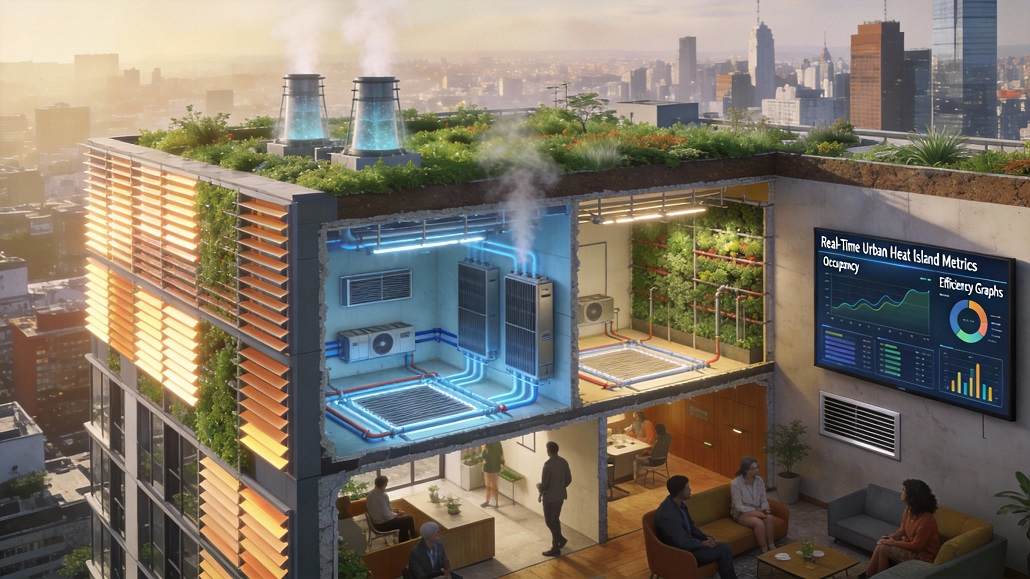
Moving beyond traditional air-based systems, the use of radiant cooling is gaining significant traction in the world of high-performance green HVAC. Radiant systems involve the circulation of chilled water through high-conductivity pipes embedded in the floors, walls, or ceilings of a building. This method is exceptionally efficient because water has a much higher heat capacity than air, allowing for the movement of significantly more thermal energy with far less mechanical effort from pumps and fans.
Additionally, radiant cooling provides a more consistent and comfortable environment by cooling the actual surfaces of the room, which then absorb heat from the occupants through radiation. This technology is particularly well-suited for climate responsive buildings that utilize high thermal mass such as exposed concrete or stone to store and slowly release “coolth” over the course of the day. By treating the building’s structure as a thermal reservoir, engineers can smooth out the peaks and valleys of cooling demand, leading to a much more stable and efficient operation.
The Integration of Natural Elements in Urban Construction
The use of living infrastructure is another critical and increasingly popular component of sustainable cooling technologies. Green roofs, vertical forests, and extensive garden terraces are no longer just aesthetic choices; they are highly functional tools for thermal regulation. By providing a living layer of vegetation and soil, these features act as natural insulators and use the process of evapotranspiration to actively cool the air surrounding the building.
In the context of dense urban construction, these green elements help to break up the “heat-trapping” nature of traditional building materials like dark asphalt and stone. When combined with smart irrigation systems that utilize recycled greywater or captured rainwater, these features contribute to a holistic approach to sustainability that benefits both the building occupants and the wider city environment. They create “cool spots” in the urban fabric that can lower localized temperatures by several degrees, providing a vital service to the community while reducing the building’s own energy needs.
Data-Driven Control and the Future of Cooling
The effectiveness of any sustainable cooling strategy is greatly enhanced by the use of intelligent, data-driven control systems. Modern buildings are increasingly equipped with an array of sensors that track everything from outdoor humidity and solar intensity to real-time indoor occupancy patterns. These sensors allow sustainable cooling technologies to be deployed with surgical precision, ensuring that no energy is wasted.
For example, a smart building management system might prioritize natural ventilation during the early morning hours when outdoor conditions are favorable, only switching to radiant cooling or high-efficiency mechanical systems when the outdoor temperature crosses a specific threshold. This dynamic management of resources ensures that the building is always operating at its peak efficiency. As we look forward, the continued evolution of these technologies incorporating artificial intelligence to predict weather patterns and occupant behavior will be essential for ensuring that our cities remain livable, sustainable, and comfortable in an increasingly warming and crowded world.