





























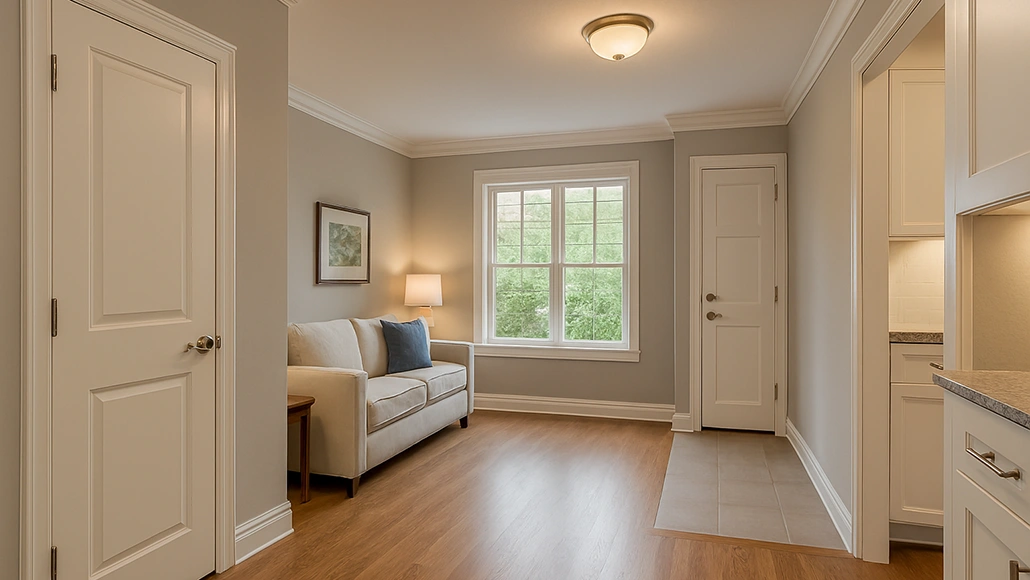


A remodel rarely fails because of poor structure or layout. Most projects fall short for a quieter reason: the finishing phase is rushed, undervalued, or treated as cosmetic instead of essential. The difference between a space that looks updated and one that feels truly finished often comes down to the final layer of decisions. Trim alignment, material transitions, lighting temperature, surface preparation, and hardware choices all communicate whether the work was thoughtfully executed or simply brought to an end.
Interior finishing touches are not about luxury for luxury’s sake. They are about cohesion and visual clarity. When finishes are consistent and intentional, even a modest renovation can feel polished and complete. When they are mismatched or unresolved, even high-end materials lose their impact. The human eye is extremely sensitive to inconsistency, particularly at edges, corners, and points where materials meet, which is why finishing details carry more weight than many homeowners realize.
Baseboards, door casing, and window trim form the visual framework of a room, and this is where craftsmanship becomes immediately apparent. One of the most common mistakes in remodels is mixing trim profiles unintentionally or choosing trim that feels undersized for the scale of the space. Uneven reveals, misaligned casing heights, and poorly joined corners disrupt the flow of a room. This level of precision mirrors what you see in other detail-driven disciplines such as embroidery software digitizing., where clean edges, consistency, and alignment determine whether the final result looks professional or unfinished. In construction, trim is not decoration; it is structure for the eye.
Trim does not need to be ornate to look high quality. In fact, simpler profiles often read more modern and intentional when used consistently throughout a home. What matters most is uniformity. Door and window casing should match across rooms, baseboard heights should feel proportional to ceiling height, and inside and outside corners should be crisp rather than overloaded with caulk. Paint finish also plays a role. Trim sheen should remain consistent, because even small variations in gloss can make elements feel replaced instead of intentionally designed.
Material transitions are another place where incomplete remodels quietly reveal themselves. Flooring changes, tile terminations, countertop edges, and wall-to-ceiling connections all deserve careful planning. A well-executed transition feels subtle and deliberate. Flooring should meet flush whenever possible rather than relying on bulky reducers. Tile should terminate cleanly with metal profiles or intentional returns instead of exposed cuts. These small moments are where craftsmanship shows, and where rushed decisions are most noticeable.
Cohesion across all these elements rarely happens by accident. It comes from experience and foresight, which is why projects handled by established construction companies connecticut homeowners rely on tend to feel more refined. Experienced teams think holistically. They consider how trim, flooring, lighting, paint, and hardware will interact before installation begins. This approach prevents last-minute compromises that can undermine an otherwise solid remodel and ensures the finished space feels intentional rather than assembled piece by piece.
Lighting is often underestimated, yet it has an outsized impact on whether a space feels complete. Many homes technically have enough light but still feel flat or uncomfortable. This is usually due to poor color temperature choices or uneven placement. Warm white lighting in the 2700K to 3000K range generally feels more natural and inviting in living areas, kitchens, and bedrooms. Cooler temperatures can work in utility spaces but often feel harsh in living environments. Layered lighting, such as combining recessed fixtures with under-cabinet lights or wall sconces, adds depth and balance.
Hardware and fixtures also play a quiet but powerful role in signaling completion. Cabinet pulls, door handles, faucets, and shower fixtures are among the most frequently touched elements in a home. When finishes clash or styles vary randomly, the space feels unsettled. Limiting metal finishes and choosing hardware scaled appropriately to cabinetry and doors helps reinforce cohesion. Undersized or builder-grade hardware in an updated space is often one of the first details people notice, even if they cannot articulate why it feels off.
Paint quality and surface preparation are often the final indicators of whether a remodel is truly complete. Sharp cut lines, smooth drywall patches, and clean caulking communicate care and attention. Poor prep leads to flashing, uneven texture, and visible repairs that become more obvious under different lighting conditions. A finished remodel should look clean in natural daylight and under artificial light, without drawing attention to the walls themselves.
A remodel looks complete when nothing feels unresolved. Materials meet cleanly, doors align properly, and the space feels calm rather than busy. That sense of completion does not come from expensive finishes alone. It comes from thoughtful execution of the details most people do not consciously analyze but always notice. When those finishing touches are handled with care, the remodel does not just look finished. It feels finished.