
























Key Takeaways
- Advanced reinforcement techniques using cost-effective materials like polypropylene bands and steel wire mesh dramatically improve masonry’s resistance to seismic activity while maintaining constructability and affordability.
- Contemporary masonry innovations focus on developing building systems that function as integrated units, facilitating proper load transfer between walls and preventing catastrophic failure patterns observed in unreinforced structures.
- Material science advancements enable masonry to withstand freeze-thaw cycling, chemical exposure, and environmental stresses that historically compromised durability, extending service life in aggressive exposure conditions.
- Resilient masonry design principles prioritize ductility and damage tolerance rather than rigidity, enabling structures to accommodate seismic movement and environmental stress while maintaining occupant safety and structural integrity.
Understanding Masonry Resilience in Contemporary Context
Building resilience has emerged as a critical design objective in contemporary construction, reflecting recognition that structures must withstand not only normal service conditions but also extreme environmental events and long-term exposure challenges that testing and degradation. Masonry, with its long historical record and demonstrated durability in diverse contexts, has proven an inherently resilient material. Yet traditional unreinforced masonry approaches showed significant vulnerability to seismic forces and certain environmental conditions. The past two decades have witnessed remarkable innovation in masonry construction methodologies that amplify the material’s inherent strengths while addressing historical limitations.
These innovations represent a fundamental shift in how engineers approach masonry design. Rather than attempting to make masonry behave like reinforced concrete or steel structures, contemporary approaches embrace masonry’s unique characteristics its compressive strength, thermal mass, fire resistance, and aesthetic qualities while implementing reinforcement and construction techniques specifically designed to enhance resilience. The result is masonry systems that perform with distinction across multiple resilience dimensions, providing building occupants protection and long-term structural reliability.
Seismic Resilience Through Advanced Reinforcement
Historical earthquake damage to unreinforced masonry buildings presented a compelling argument for employing other construction materials in seismic regions. The characteristic failure patterns out-of-plane wall collapse, junction failures where perpendicular walls met, and loss of roof diaphragm connections demonstrated that unreinforced masonry behaved unpredictably and catastrophically during seismic events. These failures were not inevitable consequences of using masonry; rather, they resulted from the specific structural characteristics of unreinforced systems and the earthquake forces they experienced.
Contemporary masonry seismic reinforcement techniques address these historical failure patterns directly. Rather than attempting to achieve seismic performance through massive walls that resist deformation rigidly, modern approaches employ reinforcement to distribute stress more effectively, create better connections between structural elements, and enable controlled deformation that dissipates seismic energy without catastrophic failure. These reinforcement methodologies, proven effective through extensive research and field validation, enable masonry buildings to perform reliably in significant seismic events.
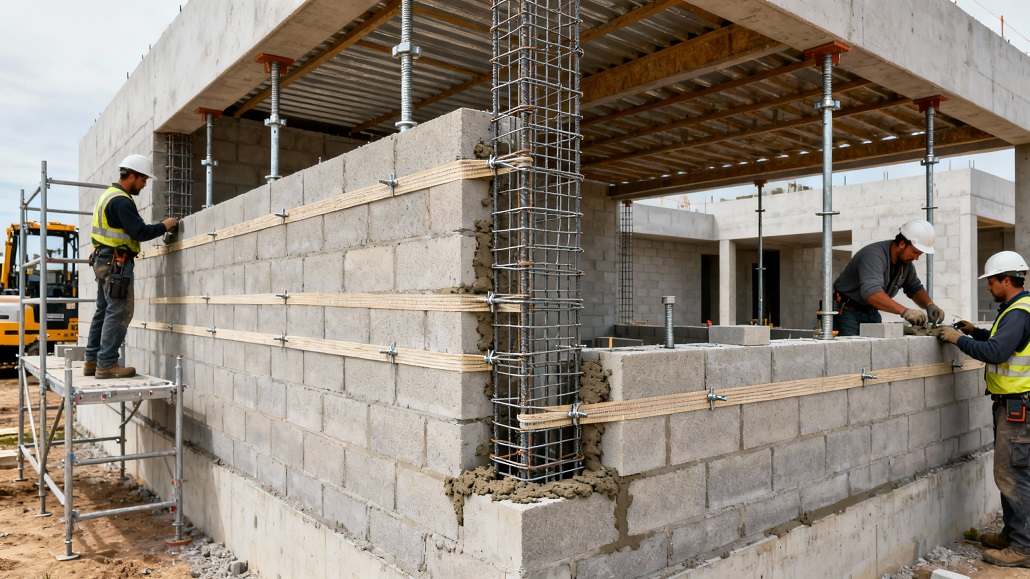
The development of cost-effective reinforcement materials has proven critical to widespread implementation of resilient masonry construction. Polypropylene bands, steel wire mesh, and composite materials offer substantial seismic performance enhancement at costs that permit their use in construction markets where expense constraints are significant. Research comparing unreinforced masonry with reinforced systems using these materials demonstrates dramatic improvements in seismic performance—structures that might experience catastrophic failure remain intact with manageable damage levels when properly reinforced with these economical materials.
Multidirectional Reinforcement for Comprehensive Performance
Traditional vertical reinforcement placed in masonry cavities addresses out-of-plane loading to some degree, but comprehensive seismic resilience requires horizontal reinforcement as well. Contemporary reinforcement approaches integrate both vertical and horizontal elements, creating reinforcement networks that distribute stress in multiple directions. Horizontal reinforcement embedded in bed joints provides crucial tension-carrying capacity to resist lateral forces that would otherwise initiate wall cracking. The interaction between vertical and horizontal reinforcement creates a three-dimensional stress-carrying matrix within the masonry that enables far superior performance compared to unreinforced construction.
The specific reinforcement arrangement varies based on building geometry, masonry unit type, and local seismic demands, but successful resilient masonry construction typically incorporates vertical reinforcement at intervals between approximately twelve and forty-eight inches, with horizontal reinforcement typically at every other or every third bed joint. These spacings represent optimization balancing structural performance against construction complexity and cost. Buildings in higher seismic zones or with critical occupancies might employ more intensive reinforcement, while lower seismic demand areas might justify sparser reinforcement placement.
The effectiveness of reinforcement depends critically on proper installation and quality assurance. Reinforcement must be properly positioned within the masonry units or cavities to achieve effective stress transfer. Mortar must fully surround reinforcement, ensuring strong bond between steel and masonry. Quality control procedures are essential to verify that reinforcement placement meets specifications before mortar cures and becomes impossible to inspect or correct. Many successful masonry buildings benefit from on-site verification that reinforcement is positioned correctly before mortar sets.
Masonry as Integrated Structural Systems
A fundamental innovation in resilient masonry design involves recognizing the building as an integrated structural system where all components must function coherently under stress. Historical unreinforced masonry buildings often failed not because individual masonry walls were inadequate in compression, but because the walls were not adequately connected to each other and to floor systems. When seismic forces induced shaking, individual walls moved independently rather than functioning as integrated units, leading to separation at junctions and out-of-plane failure of walls perpendicular to the loading direction.
Contemporary resilient masonry design ensures that perpendicular walls are adequately connected through reinforcement, that floor diaphragms are properly tied to walls, and that roof systems provide continuous diaphragm action transferring lateral forces to vertical load-carrying elements. These connections are not incidental details; they are fundamental to resilient system performance. A masonry building where individual walls are well-reinforced but poorly connected to adjacent walls might still perform inadequately during seismic events. Conversely, a properly connected masonry system can perform admirably even with modest reinforcement, because forces distribute effectively through the integrated system.
The design and detailing of connections between building elements have received substantially increased attention in contemporary masonry construction. Rather than relying on incidental friction and weak mortar bonds to transfer forces, engineers now explicitly design connection details ensuring that forces transfer effectively. Anchor bolts connect roof systems to masonry walls, ensuring the roof remains with the building rather than separating during lateral movement. Connection plates and reinforcement at corners ensure that perpendicular walls remain engaged with each other. These connection details, though often small in absolute terms, prove critical to resilient system performance.
Environmental Resilience and Durability Enhancement
Beyond seismic concerns, innovations in masonry construction address environmental resilience—the ability of structures to withstand freeze-thaw cycling, chemical exposure, and long-term environmental stresses that can compromise durability. Historical masonry often showed deterioration after decades of exposure to harsh environmental conditions, particularly in climates featuring freeze-thaw cycling combined with exposure to deicing salts.
Contemporary masonry material formulations address these historical durability challenges through multiple mechanisms. Concrete masonry units now incorporate air entrainment and specialized aggregates that improve freeze-thaw resistance. Dense, low-absorption units minimize water ingress that initiates freeze-thaw damage. Advanced mortar formulations ensure that mortar joints are less susceptible to erosion from salt crystallization and weathering. These material improvements don’t eliminate durability challenges entirely, but they substantially extend the service life of masonry construction in aggressive environments.
The performance of contemporary masonry units under rapid freeze-thaw cycling combined with salt exposure represents a significant advancement. Research examining concrete durability under freeze-thaw cycles in salt solutions shows that modern materials with proper air entrainment and cement systems maintain significantly greater strength and integrity compared to historical masonry products. The damage mechanisms remain the same ice crystal formation creates internal pressure that can overcome mortar and unit strength but contemporary materials resist these mechanisms more effectively.
Reinforcement Benefits for Environmental Stress
The reinforcement that enhances seismic performance provides collateral benefits for environmental durability. Steel reinforcement within masonry cavities restrains unit movement, reducing the stress concentrations that initiate cracking in environmental cycling. When reinforced masonry experiences freeze-thaw induced expansion or contraction, the reinforcement helps distribute stress more evenly rather than concentrating stress at weak points that would initiate cracking. This stress distribution mechanism means that reinforced masonry often exhibits greater durability than unreinforced masonry of otherwise identical material composition.
Proper construction detailing becomes critical for environmental durability. Adequate drainage planes prevent water from remaining in contact with masonry units and reinforcement, where freeze-thaw damage or corrosion might initiate. Proper flashing ensures that water entering the building system drains away rather than accumulating in cavities where damage can progress. Air gaps and ventilation channels allow trapped moisture to dry, preventing the saturation conditions that enable freeze-thaw damage. These details are not novel innovations; rather, they represent refinement of practices whose value has become increasingly appreciated as durability requirements have become more stringent.
Material Science Advancement Supporting Resilience
Contemporary masonry materials represent the product of substantial research investment aimed at improving performance characteristics. High-strength concrete masonry units enable thinner walls for equivalent load capacity, reducing material consumption and improving thermal performance. Specialized cements incorporating pozzolanic materials fly ash, silica fume, blast furnace slag improve durability in chemically aggressive environments by creating denser microstructures less vulnerable to chemical attack.
Fiber reinforcement incorporated directly into concrete masonry units or mortar improves the material’s ductility and crack resistance. Rather than fracturing sharply when overstressed, fiber-reinforced materials exhibit more gradual failure with retained residual strength after cracking initiates. This improved ductility enhances the resilience characteristics of masonry assemblies, enabling them to accommodate stress beyond the point at which unreinforced masonry would fail completely.
The development of permeable mortars and specialized drainage materials has improved masonry’s ability to manage moisture, a critical factor in durability. Rather than relying on mortar joints to completely prevent water penetration an impossible standard in practice contemporary systems acknowledge that some water will penetrate the masonry but include mechanisms ensuring this water exits rapidly rather than accumulating. These systems often incorporate mortar with intentional permeability combined with drainage planes and weep holes that facilitate water exit.
Construction Methodology Innovations
The innovations enabling resilient masonry extend beyond materials to construction methodologies and sequencing. The development of specialized tools and equipment for placing reinforcement efficiently has made reinforced masonry construction more practical and economical than historically possible. Devices for placing horizontal reinforcement in bed joints enable rapid installation without disrupting construction flow. Equipment for consolidating mortar around reinforcement ensures quality installation without the labor-intensive hand work that made reinforcement unpopular historically.
Training and skill development represent important innovations supporting resilient masonry construction. The construction trades have evolved to embrace reinforcement placement and quality requirements that were foreign to traditional masonry practice. Masonry workers now routinely place reinforcement, verify positioning before mortar sets, and understand the performance implications of construction quality. This shift in construction culture, gradually accomplished over two decades of innovation and market development, has proven as important to resilience outcomes as material or design innovations.
Integration with Contemporary Building Systems
Resilient masonry construction increasingly integrates with contemporary building systems including Building Information Modeling, prefabrication, and modular assembly approaches. The complexity of reinforcement placement and the criticality of connection details benefit substantially from detailed three-dimensional modeling that identifies reinforcement locations and coordination requirements before construction begins. Digital fabrication techniques enable components to be produced to exact specifications, then installed with confidence that they will coordinate properly with other building elements.
Prefabricated masonry panels incorporating reinforcement offer the prospect of quality-assured, efficiently-produced resilient masonry components that can be deployed rapidly in the field. Rather than attempting complex reinforcement placement under field conditions with all their challenges, factory environments enable careful quality control and skilled installation of reinforcement in optimized conditions. The resulting panels then provide high-performance resilience characteristics with the efficiency benefits of prefabrication.