




























Key Takeaways
- Concrete pavements deliver exceptional durability under heavy traffic loading and environmental exposure, with some North American concrete highways performing reliably for sixty years or more with minimal maintenance intervention.
- Strategic material selection including cement type, aggregate quality, and incorporation of supplementary cementitious materials directly influences concrete performance under repeated loading and aggressive environmental conditions.
- Rigorous design methodologies account for traffic patterns, environmental exposure, subgrade conditions, and maintenance capabilities to ensure concrete transportation infrastructure achieves intended design life with acceptable maintenance requirements.
- Life-cycle cost analysis consistently demonstrates that concrete transportation infrastructure delivers superior economic value compared to alternative materials when durability and maintenance requirements are properly evaluated.
Concrete’s Role in Modern Transportation Networks
Transportation infrastructure underpins economic activity and social connectivity, enabling movement of goods and people that modern society depends upon. The materials and construction methods chosen for roads, bridges, and related transportation infrastructure influence not only initial costs but operational expenses, safety, service life, and environmental impact across decades of operation. Concrete has emerged as the dominant material choice for transportation infrastructure globally, a position justified by exceptional performance under demanding conditions combined with proven ability to deliver service lives spanning fifty years or longer.
The preference for concrete in transportation applications reflects not tradition or manufacturer advocacy, but rather documented performance and economic reality. Concrete pavements that were originally constructed seventy years ago continue to serve traffic with only routine maintenance. Concrete bridges built decades ago remain structurally sound and capable of supporting traffic loads far exceeding original design assumptions. This documented long-term performance, combined with continuing innovation in concrete technology and design methodology, has solidified concrete’s position as the preferred material for transportation infrastructure in demanding applications.
Design Principles for Long-Life Concrete Pavements
The design of concrete transportation infrastructure begins with comprehensive understanding of the loads and environmental conditions the structure will experience throughout its intended service life. Traffic analysis characterizes vehicle frequencies and weights, allowing engineers to estimate cumulative loading that will act on the pavement. Environmental analysis evaluates temperature extremes, freeze-thaw cycling frequency, moisture exposure, and other environmental factors that influence concrete durability. Subgrade investigation assesses soil conditions and drainage characteristics that affect moisture availability and load distribution beneath the pavement.
These analytical inputs feed into mechanistic design methods that calculate pavement thickness and reinforcement requirements necessary to accommodate anticipated loading and environmental exposure. Rather than relying on empirical correlations from historical projects, contemporary design increasingly employs physics-based approaches that directly model stress and strain development within the pavement structure. These sophisticated design tools enable optimization of pavement thickness, layer composition, and reinforcement arrangement to achieve target design life with minimum material consumption.
The concept of design life the period during which the pavement will perform acceptably before major rehabilitation becomes necessary fundamentally shapes concrete infrastructure design. Transportation agencies typically target design lives of thirty to forty years for routine highway applications, extending to fifty years or longer for critical facilities where extended service life justifies enhanced design and construction quality. Achieving these targeted design lives requires appropriate material selection, thorough construction quality control, and ongoing maintenance preventing minor deterioration from developing into major problems.
Material Selection for Enhanced Performance
The concrete mixture design for transportation applications represents a critical decision influencing performance throughout the pavement’s service life. Portland cement characteristics influence early strength development, heat of hydration, and long-term durability. Supplementary cementitious materials fly ash from power generation, slag from steel production, silica fume from silicon metal processing modify concrete properties in ways that often enhance durability in aggressive environments. These materials reduce heat of hydration, improving crack control in mass concrete applications; enhance resistance to chemical attack in environments exposed to deicing salts or sulfate compounds; and improve long-term strength development.
Aggregate selection profoundly influences concrete performance in transportation applications. Coarse aggregates must provide adequate strength, durability, and skid resistance when exposed at the pavement surface. Fine aggregates must produce concrete with workability enabling efficient placement while ensuring adequate strength development. The limestone, granite, or other rock types constituting aggregates influence not only initial concrete properties but long-term durability under environmental cycling and chemical exposure.
Air entrainment intentional incorporation of small air bubbles into the concrete represents one of the most important innovations enabling concrete pavements to survive repeated freeze-thaw cycling in cold climates. The air bubbles provide relief zones where water can expand during freezing, preventing ice crystal formation from creating destructive pressures within the concrete mass. Concrete pavements in freeze-thaw climates without adequate air entrainment deteriorate rapidly, while properly air-entrained concrete survives hundreds of freeze-thaw cycles. The difference between air-entrained and non-air-entrained concrete’s durability in these environments is dramatic and well-documented through decades of field performance.
Construction Quality as Foundation for Performance
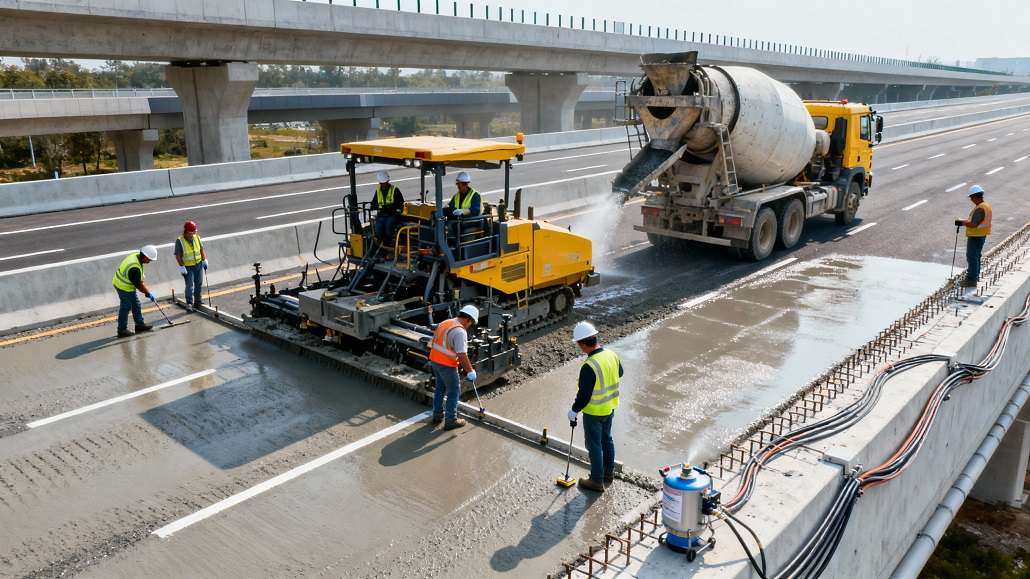
Even the most carefully designed concrete pavement will underperform if construction quality is inadequate. The placement and consolidation of concrete significantly influence final properties. Concrete that is improperly consolidated contains voids and microdefects that reduce strength and durability. Concrete that experiences segregation separation of coarse aggregate from the cement paste develops zones of reduced quality that initiate deterioration. Experienced concrete contractors and diligent quality assurance personnel ensure that concrete is placed and consolidated in ways that maximize final quality.
The finishing of concrete pavement surfaces influences both durability and safety performance. The surface texture affects friction characteristics critical to vehicle safety, particularly in wet conditions. The surface also influences water drainage an improperly finished surface that retains standing water rather than shedding it hastens deterioration through extended moisture exposure. Modern concrete pavement construction employs specialized finishing equipment and techniques ensuring that surfaces achieve intended texture and drainage characteristics.
Curing practices during the initial period after placement fundamentally influence concrete strength development and durability. Concrete must be maintained in moist conditions during the curing period to enable continued hydration of cement particles. Drying too rapidly compromises strength development and creates internal stresses that can lead to cracking. Extended curing often using liquid curing compounds that seal the surface and retain moisture supports better strength development and enhanced durability. The cost of good curing practices is minimal compared to their benefit in enhancing pavement performance throughout its design life.
Concrete Bridge Systems for Spanning Demands
Bridge structures represent some of the most demanding applications of concrete, with live loads from traffic, environmental forces including wind and earthquakes, and thermal stresses from temperature variation all creating complex loading conditions. Concrete bridges employ sophisticated structural systems post-tensioned systems, precast beam assemblies, arch structures, and others optimized for specific circumstances.
The post-tensioning of concrete bridge girders represents an elegant approach to managing tensile stresses that would otherwise crack concrete and compromise durability. High-strength steel cables are threaded through concrete members, then tensioned after concrete cures to specified strength. This tensioning creates compressive stress throughout the concrete cross-section that offsets tensile stresses from traffic loading. Properly designed and constructed post-tensioned bridges can experience live loads creating significant tensile stresses without entering the tension range that would crack concrete and potentially initiate durability problems.
Precast concrete bridge components offer quality assurance and construction efficiency advantages difficult to achieve with cast-in-place construction. Girders, piers, and other structural elements manufactured in controlled factory environments achieve superior quality compared to field construction. Components are produced to precise dimensions, ensuring proper fit during assembly. Quality assurance during manufacturing ensures that compressive strength, reinforcement placement, and other critical properties meet specifications before components leave the factory. The cost of precasting is repaid many times through reduced field labor, accelerated construction timelines, and superior final quality.
Performance Under Extreme Loading and Environmental Conditions
Concrete transportation infrastructure must perform reliably under loading conditions that far exceed what designers originally anticipated. Highways designed in the 1960s were subjected to traffic loads in the twenty-first century far exceeding anything original designers envisioned. Rather than failing catastrophically, well-designed concrete pavements continue functioning, though increasingly at the limits of their original design capacity. This extended performance demonstrates the robustness that concrete provides when properly engineered.
Environmental exposure conditions freeze-thaw cycling combined with deicing salt application, chemical exposure from industrial facilities, sulfate-rich groundwater, and others represent major challenges for transportation infrastructure. Concrete designed and constructed with understanding of these environmental challenges performs acceptably for design life. Concrete inadequately protected against recognized environmental challenges deteriorates rapidly. The distinction between success and failure is not inevitable but results from appropriate material selection, design consideration, and construction quality oriented toward recognized durability challenges.
Heavy traffic loading creates fatigue stress in concrete pavements as wheels repeatedly load and unload pavement sections. Unlike steel, which can experience millions of loading cycles, concrete strength deteriorates gradually under repeated loading. Pavement design must account for this fatigue effect, ensuring that calculated fatigue life significantly exceeds anticipated traffic loading. Well-designed pavements with appropriate thickness and reinforcement resist fatigue deterioration even under heavy traffic.
Maintenance Strategies Extending Service Life
Even well-designed concrete pavements benefit from preventive maintenance preventing minor deterioration from developing into major problems requiring expensive rehabilitation. Seal coating protects concrete surface from water infiltration and chemical exposure, extending service life substantially at modest cost. Filling small cracks before water enters through them prevents freeze-thaw damage progression. Patching minor pavement damage restores integrity and prevents larger failures.
The development of concrete pavement management systems enables agencies to schedule maintenance optimally, conducting work when conditions justify investment and maximum benefit will accrue. Condition monitoring identifies pavements requiring attention before they deteriorate to poor condition. Regular maintenance is less expensive and disruptive than major rehabilitation of severely deteriorated pavements. Many transportation agencies have moved from reactive maintenance responding to pavement failures as they occur toward proactive programs maintaining pavement condition throughout its service life.
Innovation in Concrete Infrastructure Materials and Techniques
Emerging concrete technologies promise further enhancement of transportation infrastructure performance. Pervious concrete porous material that allows stormwater infiltration addresses water management and environmental concerns while maintaining load-carrying capacity. Fiber-reinforced concrete improves crack control and ductility, enabling thinner pavements or extended service life from equivalent thickness. Roller-compacted concrete enables rapid placement of concrete pavements using compaction equipment, reducing construction time and costs for some applications.
Recycled concrete materials derived from demolished concrete structures are being investigated and increasingly employed in new pavement construction, offering sustainability benefits by reducing demand for virgin aggregate and landfill disposal of construction waste. Properly designed recycled concrete materials perform comparably to virgin aggregate alternatives, expanding circular economy opportunities in concrete infrastructure.