






























Key Takeaways
- Automated laser screeds maintain millimeter-level precision compared to manual methods prone to human error
- Robotic troweling systems achieve 300+ square meters per hour productivity rates with consistent surface quality
- Precision placement reduces concrete waste by 15-20% through accurate material distribution
- FF flatness ratings consistently meet specification requirements with automated systems exceeding manual capabilities
- GPS and sensor-equipped robots eliminate operator fatigue variables affecting traditional finishing quality
The Revolution in Concrete Execution Technology
Concrete construction has historically relied on skilled trades performing labor-intensive placement and finishing operations across expansive surfaces. Workers operating power trowels, pushing heavy screeds, and manually leveling freshly placed concrete represented the industry standard for decades. However, this approach introduced inherent inconsistencies resulting from operator fatigue, environmental stresses, and the profound difficulty of maintaining specification compliance across massive surface areas. Precision concrete placement automation now addresses these challenges through revolutionary technologies that establish new industry standards for quality, efficiency and worker safety.
The convergence of laser technology, computational controls, and mechanical engineering has enabled contractors to achieve results that transcend traditional manual labor capabilities. Modern precision systems combine accuracy impossible through human effort with consistency that builds competitive advantage into project execution. Advanced jobsite teams increasingly recognize that equipment investment in precision concrete placement automation technologies yields returns far exceeding capital costs through improved project economics, enhanced reputation for quality delivery, and expanded capacity to pursue premium projects demanding exacting specifications.
Laser Screed Technology Fundamentals
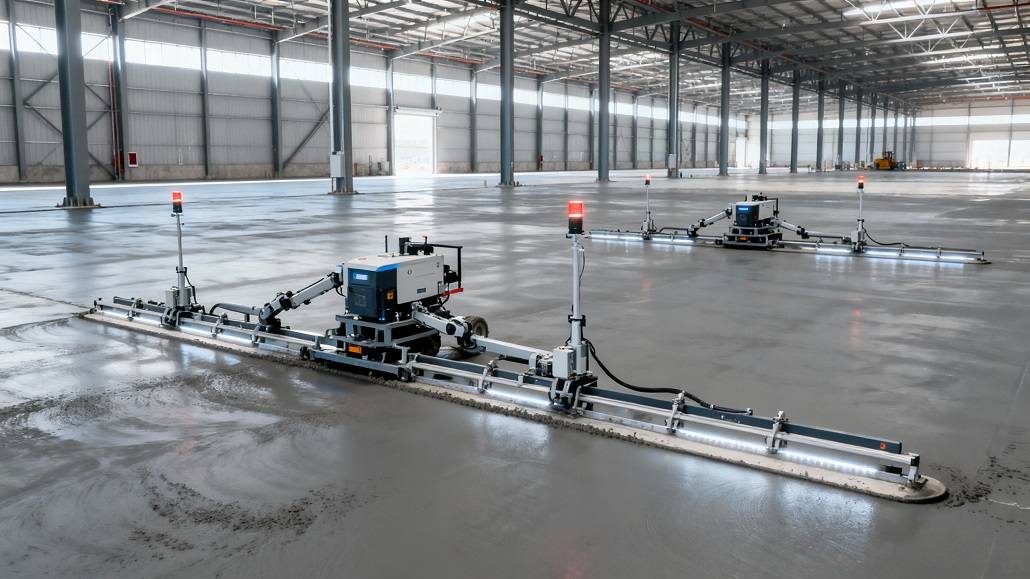
Laser screeding represents the foundational technology enabling precision concrete placement automation across residential, commercial, and industrial applications. The system comprises integrated components working in concert to achieve automated leveling with millimeter-level precision. A laser transmitter establishes a precision reference plane, while receiver sensors mounted on the screed head continuously detect laser beam positioning relative to established grades. Sophisticated control systems compare actual screed position against laser reference coordinates and automatically adjust screed elevation through hydraulic mechanisms, maintaining target grades with exceptional consistency throughout concrete placement operations.
The operational elegance of laser screed technology masks complex engineering working seamlessly behind scenes. Operators guide the screed across concrete surfaces at controlled speeds while the automated elevation adjustment system handles the cognitively demanding task of maintaining exact specifications across entire surfaces. Traditional manual screening required operators maintaining mental calculations of grade changes, crowd positioning, and elevation adjustments while controlling mechanical forces and compensating for material variations. Laser systems eliminate these human operator variables, delivering consistent results regardless of operator experience or environmental conditions affecting manual performance.
Performance metrics demonstrate compelling advantages favoring automated precision systems. FM flatness and FL levelness ratings standardized metrics quantifying surface characteristics in construction specifications consistently reach specification limits with laser screeded surfaces while manual operations frequently struggle achieving target values. A typical 150-millimeter-thick warehouse floor slab accomplished with conventional manual methods in ten hours using a twelve-person placing crew and six-person finishing crew would require modified scheduling and potentially extended timelines when precision specifications demand consistent achievement of demanding flatness values. Laser screeding eliminates these quality uncertainties while accelerating completion schedules through enhanced crew efficiency.
Concrete strength and durability directly correlate with achieving specified flatness values. Irregular surfaces with depressions and high spots create water ponding zones where moisture accumulates, accelerating deterioration mechanisms and reducing structural longevity. Conversely, precision placement establishing uniformly flat surfaces eliminates water ponding, distributes loading stresses evenly across surfaces, and enhances facility functionality throughout extended service life. The relationship between initial placement precision and long-term performance validates equipment investment from both immediate project economics and lifecycle cost perspectives.
Robotic Troweling Systems and Advanced Finishing
Concrete finishing represents perhaps the most physically demanding and skill-dependent phase of slab construction. Power trowels operated by experienced workers provided traditional improvements over walk-behind equipment, yet still required exceptional operator skill to maintain consistent results across entire floor expanses. Physical fatigue, operator experience variations, and environmental factors inevitably introduced inconsistencies that compromised final surface quality. Robotic troweling systems eliminate these operator variables through automated control of blade speed, angle, and pressure, delivering uniform finishing regardless of surface area or concrete consistency variations during progressive setting stages.
Advanced robotic troweling equipment employs multiple design approaches addressing different application requirements and site conditions. Caterpillar or wheeled drive systems distribute equipment weight across large surface areas, preventing sinking into partially-set concrete while maintaining effective mobility across expansive floors. Multiple rotating trowel blades with variable speed control adapt to changing concrete consistency as material progressively strengthens throughout finishing operations. Integrated sensor systems monitor concrete curing stages in real-time, continuously optimizing trowel operations and adjusting blade speeds and patterns to achieve desired surface characteristics as concrete strength development progresses.
One particularly innovative robotic finishing approach employs four-piece trowel systems rotating around centrally-mounted caterpillar drives, with trowels working in coordinated patterns that achieve uniform surface compaction and smoothing. These sophisticated systems produce surface quality comparable to work performed by experienced plastering professionals while covering expansive areas at production rates reaching 300 square meters per hour. The productivity advantage proves particularly compelling when multiplied across large-scale floor projects. A 10,000 square meter warehouse floor slab that might require six weeks of finishing work with traditional manual methods could reach completion in less than three weeks using robotic systems, dramatically compressing overall construction schedules.
Integration of GPS guidance and automated control systems enables robotic trowels to work autonomously across defined work areas with minimal human intervention. Operators program equipment parameters reflecting concrete characteristics and desired finish specifications, then systems execute according to established plans with continuous sensor feedback adjusting operations in real-time. This automation level reduces labor requirements from crews of multiple skilled trowel workers to a single system operator managing multiple pieces of equipment, delivering dramatic cost reductions alongside superior consistency and result quality.
Comprehensive Slab Solutions Through Integrated Systems
The most advanced precision concrete placement automation implementations combine laser screeding for initial leveling with robotic trowel systems for subsequent finishing operations, creating integrated workflows that optimize both speed and quality. Laser screeding establishes precise grade references and initial surface leveling as concrete achieves appropriate consistency for screed operation. Robotic trowels subsequently process surfaces achieving specified flatness values and aesthetic finishes. This sequential workflow, with each specialized system optimized for specific functions, produces results exceeding what either technology achieves independently while establishing new industry standards for execution quality.
Coordination between laser and robotic systems involves sophisticated timing management ensuring each system operates at optimal concrete development stages. Scheduling algorithms account for concrete strength gain rates influenced by ambient temperature and humidity conditions, as well as project-specific pour sequences and environmental factors. Real-time monitoring systems tracking concrete curing progress trigger equipment deployment at ideal times, maximizing efficiency while ensuring quality outcomes. Building information modeling systems increasingly incorporate concrete finishing system scheduling, enabling projects to optimize equipment deployment, labor allocation, and material coordination throughout construction phases.
Material waste reduction represents a compelling but sometimes overlooked advantage of precision concrete placement automation. Accurate concrete distribution and optimized screed operation eliminate the excess material historically required as insurance against placement uncertainties or screed breakthrough. GPS-guided systems deliver concrete with precision that reduces overages by 15 to 20 percent compared to conventional placement methods. These material savings, multiplied across large-scale projects, generate cost reductions and environmental benefits that reinforce the business case for equipment adoption.
Implementation Challenges and Workforce Adaptation
Despite compelling advantages, widespread adoption of precision concrete placement automation encounters real obstacles requiring thoughtful management. Equipment capital costs represent substantial upfront investments, creating financial barriers for smaller contractors and those with limited project pipelines justifying equipment purchase. Rental market development and equipment-as-service models progressively address these barriers, enabling broader contractor participation in precision technology benefits without requiring permanent capital investment. Progressive contractors increasingly view equipment rental costs as justified by improved productivity, enhanced quality reputation, and expanded market access to clients demanding exacting specifications.
Workforce adaptation presents multifaceted challenges involving both technical training and organizational culture evolution. Traditional concrete operations evolved around labor-intensive manual methods where crew experience and individual skill directly correlated with output quality. Transitioning toward automated systems requires fundamentally different skill sets emphasizing equipment operation, programming, sensor interpretation, and troubleshooting capabilities. Workers accustomed to direct physical involvement in concrete finishing may experience psychological resistance to roles emphasizing system monitoring and adjustment rather than hands-on participation.
Progressive contractors address workforce adaptation through comprehensive training programs, clear communication regarding role evolution rather than elimination, and documented career pathways demonstrating advancement opportunities in increasingly technical construction environment. Early adopter contractors report that workers initially skeptical of automation embrace equipment after experiencing improved working conditions, reduced physical strain, and enhanced job satisfaction derived from more technical responsibilities. The industry inevitably moves toward equipment-integrated operations, making workforce development a strategic imperative for contractors seeking sustainable competitive advantage.
Quality control and specification management require procedural modifications when implementing precision concrete placement automation. Inspectors and quality assurance personnel need training interpreting data and measurements generated by sophisticated equipment, replacing traditional subjective assessment approaches with objective performance metrics and electronic records. This transition, while requiring initial investment, ultimately strengthens quality management by replacing subjective evaluation with objective documentation of performance achievements throughout construction execution phases.
Economic and Strategic Implications
Economic analysis of precision concrete placement automation investments reveals compelling returns justified through multiple mechanisms. Direct labor cost reductions from enhanced crew productivity and reduced rework requirements often exceed equipment costs within two to three years of operation for major contractors. Enhanced project delivery speed and schedule compression enable contractors to increase annual revenue through expanded project capacity without proportional cost increases. Perhaps most significantly, reputation enhancement derived from consistent quality delivery creates market differentiation enabling premium pricing for projects demanding exacting specifications.
Strategic positioning as precision construction leader creates competitive advantages extending across project portfolios. Sophisticated clients increasingly specify flatness requirements reflecting modern facility operations where precision floors directly impact equipment performance and operational efficiency. Contractors demonstrating mastery of precision concrete placement automation technology capture disproportionate market share for premium projects where specification compliance directly influences client value creation and competitive positioning.
The transformation of concrete construction through precision concrete placement automation represents inevitable industry evolution driven by convergent technological capability, economic advantage, and quality imperative. Contractors, suppliers, and equipment manufacturers who lead this transition establish competitive positions that strengthen throughout construction industry evolution. The future belongs to organizations understanding that advancement requires embracing technological transformation while thoughtfully managing workforce evolution and client relationship development. Through deliberate implementation strategy and comprehensive workforce development, precision concrete technology delivers superior results creating value for all stakeholders throughout construction project lifecycle.