



























Key Takeaways
- Integrated BIM environments detect design conflicts before fabrication, reducing costly rework and manufacturing errors
- Real-time coordination workflows enable simultaneous work by multiple disciplines, compressing design timelines by 25-35%
- Automated approval routing accelerates decision-making processes, eliminating delays from scattered communications
- Clash resolution in virtual environments proves substantially faster and cheaper than discovering conflicts on fabrication floors
- Fabricators accessing coordinated design models produce components that fit together precisely, reducing on-site assembly complications
- Installation teams receive pre-coordinated designs enabling efficient on-site assembly without unexpected conflicts or modifications
Construction project delivery fundamentally depends on coordination across diverse disciplines. Architects envision spatial configurations. Structural engineers design support systems. Mechanical engineers design building systems. Electrical engineers plan power distribution. Plumbing designers route water and waste systems. Dozens of specialists contribute designs that must ultimately fit together harmoniously. Traditional coordination approaches involve circulating documents between disciplines, reviewing for conflicts, sending marked-up revisions, receiving updates, and repeating cycles until conflicts resolve. This serial process consumes months, frequently producing designs with residual conflicts that appear only during construction.
Intelligent coordination workflows transform this fundamental dynamic. Rather than specialists working in isolation and coordinating after-the-fact, connected digital environments enable simultaneous multi-discipline work where all specialists view coordinated models, see conflicts in real time, and resolve issues immediately. This shift from sequential to simultaneous collaboration compresses timelines and dramatically reduces conflicts.
Prefabrication particularly benefits from intelligent coordination. When fabricators receive fully coordinated designs with all conflicts resolved, they produce components that fit together precisely without field modifications. Installers receive pre-coordinated assemblies that flow together smoothly. Rework essentially vanishes. The result combines timeline compression with quality improvement—a rare combination where one improvement doesn’t create trade-offs elsewhere.
Understanding Integrated Coordination Environments
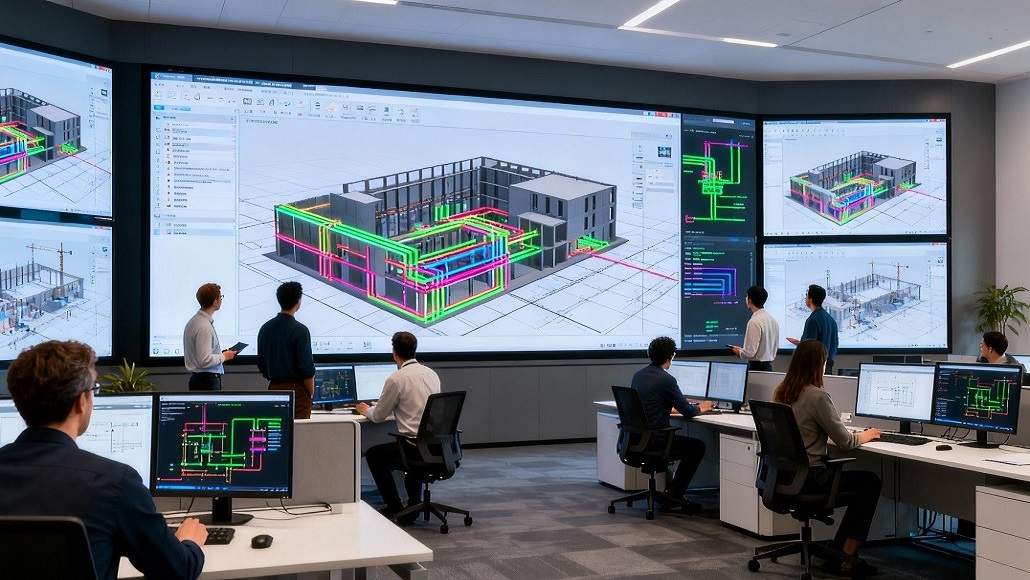
Intelligent coordination depends on integrated digital environments where all project participants access unified design models containing contributions from all disciplines. Rather than each discipline maintaining separate models, integrated environments consolidate all design information into coordinated models where conflicts are immediately visible.
Building Information Modeling (BIM) provides the technical foundation enabling coordination environments. BIM represents buildings as three-dimensional objects containing detailed information—geometry, material properties, performance characteristics. When multiple disciplines contribute to shared BIM models, every discipline sees how other disciplines’ work affects their designs. Mechanical ductwork routing becomes visible to structural engineers who can ensure ducts don’t interfere with beams. Electrical conduits become visible to plumbing designers who can coordinate routing. Architectural elements become visible to all structural disciplines who can design support systems around existing architecture.
These integrated environments transform coordination from a painful serial process into a natural byproduct of working within the same digital space. Rather than coordination being an additional task performed after disciplines complete individual designs, coordination is inherent in the collaborative design process.
Clash Detection and Conflict Resolution
Physical conflicts between building systems represent one of construction’s persistent problems. Mechanical ducts intersect with structural beams. Plumbing pipes conflict with electrical conduits. Architectural features conflict with structural requirements. These conflicts discovered during construction require expensive field modifications, rework, and schedule delays. Discovering conflicts earlier—ideally during design before fabrication—reduces these costs dramatically.
Intelligent coordination workflows employ automated clash detection identifying conflicts before they reach construction. Sophisticated algorithms analyze spatial relationships between all building components, identifying intersections that shouldn’t occur. When a mechanical duct’s path intersects a structural column, clash detection flags this conflict immediately. When electrical conduit routing conflicts with plumbing, the system highlights this interference.
Detecting conflicts early proves substantially more valuable than discovering them later. During design, resolving conflicts might require minimal rework—routing a duct differently requires changing design drawings. During fabrication, the same change requires reworking already-fabricated components. On-site, the conflict might require field modifications to components already installed. Cost differences are dramatic—a design change costs thousands, a fabrication change costs tens of thousands, a field modification costs hundreds of thousands.
The systematic nature of automated clash detection proves equally important as early identification. Manual coordination processes inevitably miss some conflicts—a particularly insidious problem because the process creates false confidence that remaining conflicts have been identified. Automated systems check all spatial relationships exhaustively, ensuring no conflicts escape detection.
Real-Time Coordination and Simultaneous Multi-Discipline Work
Traditional design sequences disciplines serially—structural design completes, then mechanical design, then electrical design. This sequence inevitably creates inefficiency as each discipline makes assumptions about other disciplines’ work, frequently discovering those assumptions were incorrect.
Intelligent coordination enables simultaneous work by multiple disciplines. Rather than waiting for structural design to complete, mechanical engineers begin designing within coordinated models that show preliminary structural work. As structures evolve, mechanical designs adapt automatically to coordinate with updated structures. Electrical engineers simultaneously route systems around evolving mechanical and structural designs. All disciplines contribute concurrently rather than sequentially.
This simultaneous work compresses timelines significantly. Projects that might require sequential discipline work spanning 6 months can accomplish the same scope in 4 months through simultaneous coordination. The time compression results not from individuals working faster but from eliminating waiting periods inherent in sequential approaches.
Simultaneous work particularly benefits prefabrication where early clarity regarding final designs enables manufacturing planning. Rather than waiting for design completion before fabricators can assess manufacturing feasibility, fabricators participate in coordinated design environments throughout design development. Fabricators flag manufacturing challenges early, designers adjust designs to accommodate manufacturing constraints, and the result is designs that are simultaneously optimal and fully manufacturable.
Automated Approval Routing and Decision Acceleration
Traditional project coordination involves numerous decisions requiring approvals from multiple stakeholders. Should a mechanical duct route above or below a structural beam? Should electrical conduit use a particular pathway? These decisions might require approval from structural engineers, mechanical designers, electrical engineers, and project managers.
Intelligent workflows automate approval routing, directing decisions to relevant stakeholders and tracking approval status. When a conflict requires resolution, the system identifies which specialists must approve the resolution approach, routes the decision to those individuals simultaneously (rather than sequentially), tracks their responses, and escalates unresolved decisions. This parallel approval process dramatically accelerates decision-making.
The transparency enabled by automated workflows prevents decisions from stalling. Traditional processes sometimes lose track of pending approvals—a designer requests input, receives no timely response, and either proceeds without approval or stalls waiting. Intelligent systems explicitly track approvals and escalate stalled decisions. Status visibility ensures stakeholders understand decision status and deadlines.
Fabrication Planning Integration
The full value of intelligent coordination emerges when fabricators access coordinated design models for fabrication planning. Rather than fabricators receiving finished designs and assessing manufacturability reactively, they participate in design development from inception. Fabricators understand manufacturing constraints and communicate them to designers as designs develop.
Fabricators accessing fully coordinated designs understand exactly which components must fabricate and how those components integrate with other building systems. Manufacturing sequences become optimized based on complete design information. Fabricators can identify components that should fabricate together, sequences that optimize manufacturing efficiency, and logistics plans that align with installation schedules.
The precision of coordinated designs means fabricators produce components that fit together exactly as designed. Field modifications become rare. On-site assembly becomes predictable. Installation teams install pre-coordinated components that flow together smoothly without unexpected conflicts requiring creative problem-solving or modifications.
Installation Sequencing and On-Site Assembly
Installation teams receiving pre-coordinated prefabricated components experience fundamentally different site conditions than traditional construction. Rather than managing complex coordination on-site where resolving conflicts is expensive and time-consuming, installation teams assemble well-coordinated prefabricated systems.
Intelligent coordination enables advance planning of installation sequences. Rather than improvising installation sequences based on actual on-site conditions, installers receive pre-planned sequences optimized for efficiency. Teams know exactly which components arrive on specific dates, where components will be positioned, and which systems install first. This planning eliminates on-site decision-making and coordination complexity.
Installation teams can validate that site conditions match design assumptions. If the coordinated design assumes specific site dimensions or access routes, field teams verify these assumptions before component shipment. Discovering and correcting assumption mismatches before fabrication completes is far superior to discovering conflicts as components arrive.
Rework Reduction and Cost Impact
The cumulative impact of intelligent coordination manifests as dramatic rework reduction. Traditional construction projects typically experience 20-30% of total work involving rework—correcting errors, fixing conflicts, and accommodating unforeseen conditions. Prefabricated projects employing intelligent coordination reduce rework to 5-10% or less.
The cost impacts prove substantial. A $10 million construction project with 25% rework rate might spend $2.5 million on rework. Reducing rework to 7% reduces rework costs to $700,000—a $1.8 million improvement representing 18% cost reduction on total project scope.
Quality metrics similarly improve. Rather than designs containing residual conflicts managed through field improvisation, intelligent coordination ensures designs are genuinely conflict-free. Field quality inspection focuses on verifying that installed systems match coordinated designs rather than discovering design conflicts during installation. Defect rates decrease and warranty claim rates drop.
Technology Enablement and Implementation
Cloud-based BIM platforms provide the technical foundation enabling intelligent coordination. Platforms like Autodesk BIM 360 enable real-time multi-discipline collaboration on shared models. Participants access current models regardless of location, see others’ work in real time, and coordinate changes through centralized systems.
These platforms integrate clash detection algorithms, approval workflow automation, and issue management. Clash detection runs continuously, flagging new conflicts automatically. Approval workflows route decisions and track resolution. Issue management systems record problems, assign responsibility, and track resolution to completion.
Implementation requires organizational change beyond software adoption. Design teams must develop collaborative practices enabling simultaneous work rather than sequential workflows. Fabricators must integrate into design processes early rather than receiving finished designs reactively. Installation teams must receive pre-coordinated designs and validate that site conditions match design assumptions.
Training and change management prove essential. Professionals accustomed to traditional sequential workflows must learn collaborative approaches. Architects must learn to design within coordination environments where other disciplines’ work is immediately visible. Structural engineers must understand that structural designs affect mechanical routing which affects electrical planning.
Industry Impact and Competitive Advantage
Organizations successfully implementing intelligent coordination workflows develop significant competitive advantages. Superior project delivery speed enables faster market response. Cost reduction through rework elimination improves profitability. Quality improvement strengthens reputation and client satisfaction. These advantages compound as organizations refine coordination practices and integrate more disciplines more deeply.
The industry increasingly recognizes intelligent coordination as essential infrastructure. Regulatory bodies increasingly require coordination verification as part of design compliance. Clients increasingly demand coordination evidence before approving designs. Professional standards increasingly emphasize coordination competency.
The future of construction belongs to organizations capable of orchestrating sophisticated multi-discipline coordination. Rather than specialists working in isolation and managing conflicts after-the-fact, leading organizations enable simultaneous collaboration where conflicts are identified and resolved in real time. Intelligent coordination workflows represent the foundation of modern prefabricated construction delivery, essential infrastructure differentiating leading organizations from traditional competitors.