































Key Takeaways
- Parametric design tools reduce engineering time by 40-50% through automation of complex calculations and iterative processes
- Data-driven design systems enable accurate material forecasting, reducing waste and improving cost predictability
- Algorithmic optimization improves module geometries, enhancing structural efficiency and manufacturability
- Design iteration becomes faster and more comprehensive, enabling evaluation of multiple optimization scenarios
- Manufacturing constraints integrated into design processes from inception eliminate downstream redesign requirements
- Integration with fabrication equipment enables seamless translation from digital models to production specifications
The engineering phase represents one of the construction industry’s largest time and cost expenditures. Traditional design processes rely on experienced engineers making iterative decisions, hand-calculating structural solutions, estimating material quantities, and repeatedly revising designs as conflicting requirements surface. This manual approach, while enabling engineering creativity, consumes months and frequently results in material waste, manufacturing inefficiencies, and missed optimization opportunities.
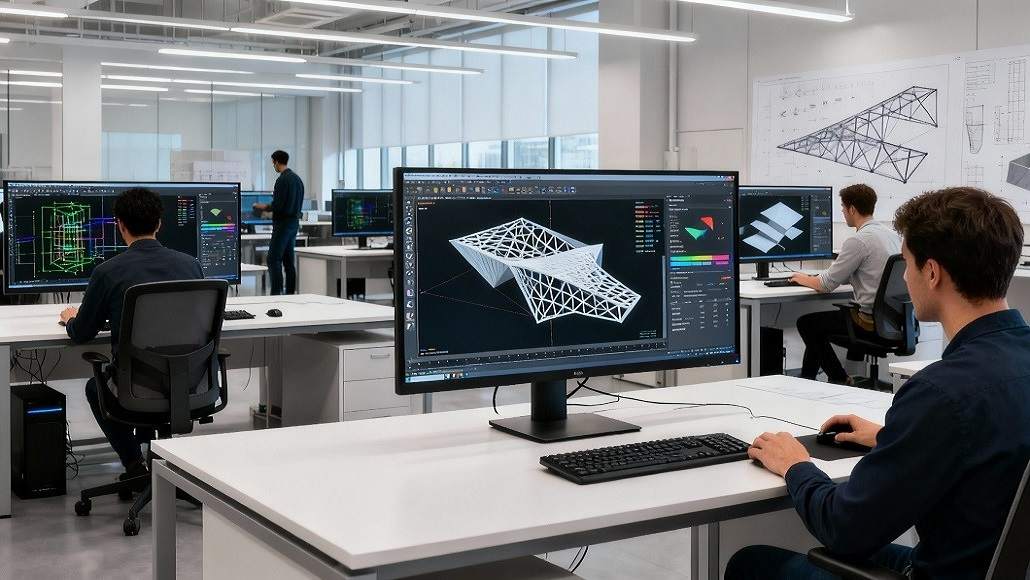
Data-driven design systems fundamentally transform engineering methodology through parametric and computational tools that automate complex calculations, accelerate iteration, and generate optimized solutions impossible to discover manually. Rather than an engineer spending weeks developing structural solutions, parametric design systems generate hundreds of alternatives in hours, evaluate each option against performance criteria, and identify the most efficient solutions. This automation compresses engineering timelines from months to weeks while simultaneously improving design quality and manufacturability.
The prefabrication industry increasingly recognizes that data-driven design systems represent essential infrastructure for competitive advantage. Organizations integrating parametric design into engineering workflows report dramatic improvements in project delivery speed, design quality, and manufacturing efficiency. The convergence of computational tools, advanced algorithms, and manufacturing-aware design represents the future of engineering practice.
Parametric Design Fundamentals and Application
Parametric design operates through systematic definition of design parameters—variables defining design characteristics, constraints, and performance requirements. Rather than designing static solutions, parametric systems encode design logic so that changes to parameters automatically propagate throughout entire designs. A building’s structural grid spacing becomes a parameter; adjusting grid spacing automatically recalculates all dependent dimensions, member sizes, and connection details.
This parameter-driven approach inverts traditional design methodology. Conventional design specifies dimensions that remain fixed regardless of changing requirements. Parametric design establishes relationships and rules enabling designs to adapt automatically as requirements evolve. If material costs increase, designers adjust cost-optimization parameters, and algorithms immediately recalculate designs minimizing cost. If manufacturing constraints restrict maximum beam lengths, designers input this constraint, and parametric systems automatically subdivide longer beams into manufacturably-sized segments.
Algorithmic design extends parametric methodology through computational processes that generate design solutions satisfying specified criteria. Rather than designers creating solutions manually, algorithms create multiple solutions automatically. A structural optimization algorithm might generate 500 different beam configurations, evaluate each against criteria including load capacity, material efficiency, and manufacturing feasibility, then identify the most efficient solution. This computational approach discovers solutions humans might spend months developing or might never discover.
The prefabrication industry particularly benefits from parametric and algorithmic design because manufacturing constraints become integral design drivers. Rather than designing without manufacturing consideration then struggling to adapt designs for production, data-driven systems incorporate manufacturing constraints into design logic from inception. Design systems encode CNC machine capabilities, standard material dimensions, equipment capacity limitations, and assembly sequencing rules. Designs automatically respect these constraints, eliminating post-design redesign cycles where manufacturing feasibility is discovered only after engineering completes.
Automating Repetitive Engineering Tasks
Engineering projects contain enormous quantities of repetitive tasks that consume time disproportionate to their intellectual content. Calculating member sizes across hundreds of components, determining connection details, forecasting material quantities, verifying code compliance for each element—these critical tasks consume substantial engineering resources despite their largely mechanical nature.
Data-driven design systems automate these repetitive tasks comprehensively. Rather than engineers manually calculating beam sizes for dozens of structural members, parametric systems analyze loads, material properties, span lengths, and code requirements, then automatically generate appropriately-sized members. Systems verify code compliance, check connections for adequacy, and flag any violations. What might require weeks of manual calculation completes in hours with superior accuracy.
Material forecasting represents another area where automation delivers remarkable value. Traditional forecasting requires engineers estimating quantities for each material type, accounting for waste percentages, then compiling comprehensive material lists. Data-driven systems extract material information directly from detailed digital models, accounting for every component precisely. Forecast accuracy improves dramatically—traditional estimates often vary 20-30% from actual quantities; parametric forecasting achieves accuracy within 5%. This precision enables more accurate cost estimates and prevents material shortage surprises during manufacturing.
Connection design, particularly complex in prefabricated construction, represents another automation opportunity. Rather than designers individually designing connections for each location and condition, parametric systems encode connection logic applicable across projects. Specifying connection parameters and load conditions automatically generates engineered connection details meeting all code requirements. This standardization simultaneously improves consistency and accelerates design.
Rapid Design Iteration and Optimization
Perhaps the most powerful capability of data-driven design systems is enabling comprehensive design iteration evaluating numerous alternatives quickly. Traditional design iteration is expensive—each iteration represents substantial engineering effort. This expense constrains iteration quantities, often limiting evaluation to 3-5 alternatives.
Parametric and algorithmic design systems eliminate this constraint. Algorithms can generate and evaluate hundreds of design alternatives automatically. A structural optimization system might evaluate 1,000 different beam configurations simultaneously, testing each against weight minimization, cost minimization, deflection limits, and manufacturability constraints. The system identifies Pareto-optimal solutions—designs that cannot improve one criterion without degrading others—providing engineers decision options based on explicit trade-offs.
This capability enables genuinely optimized designs. Rather than accepting the first feasible solution or one of a few manually-developed alternatives, organizations can identify solutions that are truly optimal for specified criteria. Projects report 15-25% cost reductions and 10-20% weight reductions through comprehensive optimization enabled by parametric design.
Module geometry optimization particularly benefits from computational approaches. Prefabrication module design involves complex trade-offs between structural efficiency, manufacturing constraints, transportation limitations, and assembly simplicity. Parametric design systems can simultaneously optimize multiple objectives, automatically generating module geometries that balance all competing requirements. The result proves geometrically superior to manually-designed alternatives while remaining fully manufacturable.
Integration with Fabrication Equipment
The full value of data-driven design emerges through integration with fabrication equipment. When digital designs connect directly to manufacturing systems, the transition from design to production becomes seamless. Rather than engineers creating designs that manufacturing teams must interpret and translate into production specifications, automated systems convert designs directly into fabrication instructions.
Computer Numerical Control (CNC) machines, robots, and automated assembly systems accept digital instructions specifying precise operations. Advanced BIM systems export design information in fabrication-ready formats compatible with equipment software. A structural design system exports precise beam dimensions, cutting angles, hole locations, and connection details directly as CNC program codes. Manufacturing equipment executes these instructions with millimeter-level precision, producing components exactly as designed.
This direct design-to-fabrication integration eliminates numerous error sources. Traditional workflows require translating designs into shop drawings, then translating shop drawings into fabrication instructions. Each translation step introduces opportunity for misunderstanding, error, or incompleteness. Direct design-to-fabrication integration eliminates these translation steps. Designs automatically flow to fabrication equipment, reducing errors dramatically.
Manufacturing teams also provide critical feedback to designers through integrated systems. Real-time production data reveals actual manufacturing times, material waste, equipment utilization, and quality metrics. Designers review this data and adjust designs to improve manufacturability. This feedback loop continuously improves design quality for manufacturing.
Material Forecasting and Waste Reduction
Accurate material forecasting represents crucial value delivered by data-driven design systems. Traditional estimation methods rely on historical percentages and manual quantity calculations, resulting in forecasts often 20-30% inaccurate. When actual material quantities differ substantially from forecasts, projects experience cost overruns, material shortages, or excess inventory requiring storage and management.
Data-driven systems eliminate these inaccuracies by extracting quantities directly from detailed digital models. Every component in the design is modeled with precise geometry. Material systems query these models for exact quantities, automatically accounting for all components, connections, and assemblies. Forecast accuracy improves to within 5% of actual quantities.
This precision delivers multiple benefits. Cost estimates become more reliable, improving project financial predictability. Supply chains optimize around accurate demand forecasts, reducing inventory carrying costs and preventing material shortages. Manufacturing scheduling becomes more accurate when material availability is predictable. Waste reduction initiatives gain concrete targets based on precise understanding of material usage.
Waste reduction itself improves through design optimization. Parametric systems analyze material usage patterns and optimize designs to minimize waste. Algorithms might adjust component dimensions to align with standard material sheet sizes, reducing trim waste. Or they might consolidate similar components to reduce setup and changeover time. These optimization-driven waste reductions typically achieve 10-15% waste reduction compared to manually-designed alternatives.
Generative Design and AI Integration
The frontier of data-driven design introduces generative design and artificial intelligence enabling machines to automatically create design solutions meeting specified criteria. Rather than algorithms optimizing designs humans create, generative systems create designs from scratch.
Generative design systems begin with specified design constraints and performance targets. Designers input requirements such as load conditions, space envelopes, material types, cost targets, and manufacturing constraints. AI systems then generate hundreds or thousands of design solutions meeting these requirements. Designers review generated solutions and select the most promising options for refinement.
The resulting designs often appear radically different from conventionally-designed solutions, revealing novel approaches humans might never develop. Structural systems might employ unconventional material distributions maximizing strength while minimizing weight. Module geometries might employ organic curved forms optimizing stress distribution. These AI-generated solutions frequently outperform manually-designed alternatives on multiple criteria simultaneously.
Generative design particularly benefits prefabrication because generated solutions automatically respect manufacturing constraints integrated into the generation algorithm. Unlike human designers who might generate solutions that look optimal but prove difficult or expensive to manufacture, AI systems generate solutions that are simultaneously optimal and fully manufacturable.
Implementation Requirements and Organizational Capability
Successfully implementing data-driven design systems requires organizational commitment beyond simply purchasing software. Organizations must develop detailed parametric design standards encoding design logic, manufacturing constraints, and optimization criteria. These standards capture organizational knowledge in formalized frameworks enabling consistent application across projects.
Engineering teams require training and capability development. Parametric design represents a different engineering mindset than traditional approaches. Engineers must learn to encode design intent as parameters and rules rather than static solutions. Developing this capability requires time and investment, though organizations report that engineers quickly recognize the productivity advantages and embrace the approaches enthusiastically.
Data quality becomes critical—parametric systems depend on accurate input parameters. Incorrect cost estimates, material properties, or manufacturing constraints produce incorrect designs. Organizations must invest in maintaining high-quality parameter libraries and validating data accuracy.
Integration with fabrication systems requires coordination between design and manufacturing teams. Manufacturing constraints must be accurately captured in design systems. Manufacturing equipment must be capable of accepting digital fabrication instructions. As these elements align, integration deepens and benefits multiply.
Competitive Implications and Industry Evolution
Organizations successfully implementing data-driven design systems develop significant competitive advantages. Superior design quality and faster engineering timelines enable lower costs and faster project delivery. Design optimization delivers superior structural efficiency and manufacturing economy. These advantages compound as organizations refine parametric design practices and continuously improve their design frameworks.
The industry increasingly recognizes data-driven design as essential infrastructure. Educational programs increasingly emphasize parametric design. Software tools become increasingly sophisticated, with AI integration expanding possibilities. Manufacturing equipment increasingly expects digital design inputs. These trends ensure that data-driven design evolves from innovative practice toward industry standard.
The future of prefabrication engineering belongs to organizations that embrace data-driven design methodologies. The ability to translate design intent into automated systems, leverage computational optimization, and connect designs directly to fabrication equipment represents the foundation upon which competitive prefabrication businesses increasingly operate. Organizations continuing traditional manual engineering approaches will find themselves increasingly unable to compete with organizations leveraging computational design power.