

























Key Takeaways
- Prefabricated bridge elements reduce construction timelines by 40-50% compared to cast-in-place methods
- Factory-controlled manufacturing ensures consistent quality with reduced defect rates in critical infrastructure components
- PBES eliminates weather delays and enables night or weekend installations, minimizing traffic disruption
- Parallel fabrication and assembly reduce overall project duration while improving structural performance
- Rail systems, transit hubs, and bridges benefit from precise modular connections and standardized components
- Infrastructure projects using prefabrication achieve cost savings of 15-20% while enhancing worker safety
Infrastructure projects represent the skeleton of modern civilization. Bridges connecting communities, rail systems transporting millions, transit hubs facilitating urban movement, and energy facilities powering economies—these megastructures define economic vitality and quality of life. Yet traditional infrastructure construction methods remain remarkably labor-intensive, weather-dependent, and prone to delays. Scalable prefabrication is fundamentally transforming how engineers and contractors deliver these critical systems, enabling faster deployment, superior quality, and dramatically reduced disruption to surrounding communities.
The global prefabricated construction market, valued at $74 billion in 2025, is expanding at a remarkable 8.9% annually, with infrastructure representing an increasingly significant segment. Prefabricated bridge elements and systems, once considered specialty solutions, now dominate major infrastructure initiatives worldwide. This transformation reflects recognition that scalable prefabrication delivers tangible advantages impossible to achieve through traditional construction methods.
The Infrastructure Challenge and Prefabrication Response
Large infrastructure projects face unique pressures that distinguish them from standard construction. Public expectation demands quality, with safety and durability representing non-negotiable requirements. Simultaneously, communities insist on minimal disruption—roads must remain partially open, rail lines must maintain limited service, and normal commerce must continue despite ongoing construction. Budget constraints frequently tighten, requiring cost controls that traditional construction struggles to maintain.
Weather dependency particularly impacts infrastructure projects. Road closures for bridge construction create economic losses extending far beyond project costs. Transit delays frustrate millions. Delays accumulate, extending closure periods and compounding disruption. Traditional cast-in-place bridge construction often stretches schedules by months due to weather, curing time requirements, and sequential construction sequences.
Scalable prefabrication inverts this equation. Prefabricated bridge elements and systems (PBES) manufacture deck panels, beams, abutments, and piers in factory environments where conditions are controlled. Weather becomes irrelevant—production continues regardless of rain, snow, or temperature extremes. Manufacturing occurs simultaneously with on-site preparation, compressing overall timelines. While site crews prepare foundations and approaches, factories mass-produce components to exact specifications.
How Prefabricated Bridge Elements Transform Infrastructure
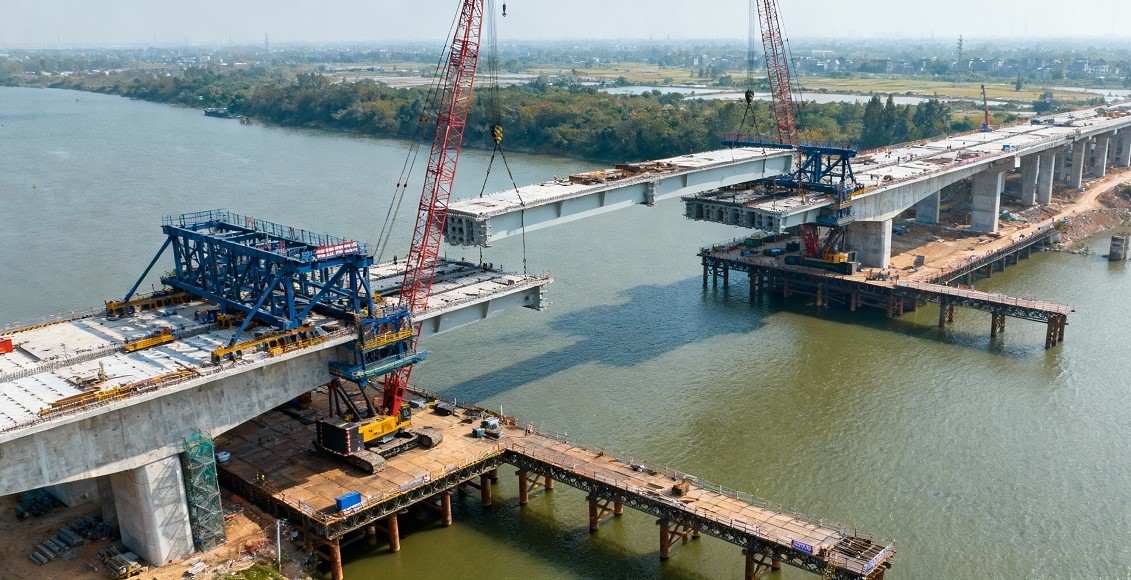
Prefabricated bridge elements represent the clearest example of scalable prefabrication in infrastructure. Rather than constructing bridges entirely on-site through extended casting and assembly sequences, PBES approaches relocate critical manufacturing to factories, then rapidly assemble components on-site.
The process begins with detailed design optimization. Engineers analyze bridge requirements—span lengths, load capacities, access constraints—and design modular components that interconnect precisely. Computer-aided design ensures every connection aligns perfectly. Manufacturing specifications are detailed to the millimeter. Advanced BIM models generate instructions guiding factory production.
In dedicated facilities, fabrication proceeds with industrial precision. Concrete deck panels cure in controlled conditions ensuring consistent strength and durability. Steel beams are cut, welded, and inspected to standards far exceeding on-site capabilities. Modular connections are pre-assembled and tested. Quality assurance includes multiple inspection stages, with defective components rejected before shipment—something impossible with cast-in-place construction.
Completed components then travel to job sites where assembly teams install prefabricated sections rapidly. Bridge decks that would require weeks to cast on-site are installed in days through bolt connections and grouted joints. This compression of timeline directly translates to reduced traffic disruption. Projects that traditionally required months of full or partial road closures can accomplish the same work in weeks, with installations often scheduled for night hours or weekends when traffic volumes minimize community impact.
Case Studies Demonstrating Scalable Prefabrication Success
Real-world infrastructure projects increasingly validate scalable prefabrication’s advantages. The I-84 Corridor Bridges project in Connecticut, USA utilized prefabricated deck panels to replace aging bridge structures. By implementing PBES, the project team completed multiple bridge replacements in record time while maintaining essential traffic flow. Prefabricated components allowed strategic installation during brief closure windows, keeping roads substantially open despite ongoing construction.
The Milton-Madison Bridge project spanning the Ohio River between Indiana and Kentucky demonstrates prefabrication’s capacity for challenging environments. Replacing a critical transportation link required maintaining traffic flow continuously. PBES enabled parallel manufacturing of span sections while temporary support structures maintained traffic. When prefabricated spans arrived, installation proceeded rapidly with minimal disruption, allowing essential commerce to continue uninterrupted throughout the project.
Similar success stories emerge globally. European rail infrastructure increasingly incorporates prefabricated viaduct systems, accelerating high-speed rail deployment. Asian rapid transit projects employ modular tunnel segments and station components, enabling accelerated schedules critical for urban mobility. Infrastructure agencies worldwide recognize scalable prefabrication’s capacity to deliver complex systems faster and more reliably than traditional methods.
Rail Systems and Transit Infrastructure Transformation
Rail infrastructure represents particularly promising applications for scalable prefabrication. Traditional rail construction sequences require extensive site preparation, followed by track installation, then electrical and safety systems. Weather delays accumulate. Coordination challenges multiply. Projects frequently exceed budgets and timelines.
Scalable prefabrication reorganizes rail construction around factory-manufactured modules. Viaduct sections—complete with structural systems—are manufactured off-site. Railway sleepers, fastening systems, and ballast platforms are assembled in controlled conditions. Station components including platforms, shelter structures, and mechanical systems arrive pre-assembled. On-site work compresses to rapid assembly and connection, followed by systems testing.
This approach accelerates deployment dramatically. High-speed rail corridors that might require years of construction can be deployed in months. Urban transit expansions that traditionally disrupted city operations for extended periods complete in shorter windows. Prefabricated rail components ensure structural consistency impossible with on-site construction, reducing maintenance requirements and lifecycle costs.
Energy Infrastructure and Specialized Facilities
Energy infrastructure—power plants, substations, distribution systems—represents another critical sector where scalable prefabrication delivers exceptional advantages. Modern power generation facilities incorporate complex structural systems, mechanical equipment, and control systems. Traditional on-site construction of these facilities extends timelines unpredictably. Equipment installation sequences require careful coordination. Weather delays compound scheduling challenges.
Prefabrication reshapes energy infrastructure delivery. Modular building systems house major equipment components. Mechanical rooms arrive as complete assemblies. Electrical distribution systems are pre-installed and tested. Structural modules accommodate specific equipment loads and configurations. On-site assembly focuses on connections and system integration rather than detailed construction.
The advantage becomes particularly apparent for renewable energy infrastructure. Solar arrays require mounting systems, inverters, and interconnection equipment. Prefabrication enables factory assembly of complete systems, then rapid on-site deployment. Wind energy facilities require structural towers, nacelle assemblies, and blade installation—areas where prefabrication accelerates deployment while ensuring precise alignment and connection.
Structural Efficiency Through Modular Design
Scalable prefabrication fundamentally improves structural efficiency. Factory manufacturing enables precision impossible on-site. Components are designed to interconnect with standardized connections, eliminating weak points that sometimes emerge in field connections. Repetitive manufacturing refines assembly sequences, optimizing structural behavior with each iteration.
Modular expansion capabilities enable infrastructure systems to grow predictably. Initial facility components can expand later as demand or requirements evolve. Rail systems can extend through additional prefabricated segments. Bridge approaches can incorporate modular widening systems. Energy facilities can incorporate modular equipment bays. This flexibility reduces initial capital requirements while maintaining capacity for future growth—a significant advantage for infrastructure agencies managing constrained budgets.
Quality Control and Safety Advantages
Infrastructure safety represents perhaps the most critical consideration for transportation and utilities systems. Lives depend on structural reliability. Prefabrication addresses safety through systematic quality control impossible in on-site construction. Factory settings enable comprehensive inspections. Component testing validates performance before installation. Assembly sequences are standardized and supervised.
Worker safety similarly improves dramatically. Factory environments provide controlled conditions, eliminating exposure to weather extremes, traffic, and difficult site access. Repetitive manufacturing tasks enable safety procedure standardization and worker training. Machinery reduces manual labor intensity. Resulting injury rates in manufacturing facilities prove substantially lower than typical construction sites.
Public safety improves through construction process acceleration. Shorter construction windows reduce community exposure to active work zones. Fewer on-site workers means reduced accident potential affecting public areas. Prefabricated components require less on-site activity near public spaces, protecting community members throughout construction phases.
Timeline Compression and Traffic Impact Reduction
Perhaps the most visible advantage of scalable prefabrication emerges in timeline compression. Traditional bridge replacement might occupy a closure window measured in months. Modern prefabricated bridge systems compress the active closure to weeks or even days. Entire span installations occur overnight or during weekend windows when traffic minimizes.
This compression directly reduces economic impact on communities and commerce. Businesses near construction sites suffer less disruption. Commuters experience shorter periods of delayed travel. Emergency services navigate construction zones for limited windows. Supply chains experience fewer transportation delays. These intangible benefits, while difficult to quantify precisely, represent significant community value beyond direct project cost savings.
Cost Effectiveness and Long-Term Value
While factory manufacturing and specialized engineering demand upfront investment, overall project economics strongly favor scalable prefabrication. Cost savings typically reach 15-20% through reduced labor, shortened timelines, and minimized change orders. Equipment rental costs decrease as projects compress. Financing costs diminish as timelines shorten.
Long-term lifecycle costs prove even more favorable. Prefabricated components manufactured under quality controls require less maintenance. Structural integrity, assured through factory testing, extends service life. Standardized connections enable efficient repairs and upgrades. Infrastructure agencies increasingly recognize that infrastructure prefabrication delivers not just faster construction, but superior long-term value.
The Future of Infrastructure Prefabrication
Scalable prefabrication continues advancing through technological innovation. Robotics-assisted manufacturing improves precision and consistency. 3D printing enables custom components within standardized frameworks. Advanced materials enhance durability and reduce weight. Digital twins enable performance optimization before physical manufacturing.
Integration of IoT sensors enables real-time monitoring of manufactured components throughout their service life. Predictive analytics identify maintenance needs before failures occur. Smart infrastructure systems optimize operations based on actual performance data.
As cities accelerate infrastructure renewal and emerging economies expand transportation networks, scalable prefabrication provides the only realistic path to meeting demand within budget and timeline constraints. The transformation has begun, and infrastructure projects increasingly reflect this paradigm shift. The future infrastructure will be faster, safer, and more reliably delivered through scalable prefabrication approaches that transform how critical systems serving billions are designed and constructed.