


























2035: How Your Children Will Build
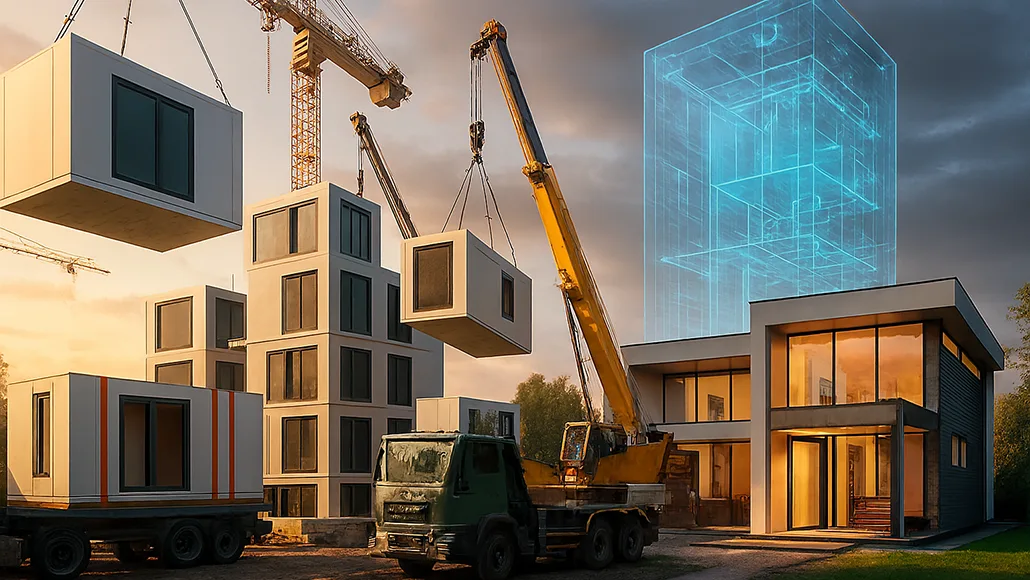
Picture this. Your son or daughter orders a house through a smartphone app. Chooses a layout from ready-made modules – like assembling Lego. The system automatically calculates loads, selects materials, creates a digital model of the building. A week later, trucks arrive at the site with finished sections. Three more days – and the house stands. Fully complete, with utilities connected, smart systems controlling climate, lighting, security.
Science fiction? Not really. All these technologies exist right now. They just haven’t become mainstream yet. But the future of construction has already arrived – it’s just unevenly distributed, as science fiction writer William Gibson said.
The construction industry is experiencing a revolution. Modular technologies, digital twins, BIM modeling, smart systems – these aren’t buzzwords for presentations. They’re real tools changing the approach to designing and erecting buildings. And at the center of this revolution – digitalization. Modern 3D rendering services allow creating photorealistic models of future objects, testing solutions virtually, identifying problems before they become costly mistakes on the construction site.
Bill Gates once said: “We always overestimate the change that will occur in the next two years and underestimate the change that will occur in the next ten.” Let’s look at what’s changing in construction right now – and what will change in the coming decade.
Modular Construction – A Grown-Up’s Building Set
Remember assembling building sets as a kid? You take ready-made blocks, connect them according to instructions, get results. Modular construction works on the same principle. Except the blocks weigh tons, and the instructions occupy terabytes of data.
The essence is simple. Main building elements – walls, floors, entire rooms – are manufactured at a factory. Under controlled conditions, with millimeter precision, with multi-stage quality control. Then they’re transported to the site and assembled like a puzzle.
The advantages are obvious:
- Speed. A modular house is erected 2-3 times faster than traditional construction. While one site is still digging the foundation, a modular building is already under roof.
- Quality. Factory conditions mean no rain, no frost, no “hungover foreman.” Each module passes inspection before shipment.
- Savings. Mass production reduces costs. By various estimates, modular construction is 10-20% cheaper than traditional.
- Ecology. Less waste, less noise, less dirt at the construction site.
The numbers are impressive. According to market research, the modular construction sector is growing 6-7% annually. By 2030, its volume could reach $157 billion. And that’s a conservative forecast.
But there’s a catch. Modular construction requires perfect precision at the design stage. A millimeter error on the blueprint turns into an impossibility to connect modules on site. That’s why detailed digital modeling – BIM that accounts for every screw, every connection, every utility – is critically important here.
The Smart Home That Thinks For You
Forget about light switches and manual heating regulators. That’s last century. Literally.
A modern smart home is a system that learns your habits and adapts to them. You usually come home at seven in the evening? By that time, the temperature will be comfortable, lighting will turn on automatically, your favorite music will start playing in the hallway. Left for vacation? The house switches to economy mode but simulates presence – for protection against burglars.
Smart systems control:
- Climate – heating, air conditioning, ventilation work by zones, considering outside weather and number of people in the room
- Lighting – brightness and color temperature change depending on time of day and activity
- Security – cameras, motion sensors, smart locks, integration with security services
- Energy consumption – the system analyzes expenses and optimizes the operation of all devices
Economic effect? There’s research online showing that smart systems reduce energy consumption by 25-30%. Over a year, this amounts to thousands of dollars in savings. The system pays for itself in 3-5 years, and then – pure profit.
But the main thing isn’t savings. The main thing is comfort. When a house adapts to you, not you to the house, quality of life changes radically. It’s like transitioning from a flip phone to a smartphone – you get used to it quickly, and going back becomes impossible.
Digital Twin: When a Building Has an Avatar
This is perhaps the most futuristic technology of all. And the most underestimated.
A digital twin is an exact virtual copy of a real building. Not just a 3D model, but a full-fledged avatar containing all information: geometry, materials, engineering systems, even history of changes and repairs. This model lives parallel to the real building and updates in real time.
Why is this needed? Examples abound.
Operation. A pipe burst? You open the digital model, instantly see where utilities run, which valves need to be shut off, where spare parts are located. No need to randomly tear up walls.
Modernization. Want to add a new air conditioning system? You load data into the digital model, the system shows where you can run ductwork, what loads the floors will handle, how this will affect other systems.
Forecasting. Sensors in the building collect data – temperature, humidity, loads, vibrations. The digital twin analyzes this data and predicts problems before they occur. Equipment operating under increased load? The system will warn about the need for maintenance.
Steve Jobs said: “Innovation distinguishes between a leader and a follower.” Digital twins are the innovation that transforms construction from a “build and forget” process into constant interaction with an object throughout its entire life cycle.
How It All Works Together Right Now
Each technology is impressive separately. But the real magic begins when they work together.
The process looks like this. First, a detailed BIM model of the future building is created. Not just a picture, but a full-fledged information model with all data about materials, structures, systems. Based on this model, modules for factory production are designed – with millimeter precision.
In parallel, smart systems are integrated into the model – where sensors will be, how cables are laid, how all this will be controlled. Before construction begins, you can test the operation of all systems virtually.
Modules are manufactured at the factory, assembled on site. And at the moment of construction completion, a digital twin of the building already exists – with all information, with all data, ready for operation.
Then life begins. Sensors collect information, smart systems manage processes, the digital twin analyzes and forecasts. The owner sees everything happening in real time through a smartphone app.
Sounds like a science fiction movie script? Such projects are already being implemented. True, mostly in commercial real estate so far – office centers, shopping complexes, industrial facilities. But technologies are getting cheaper, more accessible. What’s available to corporations today will be in middle-class private homes in five years.
The future of construction isn’t somewhere over the horizon. It’s here, it’s being built right now. And most importantly – it’s being built smarter, faster, more efficiently. The question isn’t whether this revolution will come. The question is whether you’ll be ready for it.