



















As the UK works towards its Net Zero target of decarbonising all sectors of the economy by 2050, the construction industry is taking positive steps to clean up its act and become a major player on the journey to a more sustainable future.
From driving down material waste to leveraging the benefits of digital construction software, we take a closer look at how technology will play a key role in the five green construction trends for 2025.
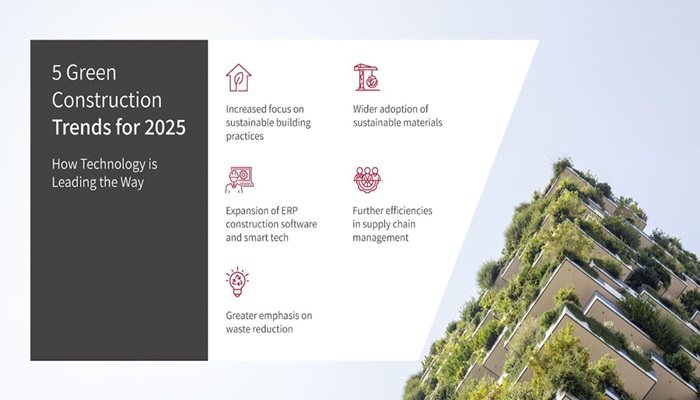
Increased focus on sustainable building practices
Innovative technology is leading the charge as the construction industry increases its focus on sustainability. Green building solutions like energy-efficient solar panels, LED lighting, and eco-friendly materials are helping to significantly reduce a project’s environmental impact by making structures more sustainable over time.
More building firms are also switching to modern electric and hybrid machinery to cut emissions, reduce their carbon footprint, and create cleaner job sites. It is predicted that 2025 will also experience a significant rise in autonomous vehicles and robotic machines taking on work that humans once did. Not only will this reduce our reliance on manual labour, but it will also improve productivity, safety and deliver greater cost-efficiency for construction teams.
By integrating these greener practices into construction, companies can position themselves as sustainability champions and achieve industry-recognised sustainable building certificates such as BREEAM and LEED to gain a competitive advantage.
Wider adoption of sustainable materials
Sustainability is the cornerstone of modern construction as the industry seeks to minimise its environmental impact through greater integration of eco-friendly materials such as recycled steel, reclaimed timber, and bamboo.
In 2025, there will be a wider adoption of sustainable resources and cutting-edge designs that offer better performance and environmental benefits like green roofs that save energy and encourage biodiversity. Similarly, engineered timber with its impressive strength-to-weight ratio will become a more popular solution to standard wood and traditional brick and block building methods, while self-healing concrete which repairs itself over time will improve the lifespan of structures and reduce maintenance costs.
Sustainable building materials not only enhance a structure’s longevity but also meet important environmental targets by reducing energy consumption and CO2 emissions. This technology-driven, greener approach to construction is set to dominate future building initiatives and new developments while also helping reduce operating costs.
Expansion of ERP construction software and smart tech
The popularity of smart technology like ERP construction software will continue to grow in 2025 as more companies look to streamline their operations and increase sustainability. By integrating multiple functions such as project management, procurement, logistics, invoice tracking, materials sourcing, and accounting into one platform, businesses can manage their resources better and more sustainably.
EPR construction software enables real-time access to costings and other financial data for an accurate picture of project expenses. It helps to enhance resource allocation, reduce material waste, and achieve optimised energy management across every stage of a project. It can also create budgets and generate reports quickly and efficiently while reducing the risk of human errors.
Smart tech’s role in sustainable construction also remains on the rise thanks to advancements in ERP construction software and other state-of-the-art solutions. For example, artificial intelligence and machine learning tools are transforming the industry by automating tasks and allowing real-time analysis of vast datasets, enabling better resource allocation and risk assessment and accurate predictions of potential project delays.
Meanwhile, virtual reality tools provide digital replicas of construction sites that allow teams to identify potential issues in real time. Similarly, advanced construction machinery like drones can conduct site surveys, and 3D printing offers fast and accurate prototyping. All these high-tech components will become commonplace as the construction industry places more importance on sustainability.
Greater emphasis on waste reduction
The UK construction industry generates more than 60% of the country’s waste, and 32% of all waste ends up in landfill. Therefore, the more materials that can be reused, the better construction will become at achieving greater sustainability.
In 2025, the circular economy concept will increase its traction in construction by promoting the reuse and recycling of building materials to minimise waste. Tasking architects and developers to lean on technology to design structures with longer lifecycles and lower carbon footprints in mind will achieve higher repurposing of materials for future projects. Over time, this will see a major reduction in waste to meet increasingly tighter sustainability regulations in the industry.
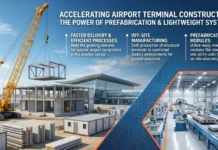
Another way firms are leveraging technology to meet sustainability targets is through wider use of modular construction and prefabrication solutions. By developing parts of a structure such as walls and roof joists in a controlled factory setting before assembling them onsite, businesses can minimise waste, slash build times, and lower their costs. Not only does this allow structures to be built faster and more accurately, but it helps soften their environmental impact, reduce energy consumption, and limit material waste.
Further efficiencies in supply chain management
Technology is vital to effective supply chain management in construction. With higher prices of wood, plastics, insulation, and other building materials likely to stay for the foreseeable future, managing these rising costs will be central to achieving sustainability throughout the industry in 2025.
Thanks to digital solutions, companies can benefit from real-time tracking, automation, and AI-powered data analysis. This allows for more accuracy across the supply chain and improvements at every stage of a build, from streamlined logistics to labour material shortages. Tools such as cloud-based construction platforms and AI-driven forecasting help minimise delays, optimise resources, reduce waste and costs, and create a more sustainable future for the industry.
All in all, technology will continue to drive greater sustainability in construction in 2025. From eco-friendly materials and renewable energy systems to digital software and circular economy practices, construction tech is helping building firms become more sustainable and achieve their environmental goals.