

























Introduction
The 13th International Conference on Urban Regeneration and Sustainability addresses all the aspects of urban environment aiming to provide solutions leading towards sustainability. The Sustainable City 2019 conference follows a series of very successful meetings that started in Rio (2000), followed by Segovia (2002), Siena (2004), Tallinn (2006), Skiathos (2008), A Coruña (2010), Ancona (2012), Kuala Lumpur (2013), Siena (2014), Medellin (2015), Alicante (2016) and Seville (2017).
The meeting always attracts a substantial number of contributions from participants from different backgrounds and countries. The variety of topics and experiences is one of the main reasons behind the success of the series. Papers presented at these meetings are archived online in the WIT eLibrary (www.witpress.com/elibrary) where they are easily and permanently available to the international scientific community.
Urban areas result in a series of environmental challenges varying from the consumption of natural resources and the subsequent generation of waste and pollution, contributing to the development of social and economic imbalances. As cities continue to grow all over the world, these problems tend to become more acute and require the development of new solutions.
The challenge of planning sustainable contemporary cities lies in considering the dynamics of urban systems, exchange of energy and matter, and the function and maintenance of ordered structures directly or indirectly supplied and maintained by natural systems. The task of researchers, aware of the complexity of the contemporary city, is to improve the capacity to manage human activities, pursuing welfare and prosperity in the urban environment. Any investigation or planning on a city ought to consider the relationships between the parts and their connections with the living world. The dynamics of its networks (flows of energy matter, people, goods, information and other resources) are fundamental for an understanding of the evolving nature of today’s cities.
Large cities are probably the most complex mechanisms to manage. They represent a fertile ground for architects, engineers, city planners, social and political scientists, and other professionals able to conceive new ideas and time them according to technological advances and human requirements.
The Sustainable City Conference addresses the multidisciplinary components of urban planning, the challenges presented by the increasing size of the cities, the amount of resources required and the complexity of modern society.
Conference Topics
The following list covers some of the topics to be presented at Sustainable City 2019. Papers on other subjects related to the objectives of the conference are also welcome.
• Urban strategies
• Planning, development and management
• Urban metabolism
• Quality of life
• The community and the city
• Infrastructure and society
• The S3 city: smart, sustainable and safe
• Eco-town planning
• Spatial conflicts in the city
• Urban transportation and planning
• Architectural issues
• Sustainable energy and the city
• Cultural heritage sites
• Urban conservation and regeneration
• Environmental management
• Flood risk
• Waste management
• Urban air pollution
• Health issues
• Water resources
• Landscape planning and design
• Urbanization of rural areas
• Urban agriculture
• Intelligent environment
• Planning for risk and natural hazards
• Waterfront development
• Sustainable regeneration and public space
• Case studies
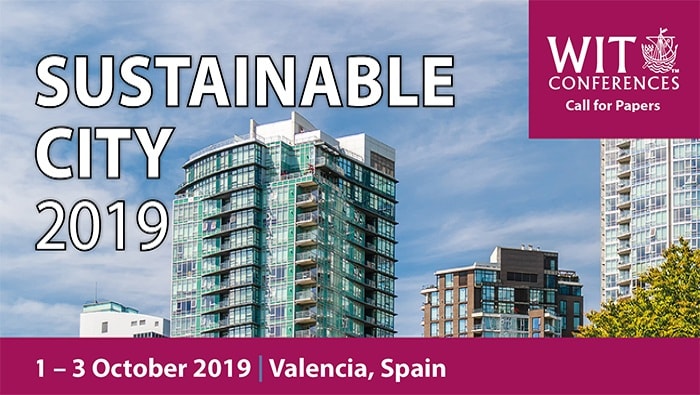
13th International Conference on Urban Regeneration and Sustainability will run from 1 – 3 October 2019 at Valencia, Spain.
For further information and to register please visit: https://www.wessex.ac.uk/conferences/2019/sustainable-city-2019