























Heat exchangers and turbines move heat, convert energy and keep production lines running. When scale, sludge or other deposits build up inside, efficiency drops, pressure losses rise and equipment has to work harder. These increase fuel use and mechanical stress, making maintenance essential. The question for managers and engineers is how to remove deposits affordably, protect people and meet environmental expectations. The best approach depends on the equipment type, deposit characteristics, access, safety constraints and downtime cost.
Each method below is evaluated based on up-front cost for consumables and equipment, waste generation and environmental footprint, safety and training needs, and long-term effectiveness and impact on fouling rate. These considerations are similar to those highlighted in maintenance and fouling strategies for industrial heat exchangers and asset-management approaches in gas turbine diagnostics. With that framework in mind, here are eight widely used, cost-conscious methods.
High-Pressure Water Jetting
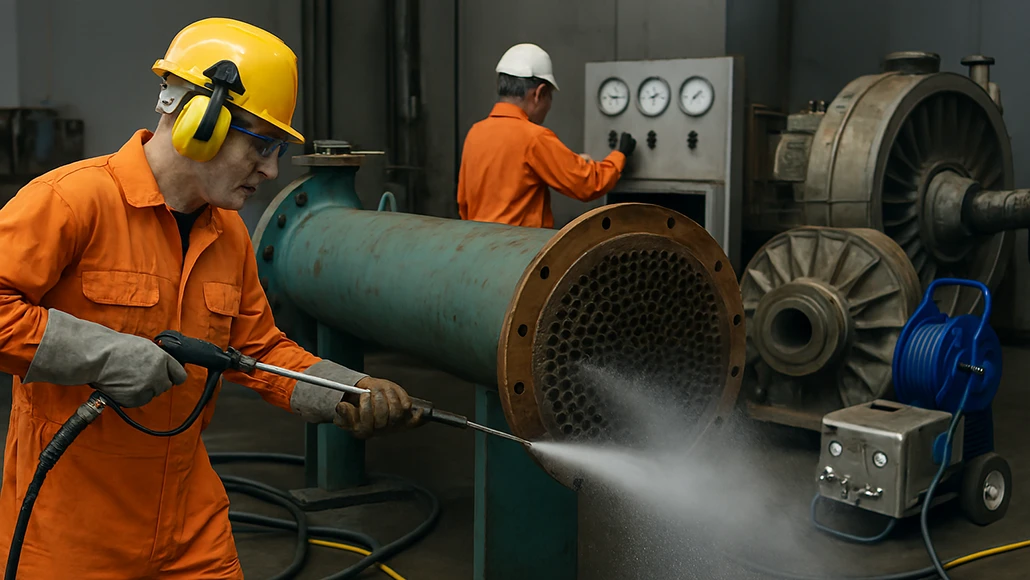
Also known as hydro-blasting, this method pumps water through nozzles at very high pressure to strip deposits from tube surfaces, tube sheets or turbine casings. Pressures vary depending on the task, but industry guidance for high-pressure jetting equipment typically covers operation above 3,000 psi and up into ultra-high ranges of over 25,000 psi.
From a cost perspective, hydro-blasting is attractive because it uses a common medium, requires relatively simple consumables and can be deployed quickly across many assets. With appropriate nozzles and access fittings, large bundles take hours to process instead of days. This makes it useful where downtime is expensive, but deposits are not extremely hard.
Hydro-blasting works best on sludge, soft or semi-hard deposits and biological growth. A key requirement is robust safety management, since updated codes of practice from organizations such as the Water Jetting Association stress training, personal protective gear and controlled work zones to manage the risks for high-pressure operation.
Chemical Cleaning and Flushing
Chemical treatments use circulating solutions — usually acids, alkalis or blended solvents — to dissolve scale, rust or organic residue within heat exchangers and associated pipework. The system is isolated, filled with solution and circulated until deposit removal is complete, then neutralized and flushed.
The main economic advantage is that employees can perform much of this work on-site. Disassembly becomes shorter, cutting labor time and reducing the risk of damage in handling. Deposits can raise energy use and maintenance costs, while effective fluid-based treatments can help restore design performance and reduce unplanned stoppages.
Chemical circulation is especially useful for complex internal channels, plate heat exchangers or equipment with limited mechanical access. However, waste streams must be collected, tested and disposed of under hazardous-waste and wastewater guidelines, which adds cost and requires coordination with environmental staff.
Abrasive Cleaning
Sponge blasting uses an air stream to propel small, deformable abrasive media that carry grit to the surface, then rebound, capturing much of the debris. Compared to traditional sandblasting, rebound and dust are significantly lower, making containment and post-job waste collection easier.
From a budget standpoint, this can reduce the need for extensive scaffolding sheeting or full enclosures, and it lowers the time spent on housekeeping afterward. Media can often be recycled several times. This method shines on external surfaces that need coating removal or corrosion control without excessive metal loss.
Mechanical Tube Cleaning
Mechanical tube tools use brushes, scrapers, bullets or projectiles that travel through tubes to remove deposits. They can be pushed, pulled, or driven by water or air. On condensers and many shell-and-tube exchangers, this is an economical approach.
Equipment cost is low, and consumables are inexpensive. Many plants train maintenance technicians to handle basic tube work, so specialist labor is needed only in unusual situations. Simple mechanical methods, such as brushing and water jetting, are still widely used to reduce pressure drop and restore heat transfer.
Mechanical methods are especially effective for straight tubes with accessible ends. They are less suitable for very small diameters, U-tubes or coils with limited access, where flexible or fluid-based methods are preferred.
Dry Ice Blasting
Dry ice blasting uses compressed air to propel solid carbon dioxide pellets against surfaces. Upon impact, the pellets fracture deposits, then sublimate to gas, leaving almost no secondary solid waste. The absence of secondary waste, lack of residual moisture and avoidance of abrasive media are major advantages that matter for budgets and safety. With almost no media to sweep up or throw, post-job waste handling and downtime drop significantly.
Dry ice blasting is recommended for gas turbine compressors, generator housings and electrical equipment. It requires specialized equipment and pellet logistics, so service providers, rather than in-house teams, often bring it in and handle it.
Ultrasonic Cleaning
Ultrasonic systems submerge components in a fluid bath and apply high-frequency sound waves. These create microscopic bubbles that collapse and dislodge deposits from surfaces, including small crevices that would be hard to reach with brushes. Researchers reviewing crystallization fouling and its mitigation identify ultrasonic techniques as one of the most promising routes for controlling offline fouling.
Although the capital cost is relatively high, this method becomes economical for small or medium parts that can be processed in batches. Labor is low once fixtures and procedures are in place, and results are repeatable. This approach is suitable for items such as turbine blades removed during major overhauls, plate packs from plate-and-frame exchangers or small heat-transfer inserts. Ultrasonic action is also non-abrasive.
Online Cleaning Systems
Online systems are automatic devices to manage fouling while equipment remains in service. In condensers and some heat exchangers, the most common example is the circulation of soft sponge balls that travel through tubes and wipe deposits from the internal surface. Other designs use retractable mechanical scrapers or spray lances built into the unit.
Their main benefit is reduced downtime. Online systems are especially well-suited for use in power plants and large chilled-water systems, where capacity loss or shutdown would be costly. The up-front investment is higher than for portable tools, but over several years, the reduction in forced outages and manual maintenance can deliver a strong return.
Steam Cleaning
Steam-based methods use superheated vapor directed at surfaces to soften oils, fats, and other soft or semi-soft contaminants. The combination of heat and momentum breaks down residue, so it can be wiped or rinsed away, while the high temperature provides a degree of disinfection.
There is no need for chemical detergents in many applications, which simplifies waste handling and increases worker safety. Steam can be a quick and low-cost option for heat exchanger support equipment, such as lube-oil skids, turbine housings, finned coils and external surfaces with grease or oil.
Comparing Cleaning Techniques for Heat Exchangers and Turbines
The most affordable solution for one asset can be poor value for another. This table summarizes the key strengths and weaknesses of the methods discussed, allowing managers and engineers to shortlist options that fit their specific constraints.
| Cleaning Method | Pros | Cons |
| High-pressure water jetting | Rapid deposit removal on large areas, no chemical waste stream, and widely available equipment and service providers | Needs strict safety controls, generates contaminated water that must be captured and treated, and is less effective on tough scale |
| Chemical circulation and flushing | Great for mineral scale and internal surfaces, minimal disassembly, and can be performed in place | Requires chemical handling expertise, waste may be classified as hazardous, and there is a longer setup and neutralization time |
| Abrasive sponge blasting | Lower dust and rebound than sandblasting, reduced containment and housekeeping, and good surface prep for recoating | Mainly for external surfaces, not suitable for delicate components, and still produces spent media that must be handled |
| Mechanical tube tools | Low equipment and consumable costs, familiar to many maintenance teams, and good for straight tubes | Access needed at both tube ends, limited performance on very hard or uneven deposits, and labor-intensive for very large bundles |
| Dry ice blasting | Almost no secondary waste, suitable for electrical and turbine components, and non-abrasive to most substrates | Requires specialized equipment and pellet supply, often requires external specialists, and is not ideal where thick, hard scale is present |
| Ultrasonic baths | Highly effective on complex geometries, non-abrasive and repeatable, and requires low manual labor once set up | Limited to parts that fit in tanks, high cost for industrial-scale systems, and requires the removal of components from the unit |
| Online systems | Maintains performance during operation, minimizes planned downtime and supports long-term energy efficiency | Higher initial investment and best suited to large continuous-duty systems |
| Steam methods | Low water use, often avoids detergents, and is good for oily or greasy residues and general sanitation | Mostly for soft deposits and external surfaces, requires steam supply and condensate management, and is not suitable for all materials |
Top Companies for Turbine and Heat Exchanger Cleaning
For some jobs, the most affordable strategy is to use external expertise. Complex exchangers, large condensers and high-value turbines can justify specialist support, especially when safety constraints or regulatory requirements are strict. Three companies stand out.
1. EAI Industrial Services
EAI Industrial Services provides industrial maintenance services with a strong focus on water-based deposit removal and related methods. It uses high-pressure hydro-blasting, vacuum recovery and other techniques to process equipment, tanks and piping.
EAI Industrial Services emphasizes environmentally responsible approaches, including the use of proprietary, non-hazardous agents where chemistry is required. Its teams design procedures to minimize downtime, often combining hydro-blasting with confined-space planning and waste handling support, so clients can return critical exchangers and process lines to service quickly.
2. Serck
Serck positions itself as a heat transfer equipment specialist, supplying and servicing heat exchangers, radiators and related assets for sectors such as power generation, marine and petrochemicals.
The company describes full service and repair capabilities, including the removal of deposits, retubing, fabrication and testing. It operates workshops as well as mobile crews, allowing on-site and off-site work. This means a single provider can handle inspection, fouling removal, repairs and performance validation.
3. Conco
Conco offers services for condenser and heat exchanger tubes. It specializes in mechanical tools, such as its TruFit tube projectiles, which match the tube ID and maximize contact with deposits while protecting the base metal.
It also promotes diagnostics, such as eddy-current testing and leak detection, alongside tube maintenance. Combining targeted tools with condition assessment allows plant teams to schedule work based on measured degradation, which can be more cost-effective than time-based maintenance alone.
FAQs on Industrial Cleaning
The following addresses the common questions engineers and managers raise when planning deposit removal for turbines and heat exchangers.
How Often Should Heat Exchangers and Turbines Be Cleaned?
No fixed interval suits every plant. Fouling rate depends on fluid quality, flow regime, temperature, equipment design, and whether upstream filtration or treatment is in place. Typical indicators for maintenance include a rising pressure drop, a decreased heat transfer coefficient, higher approach temperatures or reduced turbine power at a given fuel rate. When these exceed limits agreed with the original equipment manufacturer or internal standards, it may be time to schedule deposit removal work.
When Should I Hire a Professional Service, and When Should I Clean In-House?
In-house maintenance teams often handle routine tasks such as basic tube brushing and low-pressure rinsing. However, situations involving confined spaces, extremely high pressure or large quantities of hazardous waste necessitate the services of specialist contractors.
What Are the Main Environmental Regulations to Consider?
Two areas are usually considered in regulatory planning. First, any wastewater or rinsate leaving the plant must comply with national or regional effluent standards. In the United States, the Environmental Protection Agency (EPA) effluent guidelines establish technology-based limits by industrial category and define controls for discharges to surface waters or municipal plants.
Second, solids and spent chemicals may be classified as hazardous waste. Under the EPA’s guidelines, these must be managed from generation through transport, treatment and disposal.
Can Emergency or Unplanned Heat Exchanger and Turbine Cleaning Be Performed Quickly?
Many specialist providers offer rapid-response services for condensers, critical heat exchangers and turbines, including 24/7 mobilization. In practice, response time depends on site access, safety approvals and the job’s complexity. Emergency work is common during peak seasons for power and process plants, although these are usually more expensive than planned work.
Balancing Cost and Performance in Turbine and Heat Exchanger Cleaning
Ultimately, the most affordable way to maintain heat exchangers and turbines is to treat deposit control as a planned, data-driven program rather than a series of emergency fixes. By matching various methods, facilities can reduce energy waste, protect equipment and manage life cycle cost practically and sustainably.
