


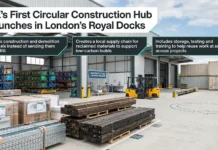






















The UK’s first Circular Construction Hub has launched in the Royal Docks in east London, marking a significant development in efforts to embed circular economy principles into the construction sector and reduce waste generated by building activity. The facility, delivered in collaboration with Newham Council and climate charity Tipping Point East, aims to recycle and reuse construction materials that would otherwise be sent to landfill while supporting the Mayor of London’s ambition to make the capital a zero-carbon city by 2030.
Located on a 20,000m² site in the London Borough of Newham, the project forms the first phase of a wider Circular Economy Village planned for Silvertown over the next five years. Backers say the facility will become the largest circular construction hub of its kind in Europe once fully operational.
The initiative is designed to support low-carbon construction as regeneration plans progress across the Royal Docks Enterprise Zone, which aims to deliver more than 36,000 homes and create 55,000 jobs. A major beneficiary will be the Lendlease-led Silvertown development, backed by The Crown Estate, which has consent for 7,000 homes with at least 30% affordable housing.
Material reuse and waste reduction
The hub focuses on capturing materials from construction and demolition projects and reintroducing them into the supply chain. Through large-scale material storage and redistribution, the facility aims to divert at least 950 tonnes of construction waste from landfill over the next five years while helping reduce embodied carbon in new developments.
Construction remains the largest contributor to waste in the UK. The sector accounts for approximately 62% of the country’s total waste output, with more than 100 million tonnes generated annually by construction, demolition and excavation activities. Despite high recycling rates, more than five million tonnes of construction waste still ends up in landfill each year.
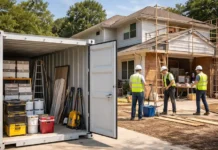
At the Royal Docks facility, salvaged materials including structural timber, cable trays and sanitaryware will be collected, quarantined, tested and, where required, kiln-dried before being reintroduced into the market. Reclaimed materials have already been sourced from exhibitions, commercial fit-outs and film sets.
The site will also operate as a live construction and prototyping environment, demonstrating how reclaimed and bio-based materials can be used in building retrofits and new developments.
Policy alignment and sector transformation
The project aligns with wider policy initiatives aimed at embedding circular economy principles within the built environment. The Department for Environment, Food and Rural Affairs (Defra) recently referenced the hub in its circular economy guidance for mayoral authorities, citing its potential to “support London’s ambitious sustainability agenda through careful deconstruction and salvage of building materials for reuse into socially impactful new projects”.
Mayor of London Sadiq Khan said:
“I am delighted to see the launch of the UK’s first Circular Construction Hub in the Royal Docks, which will help support our ambition to make the capital a zero carbon city by 2030.
“London is leading the way in the green transition of the construction sector and that this new hub is part of a wider plan to create a Circular Economy Village in the area with the hub set to become the largest in Europe when fully activated. “We are not only cutting carbon emissions, but are also creating new jobs and homes for Londoners as we build a greener and fairer city for everyone.”
The hub also supports planning policies introduced since 2016 that require major developments in London to demonstrate how waste will be minimised, structures retained where possible, and embodied carbon reduced.
Skills, innovation and industry participation
Alongside material recovery and reuse operations, the Circular Construction Hub integrates training, research and industry collaboration. The facility will provide access to salvaged materials, alongside continuing professional development (CPD) programmes, work experience placements and community workshops aimed at expanding participation in circular construction practices.
George Massoud, Trustee at Tipping Point East and Founding Director of Material Cultures, said:
“Tipping Point East will be a radical new Climate Futures centre and crucial piece of infrastructure for the circular economy in London, accelerating the transition towards net-zero and developing the construction sector’s Green Skill capacity.
“By embedding circular economy processes directly into London’s material flows, TPE will practically demonstrate how we move towards a just transition.”
Local authorities view the initiative as part of a broader strategy to combine climate action with economic development. Mayor of Newham Rokhsana Fiaz OBE said the project contributes to the borough’s Just Transition Climate Action Plan by supporting green jobs while enabling the delivery of sustainable housing.
Addressing systemic barriers to material reuse
Project partners have also highlighted structural challenges facing the adoption of circular construction practices. Current planning, procurement and compliance frameworks often prioritise the use of virgin materials, making reuse difficult to scale.
Joel De Mowbray, founder of Yes Make, said earlier intervention during demolition programmes and reform of compliance systems would be necessary to enable wider adoption of reclaimed materials.
The Royal Docks hub is intended to demonstrate a practical model for circular construction by integrating material recovery, storage, compliance processes and design services within a single operational environment. If successful, project leaders suggest the model could be replicated through a distributed network of similar hubs across the UK.
As construction activity accelerates across London’s regeneration zones, the initiative seeks to integrate circular economy principles directly into the capital’s building supply chains while supporting the delivery of large-scale housing and infrastructure projects.
