


























Close
WORLD OF CONCRETE
Saturday, December 20, 2025
JEC WORLD 2026

Three Ground-Breaking Innovations in Construction, Explained

Note* - All images used are for editorial and illustrative purposes only and may not originate from the original news provider or associated company.

Subscribe

- Never miss a story with notifications

- Gain full access to our premium content

- Browse free from any location or device.

Media Packs

Expand Your Reach With Our Customized Solutions Empowering Your Campaigns To Maximize Your Reach & Drive Real Results!

– Access the Media Pack Now

– Book a Conference Call

Leave Message for Us to Get Back

Related stories

How To Choose Trailer GPS Units That Actually Work for UK Fleets

You know the drill. A trailer van goes missing...

Improving Construction Efficiency Without Compromising Quality

Achieving construction efficiency requires process-focused improvements that enhance productivity while maintaining or improving quality standards. Through workflow optimization, enhanced coordination mechanisms, quality management practices, and strategic technology integration, construction organizations deliver projects faster and more cost-effectively without sacrificing structural integrity or compliance. Balancing speed with excellence transforms construction management from a trade-off exercise into a synergistic approach where efficiency and quality reinforce one another.

Training Strategies for Operating Advanced Construction Equipment

Modern construction equipment demands operator skills that extend far beyond basic machinery operation. Comprehensive training programs combining classroom instruction, simulator practice, and hands-on field experience prepare operators to safely and efficiently manage increasingly sophisticated equipment. Through structured certification approaches, ongoing skill development, and commitment to continuous learning, construction organizations develop operator competency that enhances project safety, productivity, and equipment longevity.
- Advertisement -
Achema Middleeast

The construction industry in the UK accounts for only 6% of the UK’s GDP, and yet represents one of the most important corners of industry in the nation – or even globally. The construction industry is responsible for national and private infrastructure, and investment in the industry has spurred growth and innovation that has benefited countless other industries. What follows are three ground-breaking innovations in construction, which were developed as a result of construction.

Computer-Aided Design (CAD)

Computer-aided design, or CAD for short, has been nothing short of a revelatory development in engineering and construction. The technology has now been in use for decades but represented a bellwether moment for contemporary construction when adopted on a more mainstream basis. The use of CAD enabled contractors to draw up complex and accurate designs with ease and to reproduce them without difficulty or opportunity for error.

The use of CAD technology has also improved logistical elements of construction, with project management made far easier by virtue of access to comprehensive and accurate plans. It is also easy to generate further plans breaking down sections of a build.

Mechanisation

Mechanisation was the first step in the development of contemporary building practices, as early industrial technologies enabled the creation of power tools and automated machinery to carry out heavy-duty tasks – and eventually complex ones. Early mechanisation involved steam-powered machinery for the transportation and deformation of heavy materials, but the last century of design and technology has seen mechanisation progress exponentially.

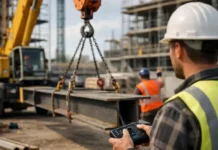
Today, even the simplest of tasks have been mechanised. Where a roofing tiler may previously have had to spend an afternoon pinning tiles by hand, nail by nail, the task today can be done in a matter of hours by using a Milwaukee nail gun. The effect of mechanised processes and tools, on the large and small scale, has shaped the modern construction industry; there are vanishingly rare examples of non-mechanised worksites, save for period-faithful renovation works on listed buildings.

Personal Protective Equipment (PPE)

The provision of personal protective equipment at work has been a legal requirement since the introduction of the Health and Safety at Work Act in 1974 – legislation which brought the safety rights of workers to the forefront and spurred proper consideration of worker safety. Today, personal protective equipment is a defining characteristic of the worksite, from hi-vis clothing to hard hats and safety goggles.

PPE is a work in progress, though – as is construction’s adoption of it. A recent study by the TUC and Prospect found that 57% of women on construction sites felt underserved by their PPE, as a result of it fitting them poorly. New innovations in PPE design are taking these results into consideration, providing inclusive PPE designs in order that contractors and construction companies can properly accommodate their staff.

Achema Middleeast

Latest stories

Related stories

How To Choose Trailer GPS Units That Actually Work for UK Fleets

You know the drill. A trailer van goes missing...

Improving Construction Efficiency Without Compromising Quality

Achieving construction efficiency requires process-focused improvements that enhance productivity while maintaining or improving quality standards. Through workflow optimization, enhanced coordination mechanisms, quality management practices, and strategic technology integration, construction organizations deliver projects faster and more cost-effectively without sacrificing structural integrity or compliance. Balancing speed with excellence transforms construction management from a trade-off exercise into a synergistic approach where efficiency and quality reinforce one another.

Training Strategies for Operating Advanced Construction Equipment

Modern construction equipment demands operator skills that extend far beyond basic machinery operation. Comprehensive training programs combining classroom instruction, simulator practice, and hands-on field experience prepare operators to safely and efficiently manage increasingly sophisticated equipment. Through structured certification approaches, ongoing skill development, and commitment to continuous learning, construction organizations develop operator competency that enhances project safety, productivity, and equipment longevity.

Managing Material Costs in a Volatile Construction Market

Construction material price volatility presents significant challenges to project budgeting and risk management. Strategic procurement approaches, supply chain resilience strategies, and contract mechanisms that balance risk effectively enable stakeholders to navigate market fluctuations successfully. Understanding market dynamics, implementing escalation clauses, developing flexible procurement strategies, and maintaining strong supplier relationships help construction professionals maintain project viability despite unpredictable material cost movements.

Subscribe

- Never miss a story with notifications

- Gain full access to our premium content

- Browse free from any location or device.

Media Packs

Expand Your Reach With Our Customized Solutions Empowering Your Campaigns To Maximize Your Reach & Drive Real Results!

– Access the Media Pack Now

– Book a Conference Call

Leave Message for Us to Get Back

Translate »