
























Key Takeaways
- Wearable technology including smart helmets and fall-detection boots reduces near-miss incidents by 25% on major projects
- Prevention-through-design approaches embedded in infrastructure planning eliminate hazards before construction begins
- Real-time monitoring systems alert workers and supervisors when safety thresholds are breached, enabling immediate corrective action
- Exoskeletons and ergonomic innovations reduce musculoskeletal injuries by supporting physically demanding tasks
- Collaborative safety culture combined with technological systems creates comprehensive hazard elimination strategies
Transforming Construction Safety Through Systematic Innovation
Construction work historically ranks among the nation’s most dangerous occupations, with workers facing constant exposure to falls, struck-by incidents, heavy machinery hazards, and repetitive strain conditions. Despite established safety protocols and regulatory requirements, construction injuries continue imposing devastating human costs alongside substantial economic burden through workers’ compensation claims, project delays, and legal liability. However, emerging jobsite safety innovations construction approaches systematically reduce these risks through integrated strategies combining intelligent equipment, real-time monitoring systems, and organizational practices creating comprehensive safety ecosystems surpassing traditional protective approaches.
Effective modern safety strategy moves beyond reactive incident response toward proactive hazard elimination at source. This fundamental shift requires understanding that construction injuries result from predictable hazard patterns rather than random misfortune. Safety innovations systematically address these predictable risks through layered approaches where multiple protective mechanisms operate simultaneously, ensuring that equipment failure, procedural breakdown, or individual mistakes do not cascade into tragic outcomes. Workers operating in construction environments protected by well-designed safety systems experience reduced anxiety, improved focus on productive work, and enhanced job satisfaction derived from genuine confidence in organizational commitment to their wellbeing.
Wearable Technology Revolutionizing Real-Time Safety Monitoring
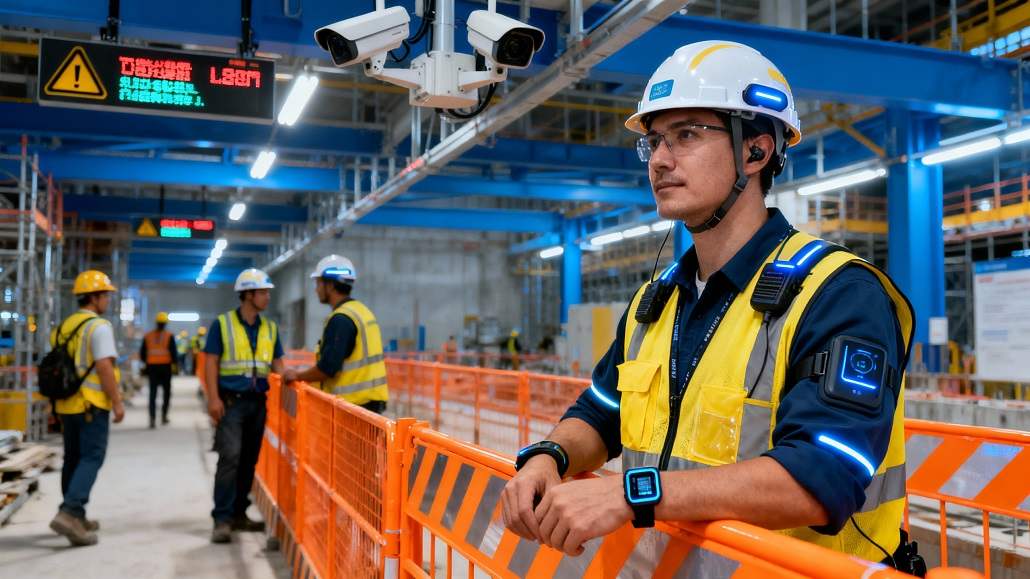
Advanced wearable technology represents perhaps the most visible and rapidly expanding category of modern jobsite safety innovations construction systems. Smart helmets integrate multiple protective functions including embedded cameras providing real-time video feed to supervisors, augmented reality displays overlaying critical information onto workers’ field-of-view, and sensor arrays detecting fatigue, microsleep, and proximity to hazards. These sophisticated devices transform hard hats from simple impact protection into intelligent safety platforms continuously monitoring worker status and environmental conditions.
Smart hard hats equipped with fatigue detection sensors recognize behavioral patterns indicating worker exhaustion or microsleep before dangerous incidents occur. Embedded accelerometers detect rapid head movements characteristic of alertness loss, while optical sensors identify eye closure patterns. When fatigue indicators exceed predetermined thresholds, safety systems alert workers and supervisors enabling immediate corrective action including work rotation, rest breaks, or temporary task reassignment. This predictive fatigue prevention approach directly addresses one of construction’s most persistent hazards workers making critical decisions or operating equipment while fatigued, dramatically increasing injury risk.
Smart footwear incorporating pressure-sensitive sensors and advanced location tracking represents another crucial wearable innovation. Specialized safety boots detect fall incidents through accelerometer patterns characteristic of falls, automatically transmitting emergency alerts while simultaneously recording precise worker location enabling rapid rescue response. Built-in charging mechanisms ensure continuous operation throughout extended workdays, while GPS tracking provides real-time worker location data enabling supervisors to verify workers have not entered restricted high-risk zones. Some advanced systems incorporate biometric monitoring detecting heat stress, abnormal heart rate patterns, and other physiological indicators of worker distress requiring immediate intervention.
Smart vests integrating strain sensors and posture monitoring technology provide real-time feedback regarding improper lifting techniques or postures likely to cause musculoskeletal injuries. When workers assume positions exceeding safe biomechanical limits, integrated vibration or audio alerts provide immediate correction before injury occurs. Advanced vests incorporate temperature sensors and humidity detection enabling heat stress prevention a critical concern during summer concrete operations or work in poorly ventilated spaces. Data collected by smart wearables feeds sophisticated analytics platforms tracking safety trends, identifying high-risk activities, and enabling targeted interventions preventing future incidents.
Prevention Through Design Embedding Safety in Infrastructure
Prevention through design, often abbreviated PtD and also referred to as safety by design or design for construction safety, represents fundamental philosophical shift regarding construction safety responsibility. Rather than accepting hazards as inevitable construction consequences requiring protective responses, PtD methodology incorporates safety considerations throughout design phases, systematically eliminating or substantially mitigating hazards before construction activity begins. This approach proves considerably more effective than attempting to protect workers from inherently dangerous construction processes that design phases could have eliminated.
Practical PtD applications demonstrate compelling safety advantages emerging from thoughtful design integration. Embedded anchor points designed into structural elements during initial design phases enable workers to establish fall protection without improvised equipment, eliminating the dangerous practice of workers installing temporary anchors before commencing work. Prefabricated stairways replacing traditional fixed ladders eliminate fall hazards and provide superior operational efficiency. Permanent parapet walls and guardrails designed into structural systems provide passive fall protection eliminating dependency on worker awareness or equipment functioning correctly.
Building design specifications can systematically reduce confined space entry requirements, minimize working-at-height exposure, and reduce heavy material manual handling through thoughtful specification of component sizes and weights. Modular construction approaches enabling off-site fabrication of complex assemblies in controlled manufacturing environments substantially reduce jobsite hazard exposure while enabling comprehensive safety protocol implementation in controlled settings. Design professionals collaborating with safety specialists and construction expertise early in project phases identify design modifications providing substantial hazard reduction at minimal cost increase modifications proving economically attractive when compared to inevitable accident costs, injury liability, and project delay consequences emerging from construction hazards.
Lighting design constitutes often-overlooked PtD opportunity with compound safety benefits. Adequate illumination preventing trip and fall hazards simultaneously enables workers to recognize equipment operation and environmental hazards. Ventilation system design integrated into construction planning ensures adequate air quality throughout structural work, eliminating respiratory hazard accumulation. Equipment selection during design phases specifies machinery with enhanced safety features and operational guardrails preventing dangerous configurations, replacing on-site jury-rigging that workers often implement when standard equipment cannot accomplish design-intended functions.
Intelligent Equipment Design and Ergonomic Innovation
Modern construction equipment increasingly incorporates safety features directly into mechanical design rather than relying exclusively on operator awareness and protective equipment. Equipment manufacturers designing machinery with integrated safety interlocks prevent dangerous operational modes. For instance, telehandlers with electronic load limiters prevent overloading and instability, automatically disabling extension if loads exceed safe parameters. Concrete pump designs incorporating pressure relief systems and hose containment prevent catastrophic failures that historically resulted in high-pressure stream injuries or equipment failure projecting component debris at lethal velocities.
Remote equipment operation technology enables workers to maintain safe distance from inherently hazardous processes. Remote circuit breaker racking eliminates worker exposure to potentially fatal arc flash incidents, while remote drywall finishing systems reduce repetitive strain from manually finishing extensive surface areas. Pneumatic systems powering various tools reduce operator effort and fatigue compared to manual methods, simultaneously reducing repetitive strain injury risk. These equipment innovations prove particularly valuable in construction because they improve safety without increasing operational complexity or reducing productivity creating genuine win-win scenarios where safety and efficiency reinforce rather than contradict each other.
Exoskeleton technology represents emerging frontier in ergonomic safety innovation, providing mechanical support enabling workers to perform heavy lifting with minimal physical strain. Passive exoskeletons utilizing spring mechanics and mechanical advantage principles reduce required operator effort by 50 percent or more while maintaining full worker mobility and operational control. Active exoskeletons incorporating powered actuators enable workers to lift loads that would otherwise require multiple workers or heavy equipment, eliminating material handling hazards while simultaneously accelerating work. Companies trialing exoskeleton technology report substantial reductions in back strain injuries, shoulder damage, and other musculoskeletal conditions historically associated with heavy material handling.
Real-Time Monitoring and Data-Driven Safety Management
Internet of Things technology and sophisticated data analytics enable jobsite safety innovations construction systems providing unprecedented visibility into jobsite conditions and worker safety status. Wearable sensors continuously transmit data regarding worker location, proximity to hazards, environmental conditions, and physiological indicators. Machine learning algorithms integrate these diverse data streams into real-time hazard assessments, immediately alerting workers and supervisors when conditions approach dangerous configurations. This proactive approach to hazard management directly prevents incidents rather than simply responding after accidents occur.
Environmental monitoring systems tracking air quality, temperature, noise levels, and hazardous substance concentrations provide real-time alerts when conditions exceed safe parameters. Concrete curing operations in inadequately ventilated spaces accumulate carbon dioxide and reduce oxygen concentration to dangerous levels historically causing worker incapacitation or death. Continuous air quality monitoring systems ensure adequate ventilation maintains safe breathing environments throughout all work phases. Temperature sensors provide early warning of heat stress development during summer operations or enclosed space work, enabling preventive interventions including work rotation, hydration emphasis, and cooling measures preventing heat-related illness.
Data analytics platforms analyzing historical incident data and near-miss reports identify patterns revealing high-risk activities, environmental conditions, and worker groups experiencing elevated injury risk. Statistical analysis reveals that specific combinations of factors—time of day, weather conditions, crew composition, or activity sequencing—correlate with elevated incident rates. This analytical approach enables targeted safety interventions addressing root causes rather than treating symptoms. For instance, if data reveals that incidents spike during afternoon hours when worker fatigue accumulates, scheduling modifications and mandatory rest breaks address underlying fatigue while maintaining productivity. Early-morning and late-afternoon breaks improve safety while simultaneously enhancing overall project economics through reduced injury-related downtime.
Creating Comprehensive Safety Culture Integration
Jobsite safety innovations construction technology succeeds only when complemented by organizational cultures genuinely prioritizing worker safety over schedule pressure or cost minimization. Organizations implementing sophisticated safety systems while simultaneously pressuring workers to skip safety procedures or expedite dangerous operations undermine technology effectiveness and expose workers to unnecessary risk. Conversely, organizations demonstrating through resource allocation and decision-making that safety represents genuine priority enable technology investments to deliver intended protection benefits.
Worker engagement in safety system development and operational procedures dramatically enhances adoption and effectiveness. Workers experiencing dangerous conditions firsthand often identify specific hazards and protective approaches that outside safety professionals might overlook. Participatory approaches enabling workers to contribute to safety planning and equipment selection increase adoption enthusiasm while generating valuable operational insights. Regular safety meetings discussing near-misses, reviewing incident data, and collaboratively identifying improvement opportunities create feedback loops continuously enhancing system effectiveness.
Training and competency verification ensure workers understand equipment operation, recognize hazards, and respond appropriately when alarms or warnings activate. Workers unfamiliar with smart helmets might initially distrust fatigue detection systems, but training explaining underlying science and demonstrating accuracy builds confidence and genuine appreciation for protection these systems provide. Comprehensive onboarding procedures for new crew members ensure they understand site-specific hazards, relevant safety systems, and communication protocols. Refresher training at regular intervals maintains skill competency and emphasizes safety commitment despite schedule pressures or other operational demands.
Contractor selection and supply chain integration ensure that all organizations participating in construction projects maintain equivalent safety commitments and compliance with established protocols. Subcontractor performance metrics emphasizing safety record alongside cost and schedule create market incentives for genuine safety commitment rather than merely superficial compliance. Project teams recognizing that construction safety represents earned commitment through consistent practices rather than temporary compliance activity achieve accident rates substantially below industry averages.
The Business Case for Safety Investment
Economic analysis of jobsite safety innovations construction investments reveal compelling returns extending far beyond humanitarian justification. Workers’ compensation insurance premiums directly reflect organizational safety performance, with companies achieving exceptional safety records obtaining substantially lower premiums. Multiproject aggregate benefits from premium reductions often exceed equipment investment costs within relatively brief timeframes. Beyond insurance benefits, companies maintaining exceptional safety records experience improved employee retention, enhanced recruitment capability enabling selection of highest-quality workers, and improved reputation enhancing client relationships and competitive positioning.
Productivity benefits emerge through multiple mechanisms complementing direct safety advantages. Safer working conditions reduce worker anxiety and distraction enabling enhanced focus on productive work. Equipment preventing physical strain enables workers to maintain productivity throughout extended work periods without fatigue-related performance degradation. Projects operating without significant accident-related work disruptions maintain momentum and schedule adherence superior to organizations experiencing frequent incident investigation, emergency response, and equipment replacement disruptions. Construction companies consistently demonstrating safety performance gain market reputation enabling premium pricing for projects where safety capability represents competitive differentiator.
The evolution of construction safety through systematic innovation demonstrates that protecting workers and maintaining operational efficiency represent complementary objectives rather than competing demands. Organizations embracing jobsite safety innovations construction technologies and supporting them with genuine organizational commitment establish competitive advantages strengthening throughout operational lifespans. The construction industry increasingly demands evidence of safety commitment, making demonstrated capability in modern safety approaches a strategic imperative for contractors aspiring toward industry leadership positions. Through thoughtful integration of technology, equipment innovation, prevention-through-design principles, and genuine organizational commitment, construction can become progressively safer while improving productivity and profitability through systematic elimination of accident-related disruptions.
