
























Close
WORLD OF CONCRETE
Friday, December 19, 2025
JEC WORLD 2026

Germany receives Europe’s first 3D printed social housing apartment

Note* - All images used are for editorial and illustrative purposes only and may not originate from the original news provider or associated company.

Subscribe

- Never miss a story with notifications

- Gain full access to our premium content

- Browse free from any location or device.

Media Packs

Expand Your Reach With Our Customized Solutions Empowering Your Campaigns To Maximize Your Reach & Drive Real Results!

– Access the Media Pack Now

– Book a Conference Call

Leave Message for Us to Get Back

Related stories

How To Choose Trailer GPS Units That Actually Work for UK Fleets

You know the drill. A trailer van goes missing...

Improving Construction Efficiency Without Compromising Quality

Achieving construction efficiency requires process-focused improvements that enhance productivity while maintaining or improving quality standards. Through workflow optimization, enhanced coordination mechanisms, quality management practices, and strategic technology integration, construction organizations deliver projects faster and more cost-effectively without sacrificing structural integrity or compliance. Balancing speed with excellence transforms construction management from a trade-off exercise into a synergistic approach where efficiency and quality reinforce one another.

Training Strategies for Operating Advanced Construction Equipment

Modern construction equipment demands operator skills that extend far beyond basic machinery operation. Comprehensive training programs combining classroom instruction, simulator practice, and hands-on field experience prepare operators to safely and efficiently manage increasingly sophisticated equipment. Through structured certification approaches, ongoing skill development, and commitment to continuous learning, construction organizations develop operator competency that enhances project safety, productivity, and equipment longevity.
- Advertisement -
Achema Middleeast

This is the first time 3DCP is being combined with the conditions of public housing subsidies, and is PERI 3D Construction’s third project in Germany, this year, using COBOD’s technology

Germany’s first publicly funded, 3D printed, multi-family house is being constructed in the North Rhine-Westphalian city of Lünen. For the first time, the construction method is being combined with the conditions of public housing subsidies.

According to the UN Habitat, the world needs to build 96,000 new affordable homes every day to house the estimated 3 billion people who will need access to adequate housing by 2030. This challenge is driven by multiple factors including housing costs rising faster than growth in incomes. 3D printing holds the promise to address this gap by reducing construction costs while increasing speed of construction through automation.

Located in the so-called Ruhrgebiet (Ruhr area), the former center for coal mining in Germany, in the Western part of central Germany, Lunen is a modest town of less than 100,000 inhabitants and is soon to be the host of the first 3D printed social housing apartment building in Europe.

“With the pioneering project in Lünen, we are showing that public housing can be built quickly, modernly, and sustainably despite these challenging times. North Rhine-Westphalia is setting standards in construction and continuing to push for more affordable housing,” said Ina Scharrenbach, Minister for Home Affairs, Municipal Affairs, Construction, and Digitalization of the state of North Rhine-Westphalia.

The building project is being carried out by PERI 3D Construction, a pioneer in 3DCP. The project is PERI’s third larger-scale construction project in Germany this year – following the data center and football clubhouse projects – leveraging 3D construction printers from COBOD.

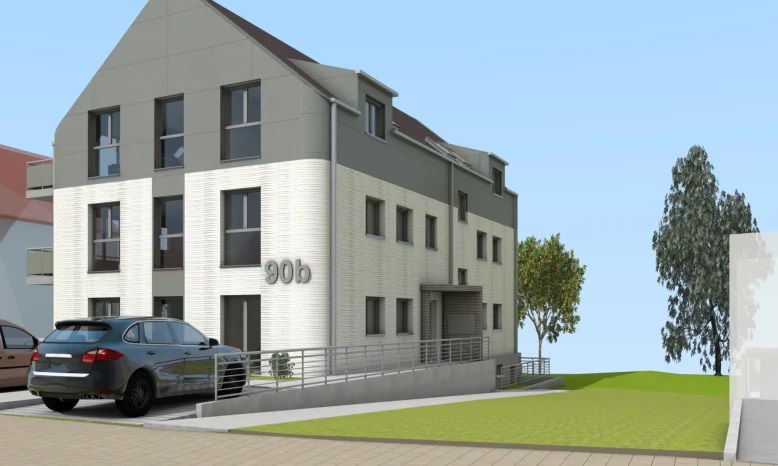
The apartment building will contain three floors – each with two apartment units – for a total of six units ranging from 61m² (670 SF) to 81m² (890 SF). The total build area will be 651m² (7,150 SF).

“We are pleased to be able to demonstrate once again how quickly, efficiently, and in a resource-saving manner the 3D printer can create living space and what potential is also opening up in the multi-family house segment. We are convinced that the technology is already ready for widespread use on modern construction sites, and especially for social housing projects,” said Fabian Meyer-Brötz, Managing Director of PERI 3D Construction GmbH.

The first floor and the second floor are built using the 3D concrete printing process, and the top floor is being built using a timber hybrid construction method. The foundation, the base, and the filigree slabs will be built using conventional construction methods. The façade structure on the first floor and upper floor retains the original printed concrete structure, while the top floor will be cladded using façade panels.

“This project continues the trend that we have seen the last couple of years, where the technology has made some remarkable leaps forward, moving away from just being used for small houses on one floor to also being used for larger and larger projects with multiple floors also outside the residential market. PERI’s German projects in 2023 including the data center, football clubhouse, and now an apartment building are a testament to this trend,” said Henrik Lund-Nielsen, Founder and General Manager of COBOD International.

Achema Middleeast

Latest stories

Related stories

How To Choose Trailer GPS Units That Actually Work for UK Fleets

You know the drill. A trailer van goes missing...

Improving Construction Efficiency Without Compromising Quality

Achieving construction efficiency requires process-focused improvements that enhance productivity while maintaining or improving quality standards. Through workflow optimization, enhanced coordination mechanisms, quality management practices, and strategic technology integration, construction organizations deliver projects faster and more cost-effectively without sacrificing structural integrity or compliance. Balancing speed with excellence transforms construction management from a trade-off exercise into a synergistic approach where efficiency and quality reinforce one another.

Training Strategies for Operating Advanced Construction Equipment

Modern construction equipment demands operator skills that extend far beyond basic machinery operation. Comprehensive training programs combining classroom instruction, simulator practice, and hands-on field experience prepare operators to safely and efficiently manage increasingly sophisticated equipment. Through structured certification approaches, ongoing skill development, and commitment to continuous learning, construction organizations develop operator competency that enhances project safety, productivity, and equipment longevity.

Managing Material Costs in a Volatile Construction Market

Construction material price volatility presents significant challenges to project budgeting and risk management. Strategic procurement approaches, supply chain resilience strategies, and contract mechanisms that balance risk effectively enable stakeholders to navigate market fluctuations successfully. Understanding market dynamics, implementing escalation clauses, developing flexible procurement strategies, and maintaining strong supplier relationships help construction professionals maintain project viability despite unpredictable material cost movements.

Subscribe

- Never miss a story with notifications

- Gain full access to our premium content

- Browse free from any location or device.

Media Packs

Expand Your Reach With Our Customized Solutions Empowering Your Campaigns To Maximize Your Reach & Drive Real Results!

– Access the Media Pack Now

– Book a Conference Call

Leave Message for Us to Get Back

Translate »