


























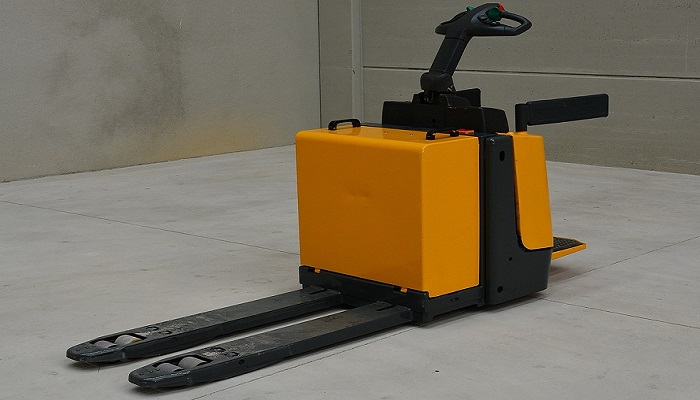


Have you ever found yourself pondering the utility of the humble pallet jack, also known as a pallet truck? If so, you’ve come to the perfect spot to gain comprehensive insight into the world of pallet jacks, their types, uses and operation. This friendly guide will unveil the mysteries of these simple yet indispensable tools of commerce.
Understanding the Pallet Jack
Let’s start by demystifying what a pallet jack really is. Essentially, it’s the most basic form of a forklift, comprising a few straightforward components: a pair of forks, a hydraulic lifting system, and wheels for mobility. It’s a no-fuss device primarily used to lift and move pallets a short distance across a flat surface.
How Pallet Jacks Differ from Forklifts
Although connected in purpose, pallet jacks and forklifts have distinct differences, such as:
Counterbalance: While forklifts use a heavy counterweight to balance loads, pallet jacks rely entirely on their wheels for support.
Operator Positioning: Forklifts often feature compartments for operators to either sit or stand. Pallet jack operators, on the other hand, usually stand behind or, in the case of ride-on models, on the truck itself.
Power Source: Forklifts are typically powered by internal combustion engines or batteries, whereas manual pallet jacks are powered by good old-fashioned elbow grease, though motorized versions do exist.
Lift Heights: Forklifts can lift loads to much greater heights for stacking, whereas pallet jacks are designed to raise a load just enough to clear the floor for transportation.
Pallet Jack FAQs Demystified
Curiosities abound when it comes to pallet jacks, so let’s tackle some common queries:
What’s the Story Behind Pallet Jack Invention?
The brainchild behind the pallet jack is George G. Raymond of the Raymond Corporation, who patented both the pallet jack and the standard pallet design we use today back in 1939.
How Big is a Pallet Jack?
Pallet jacks come in various sizes, but here are a few standard dimensions:
Typical width: 20 to 27 inches, with 27 inches being more common
Fork width: About 6.25 inches
Fork length: Usually 48 inches, although other lengths exist for different uses
Why Use a Pallet Jack?
The strengths of pallet jacks can be summed up as follows:
- Reducing manual labour and worker fatigue
- Optimal for short distance travel inside warehouses and stockrooms
- Highly manoeuvrable in tight spaces, such as semi-trailers
- Utility in various applications from moving goods on loading docks to restocking shelves
Exploring the Different Types of Pallet Jacks
Pallet jacks come in different flavours to suit various needs. Let’s explore the most common ones:
- Manual Pallet Jacks: Simple and hand-operated, these are the most basic models.
- Electric Pallet Jacks: These add an electric motor, making transportation easier and reducing strain.
- Stand-On Pallet Jacks: Ideal for long distances, they feature a small platform for the operator to stand on.
- Off-Road Pallet Jacks: Equipped with oversized wheels and a robust frame for rough terrain.
- Adjustable Pallet Jacks: These come with forks that can adjust in width to handle different pallet sizes.
Operating a Pallet Jack: A Step-by-Step Guide
If you’ve never used a pallet jack before, it might seem daunting, so here’s a brief rundown of how they work and how to operate them safely:
The Functionality of a Pallet Jack
The heart of the pallet jack’s operation lies in its hydraulic pump, connected to the handle and used for lifting. Here’s how the parts work together:
Pumping the handle with the lever in the “lift” position engages the hydraulic pump, raising the forks.
To lower the load, the operator simply switches the lever to the “lower” position, which releases pressure and lowers the forks back to the ground.
How to Manoeuvre a Manual Pallet Jack
Using a manual pallet jack is straightforward:
- Ensure the lever is in the neutral position.
- Steer and insert the forks into the pallet.
- Lower the forks.
- Pump the handle to raise the forks and the pallet.
- Transport the load to the desired location.
- Release the lever to lower when the final destination is reached.
How to Operate an Electric Pallet Jack
While more complex, electric pallet jacks are still user-friendly:
- Turn on the machine and enter any necessary access codes.
- Use the throttle to approach the pallet.
- Lower the forks, insert them into the pallet, and lift with the button.
- Transport the load smoothly with the throttle.
Once in place, lower the pallet back down and disengage.
Considering a Pallet Jack Purchase?
When eyeing a pallet jack for your needs, contemplate the following:
- Workspace layout and environment
- Load size, shape, and weight (electric models can lift more)
- Budget (manual jacks are more affordable)
Prices can range significantly based on type, size, and brand, with manual jacks starting around 300 and electric jacks going into the thousands.
Conclusion
Whether you’re a seasoned pro or on the verge of your first pallet jack experience, I hope this rundown has been enlightening. If you have anecdotes to share, questions to ask, or insights to offer on pallet jacks, feel free to spark a conversation in the comments section below.