



























The success of a massive commercial development or an intricate infrastructure project is ultimately decided on the ground, during the physical assembly of its components. While design and planning are critical, it is the mastery of installation efficiency large scale building projects that translates theoretical vision into tangible reality. In an industry where labor costs are rising and schedules are tighter than ever, the ability to streamline the construction installation process is a powerful competitive advantage. By adopting innovative building installation methods and optimizing the construction workflow, firms can achieve significant gains in site productivity, ensuring that even the most complex structures are delivered with a level of project efficiency that meets the highest professional standards. This transformation in assembly methodology is the primary engine of modern construction success.
The strategic importance of optimized construction installation
At the heart of installation efficiency large scale building projects is the recognition that every hour of labor and every movement of a crane carries a significant cost. On a large-scale project, even a minor inefficiency such as a crew waiting for a delivery or a component that does not fit correctly can scale up into a multi-million-dollar delay. Therefore, the construction installation phase must be treated as a high-precision manufacturing process. This requires a shift away from traditional, ad-hoc assembly toward a more structured, industrial approach. By meticulously planning the sequence of installation and ensuring that all necessary tools and information are available at the work face, managers can drive project efficiency and ensure that the build remains on its critical path, maximizing site productivity at every turn. This strategic focus ensures that the construction workflow is a continuous stream of value-added activity rather than a series of disconnected tasks.
Industrializing the Job Site through Precision Management
To achieve peak installation efficiency large scale building projects, the job site must be viewed as an outdoor assembly plant. This industrialization involves standardizing construction installation procedures for repetitive tasks, such as the installation of facade panels or interior partitions. By creating standard work instructions, managers can ensure that every team follows the same high-efficiency methods, reducing the variability that leads to errors and rework. This level of project efficiency is essential for large-scale projects where thousands of identical components must be installed. Standardized building installation methods allow for more accurate time-estimation and better resource allocation, which in turn stabilizes the construction workflow and provides a reliable baseline for measuring site productivity and continuous improvement across the project’s lifecycle.
The Role of 3D Layout and Laser Scanning in Installation Accuracy
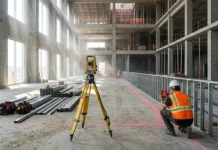
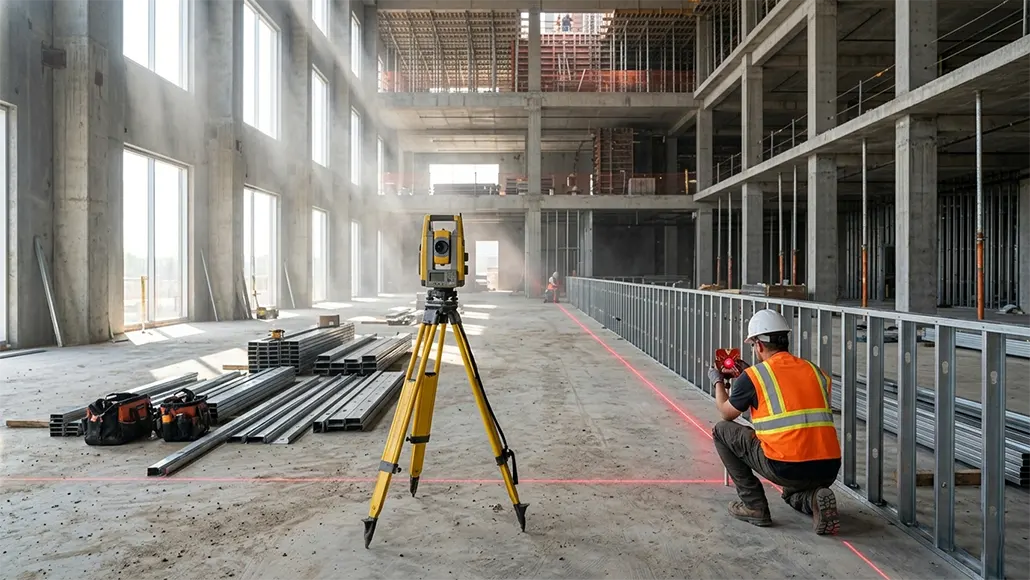
One of the most powerful tools for driving installation efficiency large scale building projects is the use of high-precision layout technology. Robotic total stations and 3D laser scanners allow the site team to project digital design points directly onto the physical floor or wall with millimeter accuracy. This eliminates the drift that often occurs when using traditional tape measures and chalk lines. When the construction installation is perfectly aligned from the start, the subsequent trades can work much faster, as they do not have to compensate for inaccuracies. This precision is a major driver of project efficiency, as it ensures that complex building installation methods such as the fitting of curved glass or high-performance HVAC systems can be executed without the need for on-site field modifications, which are the primary drain on site productivity.
Leveraging Modular and Prefabricated Building Installation Methods
One of the most effective ways to drive installation efficiency large scale building projects is through the use of modular and prefabricated components. By shifting a significant portion of the work from the uncontrolled environment of the construction site to a precision factory setting, firms can achieve a level of quality and speed that is impossible with traditional stick-built methods. Prefabricated assemblies ranging from bathroom pods to entire structural sections are delivered to the site ready for immediate construction installation. This dramatically reduces the number of individual tasks performed on-site, simplifies the construction workflow, and minimizes the risk of weather-related delays. The integration of these advanced building installation methods is a cornerstone of modern site productivity and is essential for achieving the aggressive project efficiency goals of today’s market.
Off-Site Manufacturing and the Just-in-Time Assembly Model
The marriage of off-site manufacturing and the Just-in-Time (JIT) model is the ultimate expression of installation efficiency large scale building projects. In this system, components are manufactured in parallel with the site preparation, and their delivery is synchronized precisely with the construction installation schedule. This ensures that the site is never cluttered with excess inventory, which can hinder site productivity and create safety hazards. By reducing the on-site work-in-progress, the construction workflow becomes a lean, fast-moving process. This approach to project efficiency requires a high level of coordination between the design team, the manufacturer, and the site manager, but the result is a building installation method that can cut months off the total project duration, providing a massive return on investment for the project’s owners.
The Impact of Specialized Tooling and Equipment on Site Productivity
Driving installation efficiency large scale building projects also requires a commitment to the latest specialized tooling and equipment. From robotic total stations that provide millimeter-accurate layouts to vacuum-lifting systems for large glass panels, the right equipment can drastically reduce the time and physical effort required for construction installation. Furthermore, the use of wearable technology and augmented reality (AR) can provide installers with real-time digital overlays of the design, ensuring that components are placed exactly as specified on the first try. This data-driven approach to the construction workflow reduces the need for rework and significantly enhances project efficiency, allowing teams to achieve more with less manual intervention. These advanced building installation methods turn the site into a high-tech environment where site productivity is maximized through the synergy of human skill and machine precision.
Optimizing the Construction Workflow for Seamless Execution
A truly efficient installation process is one where the work flows without interruption. This requires a deep level of coordination between all trades and a shared commitment to the construction workflow. Installation efficiency large scale building projects is often hampered by trade congestion too many workers in one area or a lack of sequential clarity. Project managers address this through the use of takt time planning, where each phase of the installation is broken down into equal work packages that follow each other in a rhythmic, predictable sequence. This approach to site productivity ensures that the project moves like an assembly line, where each team knows exactly what is expected of them and when they need to move to the next zone, maximizing project efficiency across the entire build and preventing the start-stop nature of traditional construction.
Takt Time Planning and the Rhythmic Construction Workflow
Takt time planning is a Lean methodology that is revolutionizing installation efficiency large scale building projects. The word takt is German for beat or rhythm, and the goal is to set a consistent pace for the construction installation. For example, the drywall team might be given a takt time of two days to complete a wing of a hospital, after which the electrical team immediately moves in. This level of coordination ensures that every square foot of the building is being utilized for productive work at all times. It eliminates the idle time where trades are waiting for others to finish, which is the single biggest enemy of site productivity. This rhythmic construction workflow is the hallmark of a high-performance project, providing a clear and visual way to manage project efficiency and ensuring that building installation methods are synchronized for maximum output.
Enhancing Labor Productivity through Training and Human-Centric Design
While technology and planning are vital, the human element remains the most important factor in installation efficiency large scale building projects. Enhancing labor productivity requires a focus on specialized training and the provision of clear, accessible information to the workforce. When installers understand not just the how but the why of a specific construction installation method, they are better equipped to identify and solve problems on the fly. Furthermore, applying human-centric design to the construction workflow ensuring that work areas are ergonomic and well-organized reduces fatigue and the risk of injury. This investment in the workforce is a key driver of site productivity, creating a culture of excellence where every team member is empowered to contribute to the project’s success. Efficient installation is, at its heart, a human achievement supported by technical excellence and professional management.
Conclusion: Efficiency as the Foundation of Construction Success
In conclusion, the achievement of high-level installation efficiency large scale building projects is the defining characteristic of a professional construction firm. By masterfully integrating modular components, specialized equipment, and an optimized construction workflow, the industry can overcome the challenges of scale and complexity. These advanced building installation methods do more than just save time and money; they improve the quality of the built environment and enhance the safety and productivity of the workforce. As we continue to push the boundaries of architecture and engineering, the science of installation will remain the critical link that turns ambitious designs into the resilient and iconic structures that shape our world, delivered with the project efficiency and precision that the modern market demands. The future of construction belongs to those who can install the future, today, with absolute efficiency.
